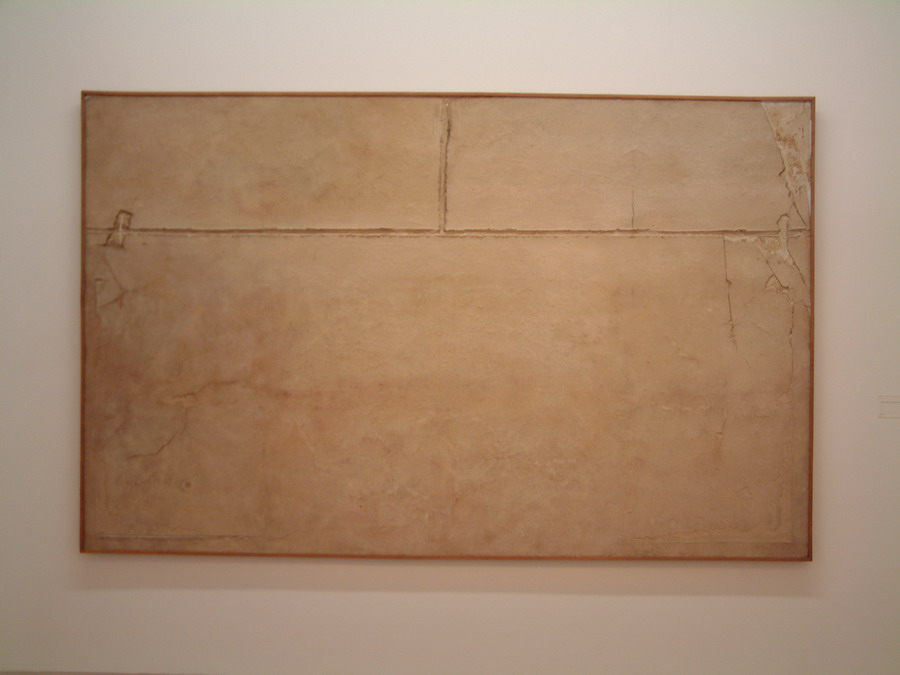
Tapies (A. Tapies) - Great White Parallel Lines
Great White Parallel Lines 195×310cm 1962 Centre Pompidou Collection
Antoni Tàpies (1923–2012), the Spanish painter and sculptor, was the most representative artist of European material abstract painting in the 1950s. He affirmed material-form painting early on, constructing works from the plainest, poorest materials of daily life. Since 1947, his Portrait series used rope and rice to create inventive figurative paintings. In the 1950s, he moved from painting to assemblage and sculpture: chairs covered with white sheets, desks piled with straw, old newspapers stacked in basins, and straw piled within gray sheets.
In the 1960s, he created his most representative "Wall" series. Through various material transformations and symbolic signs—especially crosses and symbols of struggle or unease—he sensibly generated unprecedented material energy, presenting painting texture and tension, and expressing the will to live. As critic Marcelin Pleynet wrote, "Painting, in its materialist transformation, becomes an intellectual object, fully demonstrating the intelligence of more or less these material forces, and working objectively within historical facts."
Tàpies excelled at using various materials, adding vibrant and diverse symbols onto rough, dark material surfaces, creating what seems like an old wall. Especially in Europe's ancient cities, traces of old walls fading, cracking, and peeling over time are visible everywhere. Through Tàpies' skillful material texture transformations, rigorous great parallel lines, vertical lines, and accidental effects generate an "inner color," expressing perceptions and imaginations almost indescribable by art. The artist wrote about this series: "Reality is unreliable in painting, because the truth we explore cannot be found in painting," since painting is merely a "symbol, a symbol hinting at reality."
Of course, the artist expressed the conflicts and disasters of oppressed Spain through material painting, writing in a liberated breath: "Painting for me is a human activity... I believe in the vocabulary of painting, which may remain valid from prehistory to the present..."