Agnès Thurnauer "Life-Size Portraits" Solo Exhibition
Portrait of Marcelle Duchamp, 120 cm diameter, 2008
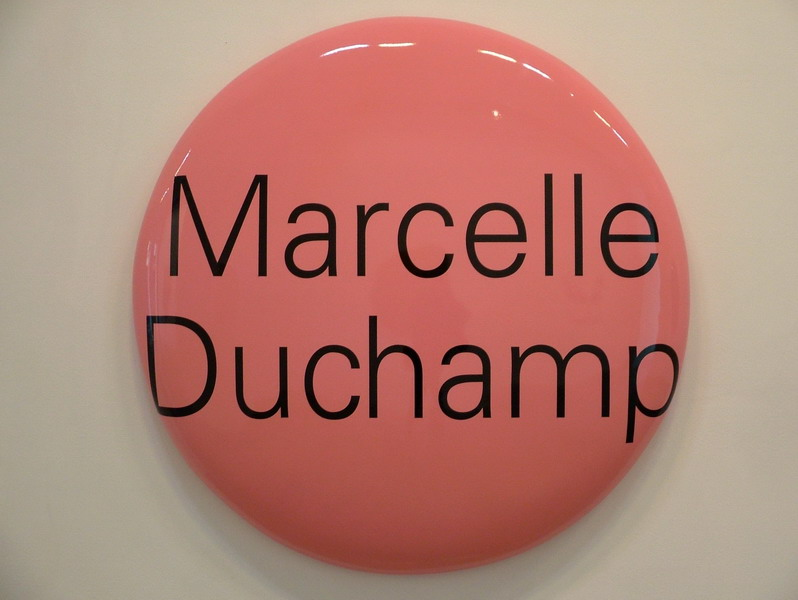


Fuck the Market, detail, 195x130 cm, 2008. Agnès Thurnauer's solo exhibition "Life-Size Portraits" is on view from February 9 to March 15 at Galerie Anne de Villepoix. A new-generation artist, Thurnauer explores diversity through figuration, abstraction, language, writing, and conceptual art. In this exhibition titled "Life-Size Portraits," she transforms names of famous figures in art history into portraits; within large circular forms that resemble badges, she offers a biting satire. She explicitly questions art history: for instance, Bacon becomes Francine, Opalka becomes Romane, and Broodthaers becomes Marcelle—names well known to all.
In modern art history, people are accustomed to referring to them by their surnames: Duchamp, Pollock, Warhol, Beuys. Often, people do not even know their first names. Yet paradoxically, in Agnès Thurnauer's "Life-Size Portraits," we inexplicably see portraits of Annie Warhol, Jacqueline Pollock, Marcelle Duchamp, Josephine Beuys, and Francine Bacon. Does she feminize these major figures in a modern art history dominated by patriarchy? Under this confusing magic, they are not only made gender-neutral but also forced into personification. Of course, "Life-Size Portraits" references the great tradition of art history, yet it confuses the viewer's perception under this literary promise.
Another series combines painting and written text, drawing inspiration from medieval religious imagery and text within the resonance of art history, such as Magritte's The Pipe. These small paintings, described as "predella panels," construct interpretation directly from formal and visual intent, starting from a critical stance. Painting establishes transformation between image and writing, with syllabic and visual rhythmic variations leading the audience into a fully semantic realm, contrasting figuration, abstraction, language, and writing. Finally, the large-scale sketch series "Fuck the Market" pays homage to the cursed artist from both symbolic and political perspectives, while simultaneously questioning the value of contemporary works.