"Airs de Paris" Special Exhibition
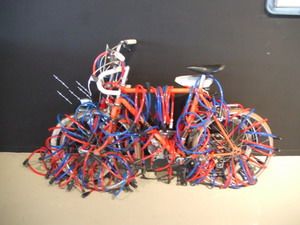
(Fig. 1 left) Entrance signage for "Airs de Paris." (Fig. 1 right) French artist Francois Corlet cement work. (Fig. 2 left) Vincent Lamouroux Bicycle on Bridge, 2006. (Fig. 2 right) Saadane Afif's "Nationality-Los Angeles" displays the French flag with three blue, white, and red garments; the red sw
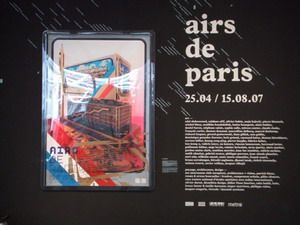

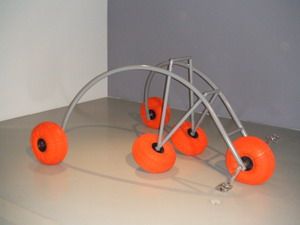
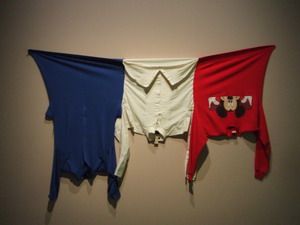
(Fig. 1 left) Entrance signage for "Airs de Paris." (Fig. 1 right) French artist Francois Corlet cement work. (Fig. 2 left) Vincent Lamouroux Bicycle on Bridge, 2006. (Fig. 2 right) Saadane Afif’s Nationality-Los Angeles displays the French flag using three blue, white, and red garments; the red sweatshirt features a Mickey Mouse image, 2002.
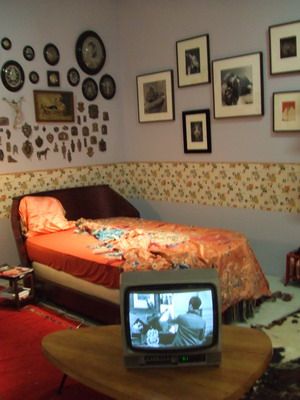
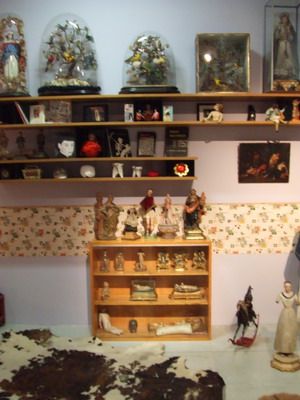

(Fig. 1 left) American artist Nan Goldin’s environmental installation If my body shows up, 2007. (Fig. 1 right) Nan Goldin’s If my body shows up presents the "Privacy and Urban Life" section as an environmental installation, 2007. (Fig. 2 left) American-born French artist Louise Bourgeois’ house sculpture and The Carved Residence installation, works from 1983 and 1990. (Fig. 2 right) French artist Richard Fauguet’s Untitled, 1999. The "Airs de Paris" special exhibition was grandly displayed on the sixth floor of the first gallery at the Centre Pompidou from April 25 to August 15. To commemorate the 30th anniversary of the Centre Pompidou’s opening, this major exhibition gathered France’s current new generation of artists (or those creating in Paris), immersing them in the unique atmosphere of Paris, thus borrowing Marcel Duchamp’s 1919 proposition of Airs de Paris. This work originated when Duchamp traveled from France to the United States, conceived as a gift for his New York friends and collectors, Louise and Walter Arensberg. Airs de Paris is a small glass vessel containing liquid; Duchamp removed the liquid (leaving an empty vessel) and named the object Airs de Paris. This problematic work became a "riddle" of contemporary art: since air is an object of nothingness, is the gift the empty glass vessel or the air inside it? For Duchamp, air is omnipresent, so art should also be omnipresent (he had previously declared that "any object can become art"). Thus, Airs de Paris carries definitions of being random, mutable, shareable, and transportable. Of course, Parisian air is romantic, proud, poetic, imaginative, groundbreaking, popular, illusory, negative, chic, cynical, provocative, arrogant, and uniquely dominant. Especially in today’s era of globalization, artists have become nomadic tribes, gathering in major art capitals worldwide, with Paris being one such hub. Statistics show that artists from 170 countries converge in Paris, sharing its unique atmosphere through various whimsical creations. This special exhibition commemorating the Centre Pompidou’s opening is founded on this premise, highlighting Paris’s unique creative direction under globalization, attempting to revive the fading halo of contemporary art and lead trends. More cleverly, it raises the profile of French contemporary artists (mostly French nationals) and showcases their increasingly subtle and chic contemporary artistic perspectives.
The "Airs de Paris" special exhibition is divided into ten sub-themes. "Other Urban Spaces, Restoration and Fiction": Here, artists believe modern cities are no longer just theaters of architecture and connected spaces; they intend to use metaphysical methods to restore and re-establish the post-urban condition based on current stakes. They are particularly interested in issues of mobility (circulation and connection), involving architecture and general urbanism as areas of exploration for these young artists, exemplified by Francois Corlet’s snow-house-like work. "Newly Perceived Space-Time": Younger artists, endowed with the internet and advanced communication technologies, construct explorations, creating a unit of perception where cities possess different space-times. "New Public Language and Urban Mass Culture": Since the 1980s, metropolitan public language (graffiti on walls) has gradually changed the natural landscape of cities. Marginal culture has become a new source of inspiration for artists. The development and spread of new public language have become contemporary urban mass culture, deeply questioning original authors and copyright. Especially in today’s internet image world, originals lose their function and allure; J-L Moulene serves as a symbol here. "Mass Media and NTIC at the Core of Urban Life": Today is a comprehensive mass media world, fully penetrating daily life and deeply changing our perception of reality, turning metropolitan cities into "e"-utopias and the core of urban life. Artists fabricate their Brave New World through these media images and information, such as A Leccia’s video art works. "Conflict, Risk, and Accident": The beautiful new world expected after the Cold War did not arrive, nor did the millennium utopia. New conflicts continue, risks grow more sinister, and accidents happen at any time. In this era of natural disasters and human-made calamities, situations arise constantly; open and covert wars and struggles proceed lawlessly. Under the banner of all-encompassing media information, society faces significant threats due to new combat technologies and unbalanced natural ecosystems, making everything unimaginably accidental. The disaster-stricken society becomes another aspect of contemporary art exploration, as seen in Swiss artist Thomas Hirschhorn’s works. "Urban Ecology and Biotechnology, Natural to Non-Natural": Natural ecology has long been the guarantee of metropolitan quality of life. In today’s rising environmental awareness era, handling urban nature or natural cities becomes the core of ecological balance. New biotechnology brings new revelations to cities, which compromise between the natural and non-natural to construct themselves. Contemporary art does not lack diverse topics; many artists revolve around this theme, such as French artist Dominique Gonzalez-Foerster. "Identity and Community": Urban life involves numerous racial and minority issues, ranging from residence, employment, and society to politics. The social unrest in the suburbs of Paris in 2004 was triggered by issues of identity and racial discrimination. Surrounding contemporary French politics, "community" according to dictionaries is not merely a gathering of people living together, but requires true face-to-face participation with others to perfectly integrate and coexist harmoniously. The unit exploring identity and community naturally focuses on Arab and African descent artists. Many works deeply feel racial discrimination and social injustice, such as Saadane Afif’s Nationality-Los Angeles, which displays the French flag with three blue, white, and red garments, the red sweatshirt featuring a Mickey Mouse image, and Adel Abdessemed, who uses video tape to show a black person bleaching their skin with milk, clearly presenting issues of identity. "The Complex Relationship Between Individual and Globalization": In these over-developed countries, individualism prevails. Individuals reside within groups but do not belong to them, nor can they escape them. In today’s complex and tight relationships under globalization, these connections are subtle and uncertain. Of course, society is a whole constituted by you and me, but lonely and helpless individuals still feel profound isolation in today’s indifferent groups. This indifferent society alienates the individual from the whole (or globalization), leading to greater loneliness and self-loss. From this situation, individuals attempt to establish themselves and explore personal limits. These subtle and complex relationships have also become areas explored by contemporary artists, including Chinese artist Huang Yong Ping’s works with implications of globalization residing in France. "Privacy and Urban Life": Personal privacy has become impossible in today’s urban life. Voyeurism has become a popular hobby among the masses, while hiding has become the wise way of today. However, humans cannot bear loneliness, or in today’s culture of showing off, concealing inner emptiness and flaunting appearance has become the norm. Everyone wears a mask of illusory glory to avoid criticism. Psychoanalysis reveals many hypocritical pathological connections in the cultivation of these external appearances. Artists analyze this ambiguous relationship between privacy and urban life with keen eyes, most representatively demonstrated by American artist Nan Goldin’s environmental installations. Finally, not strictly plastic arts, but "Geographical Atmosphere: Landscape, Architecture, Design": Clearly, the Centre Pompidou is not just a center for plastic arts but also for architecture and design. This unit presents contemporary urban architecture, buildings, and landscapes under globalization, featuring 19 architectural works by famous architects such as Zaha Hadid, Philippe Rahm, and Didier Fiuza Faustino. It also includes Bruno Latour’s map of Paris’s unrecognized environmental pollution. The innovative designs of the Bouroullec brothers, to the two most important contemporary French horticulturists Gilles Clement (who established sensitive environmental spaces and proposed the necessary position of nature in the city) and Patrick Blanc (famous for his vertical gardens), green spaces have become contemporary urban decoration and a guarantee for improving quality of life.
All ten sub-themes of the special exhibition revolve around the space-time and humanities of contemporary cities. It appears that contemporary artists are not only nomadic tribes but also bohemian groups of metropolises. Through today’s new technology and the internet, they disseminate information in all directions, perceiving the compressed space-time and non-empathetic feelings of the present, and understanding the all-encompassing political, economic, and social trends, turning metropolitan cities into "e"-utopias. In today’s world where fictions and simulacra are more real than reality, where simulacra fabricate their Brave New World—where truth is not what it seems, and illusions appear in illusory forms—the metaphysical proceeding materially is underway. Can the audience empathize? Clearly, this special exhibition reflects a very French taste in artistic perspective. The openness of France’s institutionalized art seems not so open; looking out at the world (globalization), it seems to see only its own navel (this point is most beautiful). Because this exhibition, as its name suggests, clearly shows the French contemporary art system elevating itself. The development of French contemporary art is quite contradictory: on one hand, it is driven by the system, and on the other, it is suffocated by it. One can imagine why Duchamp traveled across the ocean to New York back then was not unreasonable. To this day, French art can only parasitize on the system; otherwise, it lets itself go wild.