Alfred Sisley - The Flood at Port-Marly
The Flood at Port-Marly, 60×81 cm, oil on canvas, 1876. Held in the Musée d'Orsay, Paris. Alfred Sisley (1839–1899) was British-born in Paris. He briefly went to London to improve his English but lived in Paris his whole life. His father wanted him to do business, but from 1862 he entered the École
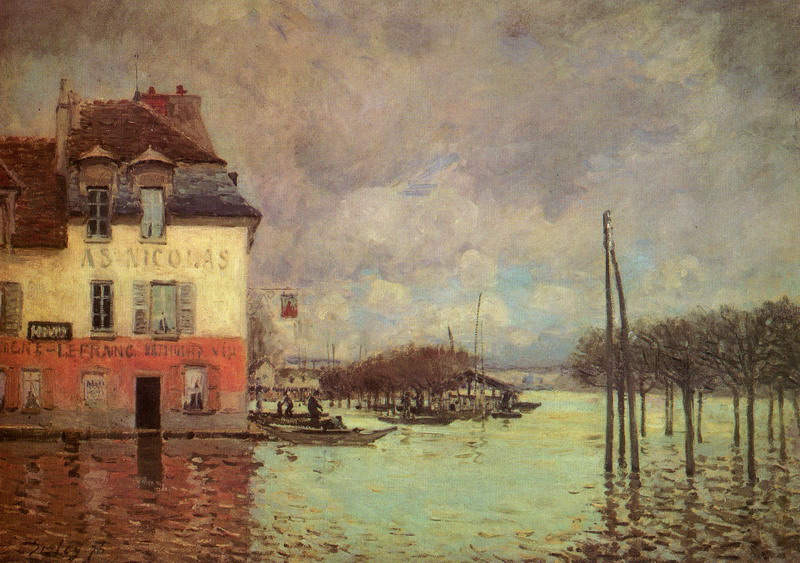
The Flood at Port-Marly, 60×81 cm, oil on canvas, 1876. Held in the Musée d'Orsay, Paris. Alfred Sisley (1839–1899) was British-born in Paris. He briefly went to London to improve his English but lived in Paris his whole life. His father wanted him to do business, but from 1862 he entered the École des Beaux-Arts, in Charles Gleyre’s studio, where he became friends with Monet, Renoir, Pissarro, and Bazille. Throughout his life, he had a special fondness for bright landscape painting. Early on, he was influenced by Corot and Daubigny; then, inspired by Monet, he left the studio. In 1863, he participated in the Salon des Refusés; in 1874, he joined the first Impressionist exhibition, gradually developing his own original landscape style—poetic and lyrical, earning him the title of “the Corot of Impressionism.”
He was the most unassuming, least conspicuous, poorest, yet most poetic painter among French Impressionists, specializing in landscapes. This work, The Flood at Port-Marly, is Sisley’s most famous piece, completed during the height of Impressionism and his most creative period. Here, he interprets an Impressionist favorite theme: the changing light on water and its reflections. Under the painter’s colorful brush, the flood becomes a lyrical kaleidoscope lake. Amidst vibrant, rapid brushstrokes, the water turns into precious rainbows; blue, yellow, pink, and the tree and house reflections merging sky and sea seem dissolved in the water. For Sisley (like other Impressionists), even a tragedy like a flood loses its contingency and becomes pure subject matter for painting.