Andre Cadere "Infinite Painting" Solo Exhibition
Series 6, 1977, arranged on the floor. This spatial form was exhibited at a Belgian gallery.
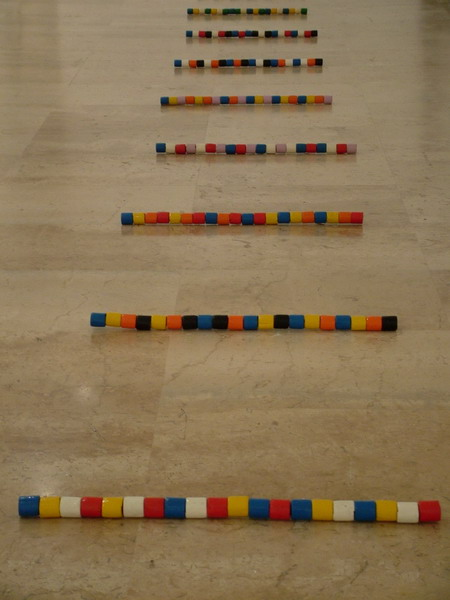
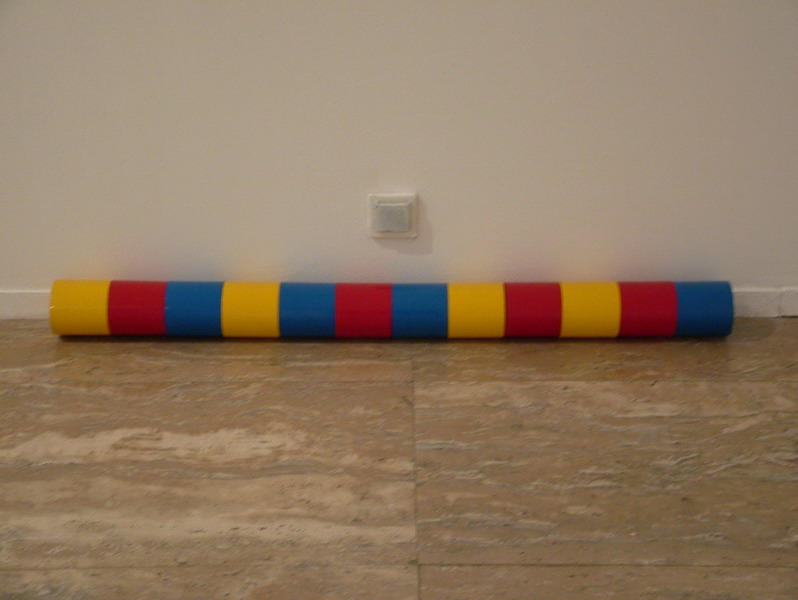
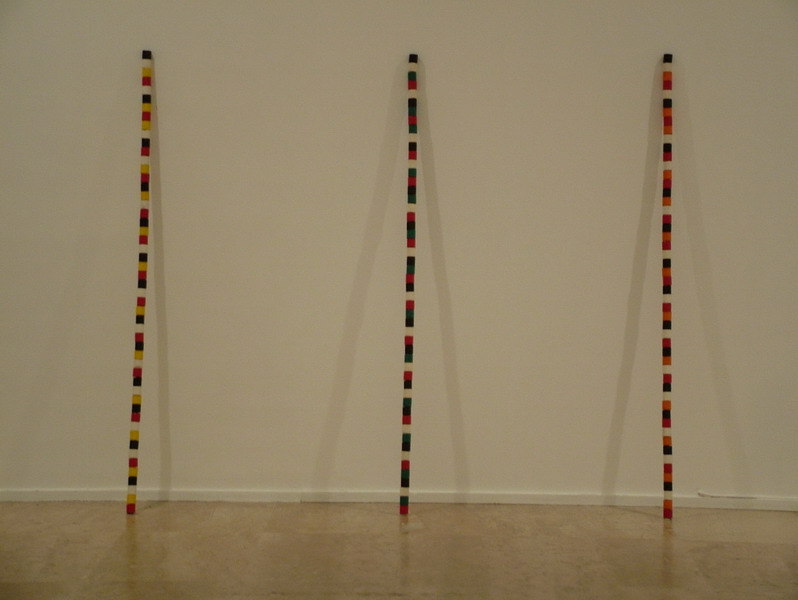

This is Andre Cadere's earliest work - Six Elements Partial, 1970. The Andre Cadere "Infinite Painting" solo exhibition runs from February 14 to May 11 at the Paris Municipal Museum of Modern Art. Andre Cadere (1934-1978) was an individualist in contemporary art; only those with deep knowledge of French contemporary art would know him. He was a conceptual artist active in the 1970s who died young, becoming a hidden gem in art history. Thus, it is particularly pleasing to see this unique solo exhibition today.
Cadere's conceptual identity is built upon systematized and procedural painted cylinders, which became his artistic hallmark. These unusual objects exist between painting, sculpture, and object. They can be exhibited like paintings or sculptures, or installed via space (floor and wall), moving to be shown anywhere—galleries or elsewhere, indoors or outdoors. The artist wrote, "Within these parameters, the work is composed of painted segments, one overlapping another, assuming a pictorial relationship. The segment surfaces are painted in various colors, allowing infinite overlapping composition. My work there includes the pictorial aspect, making all of painting the question." He continued, "These painted cylinders can be presented anywhere, without needing a specific location or special regulations. This work is not limited to public or private spaces or walls, nor does it require hanging, sticking, attaching color, or any systematic installation." In such exhibition-installations, works are displayed as if they were fixed pieces, meaning "incapable of criticism." Finally, he pointed out, "I want to say my work and this reality's complexity offer another view, perhaps that of a hero. One might say a hero among people, in the crowded streets. He appears just like anyone, yet conscious, perhaps through a gaze, a method or other means, allowing those things to squeeze through an unconscious type."
Andre Cadere came to Paris in 1967 with his diplomat father and settled there. Upon arriving in the art capital, he immediately engaged in artistic activities, participating in various salons like the Salon de Mai, Marché de l'Art Expérimental, and Salon des Artistes et Jeunes Peintres, associating with Parisian art friends, entering trends of extreme art, conceptual art, and land art, beginning to question the identity of works and authors. In 1970, Cadere participated in a group exhibition at the American Center with artists Christian Boltanski and Jean Le Gac, weaving 750 meters of line across the center's entrance doors. It was then that the rod concept took shape. From 1972, these iconic painted cylinders or rods became the core of his creation and activities; he began carrying this symbolic object everywhere, participating in events and walking through streets or art spaces. Starting from Paris, via London and Brussels, he later went to Documenta 5 in Kassel. Without invitation, he demanded an independent behavior never before seen in art, strolling through Kassel's streets with this object, slowly constructing his strategy of mobile presentation, further shaping his artistic identity through "painted cylinders."
In 1973, he participated in the group exhibition "Painting Becomes a Question" held by Michele Claura and René Denizot in a Vendôme Square apartment; his work was hidden in a closet, clearly visible as a referential textual theme, asking if painting had become a question? Only after 1975 did he formally accept invitations from leading galleries in Paris, Belgium, Britain, Germany, and the US to exhibit, presenting his painted cylinders through new spatial installations. Unexpectedly, on August 12, 1978, he flashed away like a comet—disappearing, leaving behind his dazzling works.