Annette Messager "Les Messagers" Solo Exhibition
(Fig. 1 Left) Large advertisement billboard for Annette Messager's "Les Messagers" solo exhibition at Centre Pompidou. (Fig. 1 Right) Scene from "Pinochio Walks at Pompidou," an environmental mechanical spatial installation work from 2007. (Fig. 2 Left) Scene from the "Spear (Les Piaues)" series, 19
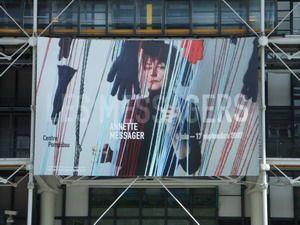
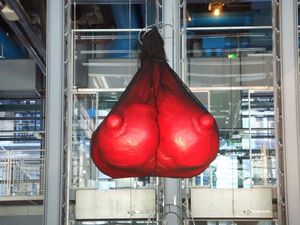
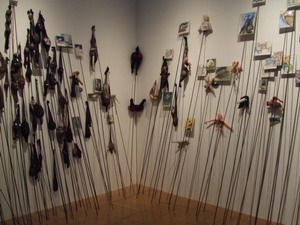
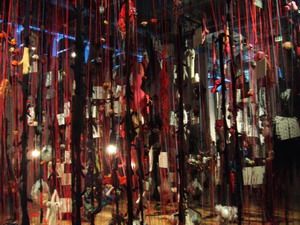
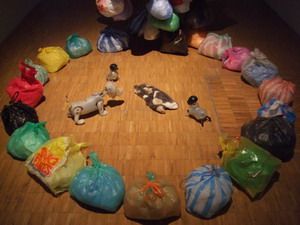
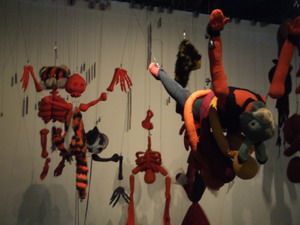
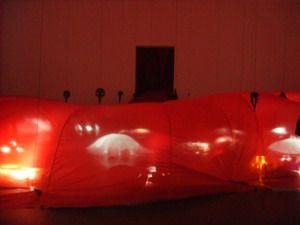
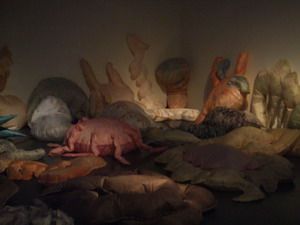
(Fig. 1 Left) Large advertisement billboard for Annette Messager's "Les Messagers" solo exhibition at Centre Pompidou. (Fig. 1 Right) A scene from "Pinochio Walks at Pompidou," an environmental mechanical spatial installation work from 2007. (Fig. 2 Left) A scene from the "Spear (Les Piaues)" series, 1991-1993. (Fig. 2 Right) "Dependence-Independence" (1995-1996), a monumental environmental spatial installation. (Fig. 3 Left) "Observation" (1998), a humorous object installation featuring three small toy dogs watching a construction. (Fig. 3 Right) "Articulated-Disarticulated" (2001-2001), a large-scale environmental mechanical spatial installation series. (Fig. 4 Left) "Casino" (2004-2005), a poetic theatrical environmental mechanical spatial installation, a masterpiece created for the French Pavilion at the 2005 Venice Biennale. (Fig. 4 Right) "Inflate-Deflate" (2006), a mechanical environmental spatial object work.
The "Les Messagers" solo exhibition by Annette Messager was grandly displayed in the South Gallery of Centre Pompidou from June 6 to September 15. Annette Messager is currently one of France's most famous and popular female artists, having represented France at the previous (2005) Venice Biennale and won the Golden Lion Award (the prize for outstanding artist). This special exhibition is not a retrospective; within its diverse facets—painting, drawing, embroidery, craft, photography, sculpture, objects, installations, etc.—it spans from her early works in the 1970s to recent dramatic monumental objects and environmental spatial installations. Through scenes mixing playfulness and tragedy, she creates dialogue via similarity and tension. Her artistic world inhabits extraordinary folk imagery and exquisite art, presented in series where works interconnect and often develop new sensations from internal elements. Her distinctive language is directly based on our mundane daily living environment, making it almost universally understandable. Depending on this substantial duality, the audience experiences an anomalous feeling oscillating between attraction and repulsion.
Born in 1943, Annette Messager is a heroine of contemporary French art and the most internationally significant female artist in France from the 1970s to the present. Like Boltanski and Leconte, she draws creative inspiration from non-mainstream subcultures. She exhibits a sensibility similar to Boltanski and Leconte, expressing a shared taste. However, as a female artist, she naturally builds upon women's acumen, delicacy, capability, and sensitivity. Early in her career, Messager's art explored the relationship between women and society: "Boarders" (1970) was an anomalous work displaying a series of bird specimens in a window, dressed them in various knitted embroidered clothes like her own children, revealing maternal nature through black humor. In "Albums and Collections," akin to women's habit of collecting miscellaneous items, she collaged magazine and advertising images into series, such as the 1972 "Self-Mutilation" series on women's beauty instincts, progressing through "My Lovely Misses," "My Beloved Men," to "My Embroideries." The artist stated: "I love the key presentation of these image materials, using scissors and flexible manipulation of these data. People might see me as a castrator—but I have lost nothing! I know that sadism or idolatry costs only 3.50 francs! Of course, it often involves introspective distortion. What I like is to make the audience slightly shy, casting them as accidental voyeurs with a strong sense of secret awareness. More often, it involves mocking images that ultimately move us. Of course, Annette Messager's illusions are everyone's illusions." By establishing her identity as a woman, she became "Artist Annette Messager," "Collector Annette Messager," and "Fraudulent Annette Messager." In this exhibition, these series were gathered in the "Secret Room of the Collector," a closed exhibition room viewable only through small windows, heightening curiosity and a sense of deprivation regarding revelation and secrecy.
Starting in the 1980s under postmodern trends, Annette Messager moved away from female narcissism, beginning to use her own body as a creative medium. She painted on her body, photographed the results, and sometimes collaged and altered them, placing them directly on walls. Thus entering a dramatic, whimsical, and absurd world of strange forces, akin to traditional folk myths, she presented nightmare-like fairy tales or personal dream myths symbolizing the medieval "Apocalypse." Within this black romanticism, she drew from medieval hellscapes, Goya, Surrealism, to Hitchcock's bizarre world. The "Chimeras" (Les Chimères) series (1982-1984) used black-and-white photographic fragments of body parts, collaged and juxtaposed like montage to construct forms—for example, a large eyeball altered into a bat or a flying phallus, or a crescent-shaped humanoid composed of a phallus, eyeball, and grinning mouth. The "Mes Trophées" (My Trophies) series (1986-1988) featured body parts like hands, feet, tongues, ears, eyes, and genitalia, over which she painted imagined scenes with watercolors and colored pencils, then photographed and framed them like magical classical paintings. The "Mes Voeux" (My Wishes) series (1988-1990) collected numerous framed photographs from the "Trophies" series, hanging them in large circles or writing themes under small photos, adding small dolls (which later became her beloved creative material) to construct images according to space. The artist wrote: "I like looking at these eyes, mouths, noses, lips, penises, and teeth... They touch me in a way, skimming over those photographs... It is interesting to mix a man's eyeball with a woman's mouth... Thus becoming a hybrid monster, a dinosaur! These unrecognizable prototypes, I combine them into relationships in my darkroom or laboratory. I have the impression that I choose fragments of images, which become my creation... Making a collection of gnashing mouths, a fragment of a man's skin and an ear or someone else's nose, thus reconstructing a type..."
From 1990 onwards, her work developed into large-scale three-dimensional environmental installations, liberated from the past, becoming larger and more dramatic, yet more humorous, witty, magical, dreamlike, and unsettling. Works often depended on spatial construction and clever fabrication from unusual materials, presenting unexpected images full of imagination and surprise. The "Spear (Les Piaues)" series (1991-1993) tied various small objects (such as drawings, small photos, dolls, images, and miscellaneous items packed in black stockings) to the ends of iron rods of varying lengths, resembling Harry Potter's wands. The series constructed bizarre magical tension and imaginative space, quite humorous with thick black comedy and magical elements, eliciting knowing smiles. The artist considered "the artist as a conspiracy and an exorcism." "Dependence-Independence" (1995-1996) was a monumental environmental spatial installation where numerous objects (clothes, gloves, cotton, drawings, small photos, dolls, images, letters, etc.) were tied to colorful yarn or black fishing nets, hanging from above to the ground in a large series, forming a forest-like labyrinth that revealed human internal organs or other mysterious objects, a bewildering scene that seemed to mock art-loving audiences. Following this, "En Balance" (1998) was also an environmental spatial installation, meticulously designed by the woman, using colorful yarn to weave indeterminate and determinate forms in space, resembling spiderwebs or blood vessels, occasionally featuring extraordinary animal icons, full of interest and imagination. As the millennium approached, two works made people smile: "En observation" (1998), an humorous object installation featuring a collection of colorful plastic bags hanging above three small toy dogs watching; and the confusing "Gants - tete" (1999), constructed from a series of black wool gloves with colored pencils inserted at each fingertip, creating a novel skull image on a white wall, quite humorous and clever, showing women's acuity and dexterity. "Les restes" (1998-2000) was an object installation that deconstructed two large lion dolls, arranging all fragments on a large wall, evoking extraordinary violence and social metaphors.
Messager's recent works are more confusing, larger, and more dramatic. "Articulated-Disarticulated" (2001-2001), a large-scale environmental mechanical spatial installation series (introducing automatic mechanics for the first time), was a masterpiece for the 11th Documenta. It featured groups of dolls of various colors and sizes constructed in unusual scenes; through mechanical lifting, lowering, twisting, and turning movements, the dolls resembled a folk puppet auto-theater amidst chaotic disaster imagery, humorous and metaphorically suggesting life as theater. "La ballade des pendus" (2002) was an environmental mechanical spatial installation where a series of dolls hung in the air, circling continuously along a circular track like a carousel. Next came the poetic "Casino" (2004-2005), a theatrical environmental mechanical spatial installation, a masterpiece for the French Pavilion at the 2005 Venice Biennale. In a dark space, a large sheet of light red canvas swayed with computer-controlled wind rhythms, creating an extraordinary tide. Rolling red waves pushed forward, with white light mirages visible beneath the red waves, resembling a dreamlike realm. "Gonfle-Degonfles" (2006) was a mechanical environmental spatial object work consisting of inflatable objects made from parachute fabric, shaped like human internal organs and grotesque forms. Operating through mechanical breathing, inflation, and deflation, they resembled living creatures, existing between ambiguity and magic, humor and dreams. "La ballade de pinochio a Beaubourg" (2007) was an environmental mechanical spatial installation exhibited in the underground gallery at the entrance of Centre Pompidou, created to celebrate the museum's 30th anniversary. It consisted of a series of long white cloth pillows arranged into two inner and outer rectangles, with the legendary figure Pinochio running endlessly around the inner rectangle. On the second floor, three giant body parts (a large red breast, two black hands, a large red palm) wrapped in black fishing net alternately descended from the ceiling to the ground. The exhausted Pinochio mocked human absurdity, while the falling bodily objects reinforced invisible violence and the imagination of calamities from heaven. Annette Messager constantly explores emotional tension and internalized anomalous images, provoking extraordinary feelings in the audience between intimacy and violence, fear and security. She releases extraordinary global messages through her work. The artist said, "I believe that the more unique the work, the easier it is to share excellently with others."