Anselm Kiefer "Meteorite" Special Exhibition - Excerpts from Interview
(Image) A spectacular view of the Anselm Kiefer "Meteorite" special exhibition. Anselm Kiefer "Meteorite" Special Exhibition - Excerpts from Interview: The Grand Palais is a special place, not just for its volume but for its architecture; its clear and massive structure challenges the artist's prese
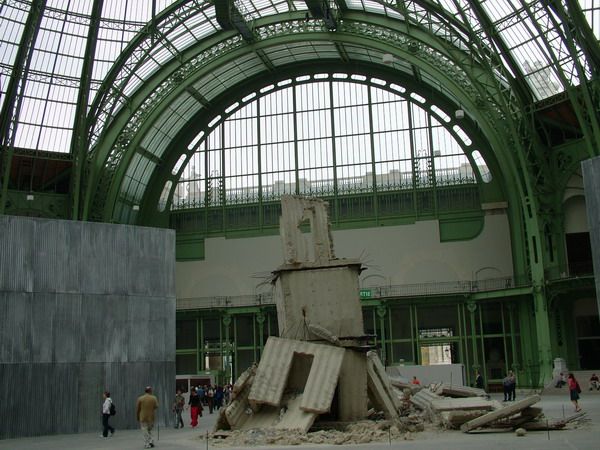
(Image) A spectacular view of the Anselm Kiefer "Meteorite" special exhibition. Anselm Kiefer "Meteorite" Special Exhibition - Excerpts from Interview: The Grand Palais is a special place, not just for its volume but for its architecture; its clear and massive structure challenges the artist's presentation, requiring a battle with this building. The Grand Palais at late night is like the world, where people can see the starry sky, an infinitely open place, close to the universe. A vast exhibition space without a ceiling as a venue is quite novel and highly challenging.
The special exhibition at the Grand Palais is called "Meteorite." "Meteorite" is a theme in many of my paintings over the years. This theme encompasses the birth and disillusionment of the universe, with tens of millions of stars being born and dying every day, much like humans. For a planet, it may be tens of millions of years, but for humanity, it might only be a moment; the relationship of time is so different. When a planet dies, it explodes into a blazing white light and shatters into various types of fragments, whose ashes float in the unimaginably distant universe, and then these materials re-aggregate and condense into a new star, a different planet. "Meteorite" expresses this metabolic world, this natural and celestial metabolism. This theme includes not only our lives but also the universe.
My painting is not a hallucinatory or delusional art. I do not paint images for the sake of painting; I paint because something appears under certain circumstances, a kind of impulse strikes me, and I transform it into something. Something that I possess and that haunts me, I release it; something I must transform and metabolize, which becomes the rationale of my creation.
The catalog presents 60% of my work; it is the only book of its kind, not a mass-market book. Books often attract me because they manifest time. It is both the time spent writing a book and the time required to read it, page by page, with the appearance of paintings. Regarding painting, when people enter the exhibition hall, they can view a painting, which exists on-site (within the timeframe of the exhibition). Through the catalog, people can continue to savor and understand further, without being limited by the temporal framework. This is the greatest difference between the catalog (book) and the exhibition. The books I create exist between these two aspects: these books surround such repeated reading and opening for appreciation; people read my books as if viewing artworks, these works existing between appearance and timeframe.
There is no need to understand my works based on what I say. One must open one's eyes to observe things, must view them according to one's own inherent system of thought, inherent history, and expression, constructed through our intellectual combinations. Each viewer must determine their own viewed works according to these types. For this reason, there are thousands of works in the world because everyone views from a different angle; this is what is interesting. Every perspective opens the door to my vision towards another viewpoint, another painting, another interpretation.
What satisfies an artist is when someone, for example, an economist or a microbiologist, sees something you never thought of; this is fortunate.
In Barja and the Grand Palais, the houses (exhibition rooms) I built welcome these meaningful works of mine. There are passages between these houses; where there are passages, there is intersection. Intersection is meeting. At the Grand Palais, there will be many intersections, which is why I keep these house exhibition doors always open; through them, people can enter and exit, following into another door, establishing connections, joints, and relationships between works, and among people. When I use poetry, for instance, a line of verse or a word, it is something engraved in my heart and deepens me; it transforms and invisibly enters my paintings. (Translated from Anselm Kiefer "Meteorite" Special Exhibition Press Release - Jean-Baptiste de Beauvais Interview Excerpts p8-9)
Regarding poets Paul Celan and Ingeborg Bachmann: This "Meteorite" exhibition is specially dedicated to commemorating the works of German-Jewish poet Paul Celan and Austrian poet Ingeborg Bachmann concerning humanity. Let us now look at these two poets. Paul Celan (1920-1970), a German-Jewish poet, was born on November 23, 1920, in Cernauti, Ukraine (then), writing poetry in German. From 1947, he fled Nazi Germany, wandered in Paris, and settled there; he died by suicide in the Seine River on April 20, 1970. Etched upon him were the profound experiences of Nazi concentration camps. Poet Paul Celan strongly refuted the idea of outstanding philosopher Theodor W. Adorno that "to write poetry after Auschwitz is barbaric." Paul Celan indeed worked poetically within language; these executioners are also examples of immense poetic courage, leading to a complex plot, interruption, and particularly exciting writing. His most famous works include: Ash-Glory (1947), Death Fugue (or Mourningstone) (1952), No One's Rose (1963), Grimmer Heart (1965), and finally Dark Toll (1969), etc. In 1946, he wrote in a letter: "...I want to tell you how difficult it is for a Jewish poet to write in German. When my poems are published, expressed in outstanding German—allow me to cite this earth-shattering, horrifying thing, opening the book to read my poems is those who murdered my mother... worse still comes... yet my fate is to write in German."
Ingeborg Bachmann (1926-1973), an Austrian poet, was born in 1926 in Klagenfurt, Austria, and tragically died in a fire in Rome, Italy, on October 17, 1973. She obtained her doctoral degree in 1950. Her poetic creation began with the post-war group she founded in '47 (members included Gunter Eich, Heinrich Böll, Ilse Aichinger), whose concept was "to construct a new world without a new language." Soon, Bachmann's debut work, Delayed Departure, caused widespread success among audiences and received critical acclaim. From 1961, she published numerous articles: Thirty Years, Malina, and Three Paths to the Lake, continuing to write poetry, more famously including The Unruly Man Goes to the Sea. She threw herself into the struggles of post-war writers, simultaneously entangled with women, often exploring issues of oppression suffered by women in the modern world. Close to Paul Celan, like him, she long questioned the possibility of literary creation after the Shoah (German Nazi racial genocide). (Translated from Anselm Kiefer "Meteorite" Special Exhibition Press Release p16). Thus, allowing dear art friends or lovers of art to have a more comprehensive understanding and knowledge of Anselm Kiefer's "Meteorite" special exhibition.