Renoir (Auguste Renoir) - The Moulin de la Galette
The Moulin de la Galette, 131×175 cm, oil on canvas, 1876. Held at the Musée d'Orsay, Paris. Renoir (Auguste Renoir, 1841–1919), one of France's Impressionist masters, was born in Limoges...
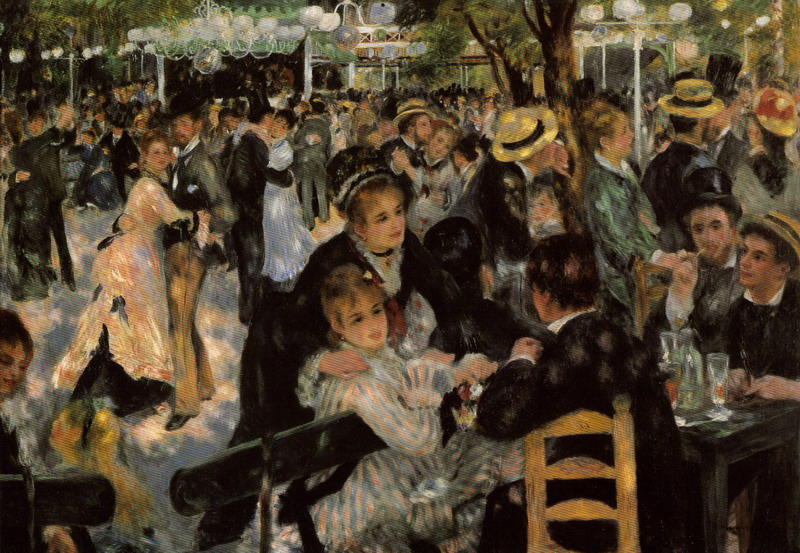
The Moulin de la Galette, 131×175 cm, oil on canvas, 1876. Held at the Musée d'Orsay, Paris. Renoir (Auguste Renoir, 1841–1919) was one of the great masters of French Impressionism. Born in the famous Limoges ceramic-producing region of France, his family moved to Paris in 1845. He showed a natural talent for music in elementary school, and his music teacher hoped he would pursue that path. However, his father sent the young Renoir to a ceramics studio to learn painting on pottery. This sparked a strong interest in painting; he began visiting the Louvre. At age 21, he entered Gleyre’s studio, where he met Monet, Sisley, and F. Bazille. Later, he encountered Degas, Manet, and numerous writers and art critics, entering Paris’s avant-garde art circle. In 1866, his work was rejected by the Salon. In 1870, he participated in the first Impressionist exhibition, becoming one of its most representative painters. He is also the painter who completed the most portraits among the Impressionists (his major themes were portraits, group scenes of daily life, domestic moments, etc., with landscapes being particularly rare and distinct). His works often depict scenes of happy social life. As one art critic wrote: “He is one of the greatest creators of his time, painting eternal femininity, sensual nudes, innocent little girls, rich nature, dazzling light, and rhythm.”
The Moulin de la Galette is one of Renoir’s brilliant masterpieces of group scenes (another such work is Luncheon of the Boating Party). Before this, he had only painted simpler figures. The inspiration for this work seems to come from Rubens’ Festival of Peasants and Watteau’s Pilgrimage to Cythera. Here, the painter depicts the Moulin de la Galette on the slopes of Montmartre, capturing the days when French people celebrated holidays under bright sunlight and greenery, dancing joyfully outdoors and gathering happily over beer. With his exquisite technique, Renoir perfectly mastered the vibrant group scene, vividly displaying various complex elements and structures. He completely captured the flickering light, colors, and atmosphere, profoundly revealing the joyful and fulfilling lifestyle of Parisians at that time.