Rodin (Auguste Rodin) - A Master of Sculpture
Life-like marble statue of Vicuna, 1888. Collection of the Musée d'Orsay, Paris.
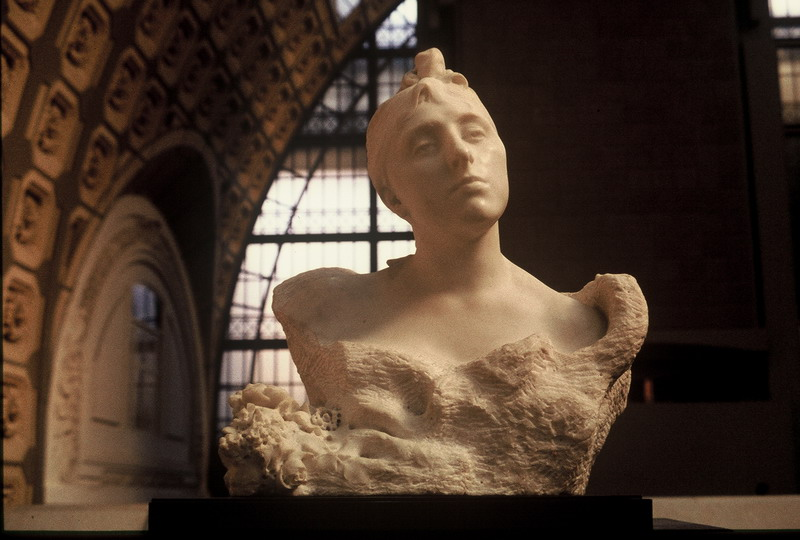

Text and photos by Chen Chi-Hsiang. Rodin (Auguste Rodin, 1840–1917) was the most representative sculptor of France in the late 19th and early 20th centuries. His outstanding works had a significant impact on Western sculpture as a whole; his art ended Romanticism and simultaneously opened the door to modernist sculpture in the 20th century.
Born into poverty, his father was a clerk at the Paris Police Department. He received religious education as a child and began showing artistic talent early, starting to draw at age nine. His academic performance was average, but at fourteen he entered the École Impériale de Dessin to study drawing, copying French 18th-century paintings (such as those by Boucher and Fragonard) and ancient artworks from the Louvre. Later, he attended the Gobelins Manufactory school for figure drawing. In 1857, he applied three times to the sculpture department of the École des Beaux-Arts but was rejected each time because his work was considered too traditional. Undeterred, he took up decorative work from 1858 to make a living, copying plaster casts and learning casting techniques. In 1860, he completed his first work, Bust of the Father, in a rigorous Neoclassical style.
In 1862, following the death of his sister Marie, Rodin entered the church like an novice monk out of grief. The following year, he sculpted a bust of Father Yameau, who recognized his talent and encouraged him to leave the clergy and continue as a sculptor. He began his first public work, Man with a Broken Nose, but withdrew it from the Salon due to its rejection by the academic establishment. The path to becoming a sculptor was clearly arduous. With willpower and courage, Rodin entered the studio of sculptor Carpeau to learn continuously and took anatomy courses at hospitals while struggling to make a living. In 1864, he met Rose Béret; they lived together and had a son, Auguste Eugène, in 1866.
In 1876, called by the works of Renaissance artists, Rodin visited Italy’s Renaissance sites. In Florence and Rome, he copied sculptures by Donatello (the first artist in sculpture history to create nude figures) and Michelangelo, deeply moved and influenced. He then began working on The Age of Bronze. When exhibited at the Salon, it sparked controversy and accusations of direct life-casting. After years of effort, in 1880, with his plaster original of Saint John the Baptist and The Age of Bronze (cast in bronze), he participated in the Salon and achieved fame overnight. The government purchased his works for its collection and commissioned him to design the famous The Gates of Hell for the future Museum of Decorative Arts. Thereafter, he began working on Adam, Eve, The Three Shadows, and The Thinker within The Gates of Hell.
In 1883, Rodin met Camille. She became his student, mistress, model, and assistant; their friendship lasted fifteen years. The following year, he completed the model for The Burghers of Calais. In 1885, he completed his first Camille Bust and went on to illustrate Baudelaire’s poetry collection.
Looking back in his later years, Rodin said: "To make a living, I learned all the technical skills of my profession, such as rough-cutting marble, stone, making plaster molds, casting, and even designing jewelry for goldsmiths. I regret losing much precious time, but what I did and worked hard at helped me complete beautiful works."
By 1889 (when the Eiffel Tower was completed and the World's Fair was held), Rodin’s artistic achievements reached their peak. He participated in the World's Fair Salon and an exhibition at the Georges Petit Gallery with thirty-six works, notably The Burghers of Calais. The government had commissioned him to create a large statue of Hugo, but it was rejected because the figure was reclining, whereas authorities wanted a standing statue. He had to remake it, completing it in 1891. That same year, the Société des Gens de Lettres commissioned him to create a statue of Balzac. From then on, commissions for various commemorative statues poured in. In 1893, he became the general secretary of the sculpture section of the Société Nationale des Beaux-Arts. In his original style, he dedicated himself to expressing the power of movement and posture. After years of effort, The Burghers of Calais was finally unveiled in 1895. That year, Rodin settled in Meudon and completed the controversial Balzac statue.
In 1900, with the arrival of a new era, Rodin participated in the Paris World's Fair, prominently exhibiting one hundred and fifty works, causing a sensation. From then on, Rodin became an internationally renowned sculptor. He wrote: "I exhibit my sculptures with full confidence, just as I understand sculpture; I will serve art." Following the turmoil over Balzac and the pain of separation from his lover Camille, Rodin turned a new page. With a comfortable financial foundation, he used his remaining strength to establish a museum to house all his sculptures and collections. In his later years, many of his numerous works were marble sculptures, such as The Centaur (1901–1904), Hand of God (1902), Blue Iris or Message from God, Walking Man (1900–1907), and Paolo and Francesca (c. 1905). In 1904, The Thinker was enlarged, and the following year it was placed in front of the Panthéon in Paris (moved to the museum after 1922).
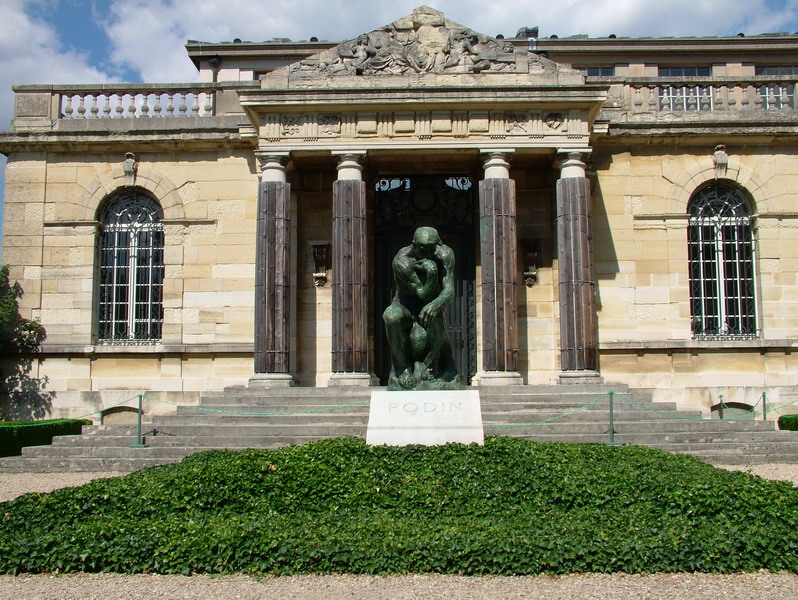
In 1916, Rodin fell ill and could not recover. He donated all his lifetime works to the French government. On November 17 of the following year, the great master of sculpture passed away, resting before the 18th-century castle of the Meudon Billon mansion, where the eternal Thinker stands guard over the outstanding sculptor.