B. Newman - Illuminating George
Illuminating George 290×442cm 1961 Collection of the Centre Pompidou, Paris
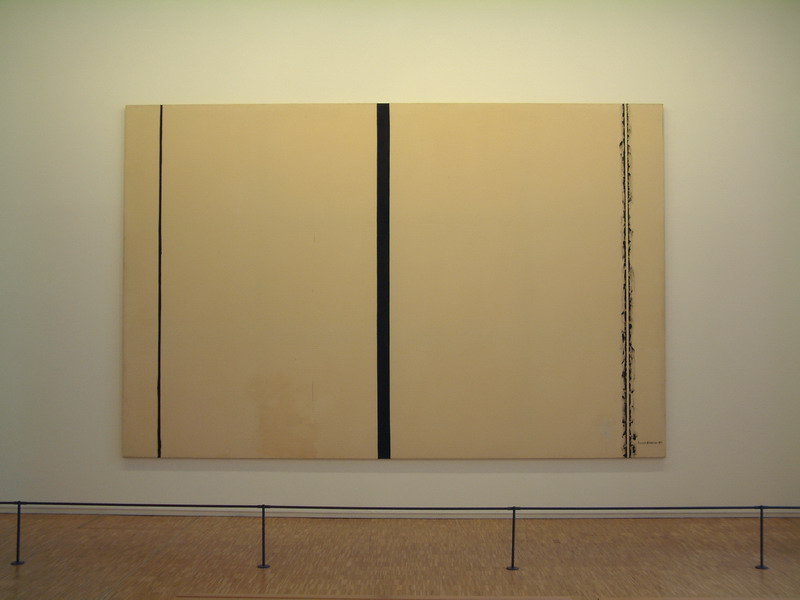
B. Newman (1905–1970) is the most representative painter of the American Abstract Expressionist movement in the 1950s. Since 1946, he has displayed his calmest and purest large-color-field abstraction within vertical structures, tending toward Eastern spirituality, exerting a significant influence on younger American artists (especially Louis and Noland, main painters of late-color abstraction in the 1960s; Minimal Art in the 1970s; and Neo-Geometric in the 1980s).
Newman’s works have always been determined by canvas form to decide picture structure. The pictures are often divided by one or several vertical lines (color bands), metaphorically expressing through form/color within contrasting stable colors. Especially in 1957, after suffering a heart attack and returning from the brink of death, Newman deeply integrated life experience into art. Particularly in February 1961, when his brother George passed away, facing death, black became the symbol of painting, leading Newman to deeper exploration of spiritual states.
Newman stated: "Black is used only when an artist attempts to create something new." In this vast white canvas's infinite space, there are only three solemn vertical lines, with the central wide black line as the axis. It divides unequal areas: to the left, near the canvas edge, a fine black line; to the right, a hollow blank space, reminding one of the crown of thorns worn in depictions of God's passion. Dedicated to mourning his brother "George," the name "George" in Hebrew is one form of the verb "to shine," especially through this infinite (blank space extending beyond the canvas to the entire wall) realm of emptiness. Newman wrote: "Emptiness is not so easy; the problem is that it is created by painting."