Observing the Mind, Surveying the Realm
Protected Area Landscape 73.5x102.5 cm (c. 1832) held in Dresden Gemäldegalerie. Caspar David Friedrich (1774-1840) was one of Romanticism's most unique painters; while trends focused on tragic history and dramatic human scenes, he withdrew...
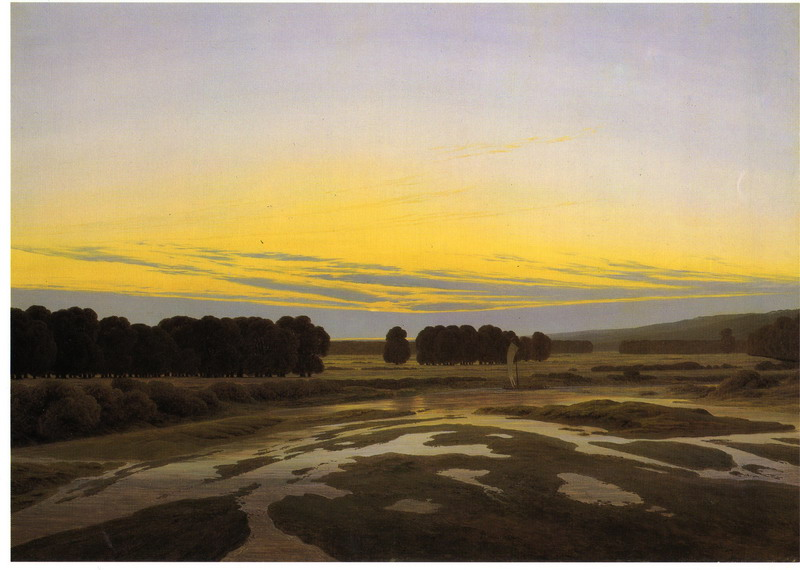
Protected Area Landscape 73.5x102.5 cm (c. 1832), held in the Gemäldegalerie in Dresden, Germany. Caspar David Friedrich (1774–1840) was one of Romanticism’s most distinctive painters. While prevailing trends focused on depicting and expressing tragic historical events and dramatic human scenarios, he withdrew from society, immersing himself in a spiritual world and focusing intently on the natural scenes that captivated him. With an extraordinary and poetic romantic sensibility, he revealed new possibilities and vitality in nature. His unconventional pursuit of pure artistic inquiry aligned with the pure philosophical thoughts of German philosophers Immanuel Kant and Friedrich Schiller at the time.
Friedrich began his painting studies in Copenhagen before moving to Dresden, then the cultural center of Germany, where he quickly became part of the Romantic movement and befriended the thinker Goethe. After a severe illness in 1810, he experienced a rebirth-like wonder at life, withdrawing into nature to live a monastic existence. This brought major revelations to his painting art; he devoted himself entirely to the grandeur and mystery of nature. Majestic natural landscapes often evoked ancient Germanic mythology. In this bewitching and infinite nature, humans became insignificant figures, breaking through the anthropocentric core thought since the Renaissance. In these quiet and magical natural scenes, he expressed his most pure and spiritual artistic world.
A contemporary painter described him thus: “Dear friend, I will introduce you to Friedrich’s landscapes. You know how controversial his works are, like a completely new phenomenon in plastic arts… Friedrich’s creations clearly differ from other landscape painters in their choice of subjects… His landscapes possess a religious melancholy and mystery. They move the heart more than they satisfy the eye.”
Protected Area Landscape: In this panoramic view of majestic scenery, the sky and landscape divide the canvas in half, with the horizon line forming the core of the entire composition. The dawn’s blue and orange hues fill the sky, contrasting with rolling hills on the distant horizon. Rows of trees stretch out, surrounding a swampy lake shimmering with water reflections. On the far side of the lake, a metaphorical sailboat appears (with no people visible). The entire scene appears exceptionally vast, elegant, serene, and transparent, permeated by an extraordinary clear air. Friedrich unusually captured the bright light characteristics of Northern landscapes, creating a poetic spiritual realm akin to Eden.
This exceptional clarity of air became the distinctive atmosphere and symbol in Friedrich’s landscapes. His wife told visitors, “On the day he painted the air, people could not speak to him.” It is within this air, surpassing other landscape elements, that the artist felt a special closeness to God; in fact, this was the main theme of those majestic landscapes. Such scenery reveals the incredible: humans can only contemplate silently, much like the figures dotted in Friedrich’s landscapes, often facing away from the viewer or rendered insignificantly. Another message implies that humans are fundamentally minute in the universe.