Camile Henrot "Is It Possible for a Revolutionary to Fall in Love with Flowers?" Solo Exhibition
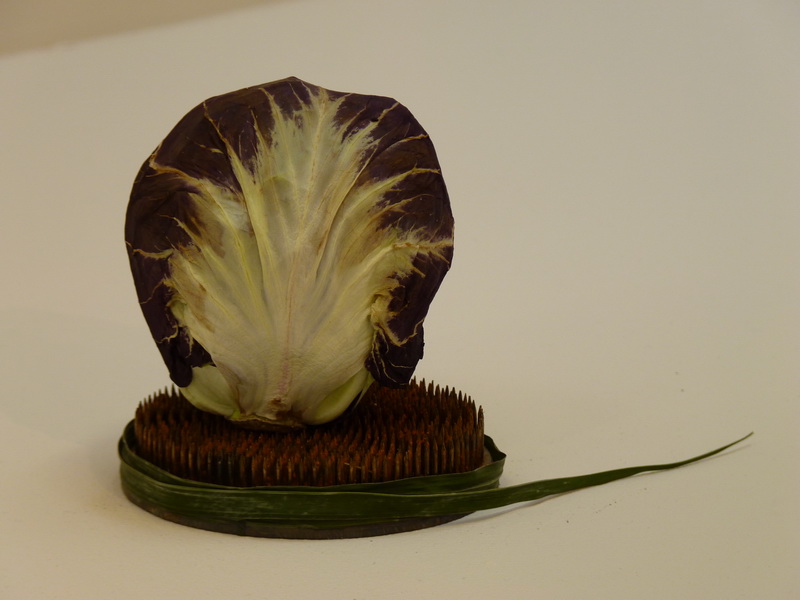
A poetic purple-red vegetable, surrounded by green grass on its base, titled after John Cage's diary proposition: "Diary - How to Make the World Better (People Instead Make Things Worse)." Object-space installation 2012.
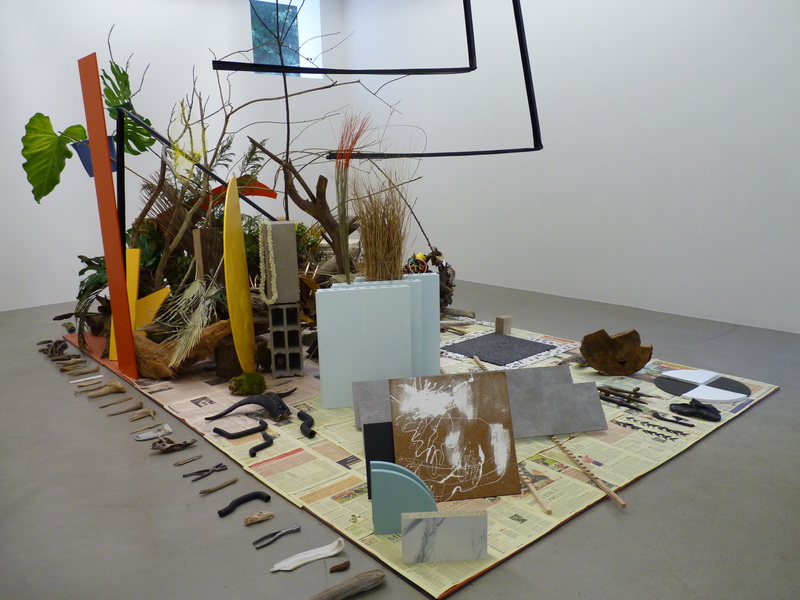
Venue: Kamel Mennour Gallery. Dates: September 6 to October 6. Text and images / Chen Chi-Hsiang.
Camile Henrot (born 1978) is one of the most unique artists among France’s new generation. She caught my attention at the recent Palais de Tokyo triennial Strong Proximity with her floral installations, which commanded a different kind of regard. Her work is built on innovative floristry; while flower arrangement has long been a lifestyle art in both East and West, only Camile Henrot explores it as contemporary art. Clearly constructed under the co-constitution of form and text, language and text outweigh material form. The exhibition title, "Is It Possible for a Revolutionary to Fall in Love with Flowers?", points to behavioral consciousness; text seems to dominate natural beauty. Perhaps text blinds the eye, becoming an ultimate aesthetic.
The artist likes to quote Marcel Liebman, a collaborator in the Soviet Leninist regime: "People start by liking flowers. Soon, text intrudes, forcing you to face life like a landowner, lazily spreading out in a hammock in their brilliant garden, reading French novels, until finally becoming funeral values." The realm of loving flowers slides into something almost named anti-revolutionary. Literary texts, like fresh flowers, are vivid shell colors. Literature asks us to paint: between revolution and comfort, must we choose? (Note 1)
Her arrangements are quite ordinary; if seen in a flower shop, you wouldn’t pay special attention. But from another angle or scene, it is different. I often say: "The same is not necessarily identical." In contemporary art spaces or galleries, however, they provoke different responses. Her flowers are neither Eastern nor Western style. She constructs perspectives with a unique gaze, combining floristry with text, as if the flowers are the body and the text the content. Under material forms, she attaches literary connotations, especially using literary works as titles, referencing meanings and triggering imaginative spaces through these propositions.
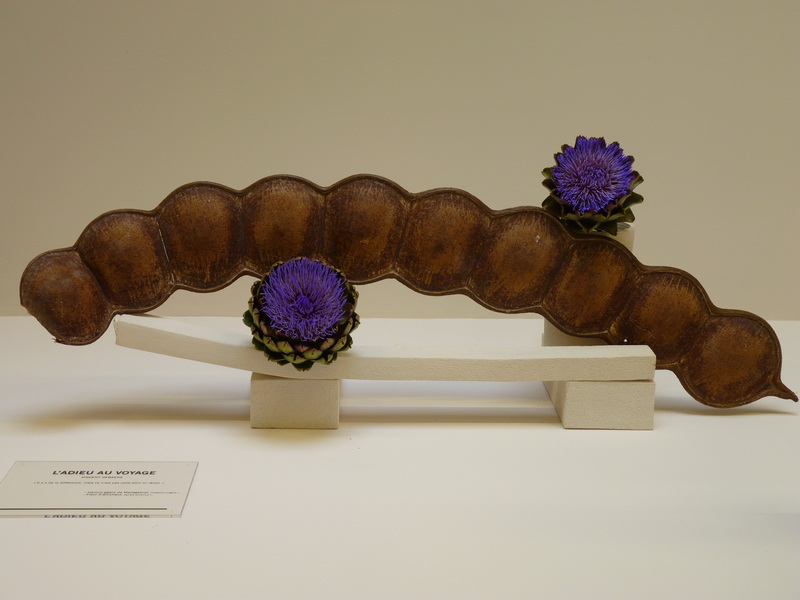
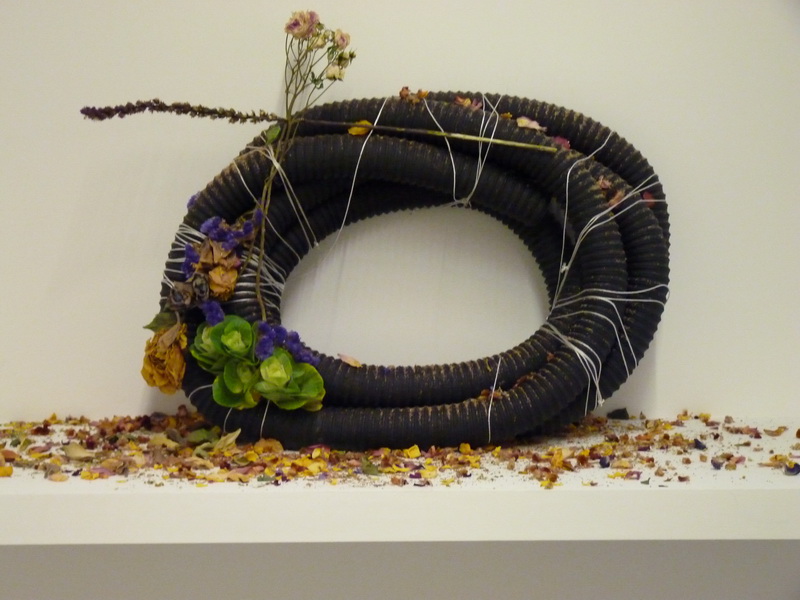
For example, a bunch of dry, narrow grass blades inserted in a glass bottle, titled after French writer L-F Celine’s book Voyage Until Midnight. A pineapple (a symbol of exoticism) with a red flower standing upright on top, titled after writer A Vobdine’s book Post-Exoticism Ten Lessons - Lesson Eleven. On a ceramic vase, a black-and-white dry stem is inserted horizontally, with some green grass at the end, quite concise, titled after writer S Zweig’s Magellan, accompanied by a Japanese poem: "The sea has always been so azure and mirror-like, the weather so clear and scorching, the air so dry, the horizon still so distant." A poetic purple-red vegetable, surrounded by green grass on its base, titled after John Cage’s diary proposition: "Diary - How to Make the World Better (People Instead Make Things Worse)." Or a giant Madagascar seed pod, with two purple morning glory flowers placed on it, titled by V Debane as Farewell Travel, with the subtitle "There is a difference, but this is not what everyone dreams of." A soft black hose twisted around several times, with red and blue dried flowers inserted, sprinkled with colorful petals below, titled after philosopher M Blanchot’s Infinite Dialogue.
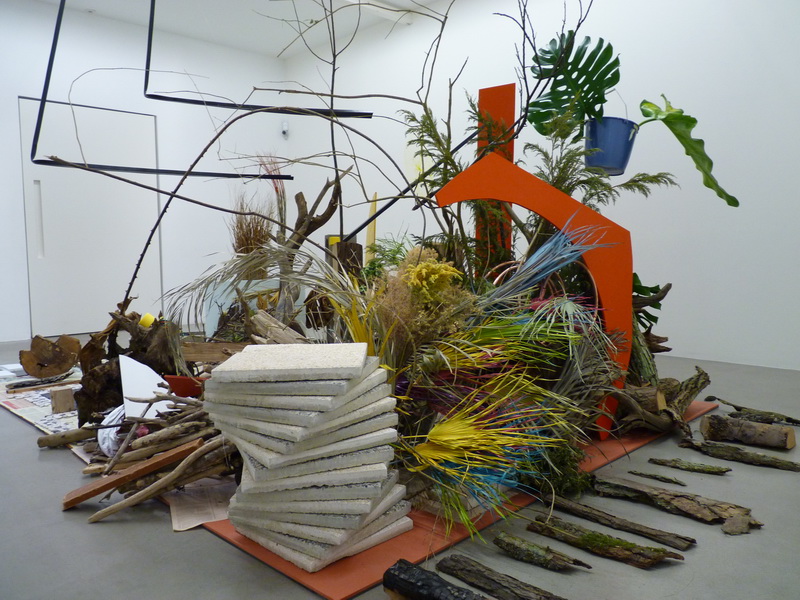
In this solo exhibition "Is It Possible for a Revolutionary to Fall in Love with Flowers?", she uses numerous plants, flowers, straw, fruits, stone slabs, branches, diorite, and wood to construct an island drifting in the ocean, titled after D Defoe’s world masterpiece Robinson Crusoe. Between form and color, imagination and metaphor, literature and philosophy, behavior and attitude, concept and consciousness.
Note 1: From the press release for Camile Henrot’s solo exhibition "Is It Possible for a Revolutionary to Fall in Love with Flowers?".