The Collapse of Anti-Technology and Technical Systems: "Chasing Napoleon" Exhibition (Part II)
Ryan Gander Nathaniel Knows More Than the Weight of Your Shadow Spatial Installation 2009
The Dream of a New World by Theodore Kaczynski: Robert Kusmirowski (born 1973), Poland’s most representative contemporary artist, excels at reproducing past situations based on data, images, and objects with infinite accuracy. Here, the artist recreates Theodore Kaczynski’s log cabin in the wilderness forest where he settled starting in 1971. The "Unacabine" (2008), life-size with original materials and colors, transforms one of the US Police Department’s most important crime scene evidences into an extraordinary object—sculpture. It presents the myth of the sensitive anarchist primitivist: Kaczynski’s isolated primitive life in the lush green forests of Montana (without water or electricity). This cabin was built by Kaczynski himself, inspired by the marginal writer Henry David Thoreau from the mid-19th century, who spent two years, two months, and two days alone in the remote countryside. This unusual experience led him to profoundly write about "Walden; or, Life in the Woods."
Gardar Eide Einarsson (born 1976) is a Norwegian artist living in New York, particularly interested in the specific forms of Scandinavian utopias. Figures of fugitives hold a relative idealism for him; the artist believes that major American murderers belong to a tragedy of individualism. Thus, Einarsson redraws the portrait of the American anarchist-terrorist Theodore Kaczynski drawn during the FBI manhunt in 1996. He appropriates this identity tension, depicting a handsome man with sunglasses and a hat in "Theodore Kaczynski Portrait" (2005), proving an undeniable desire to escape under a cult of personal heroism.
Ola Pehrson (1964–2006) is one of Sweden’s most representative contemporary artists, skilled for years in hand-copying photographic images and data from mass media. Two years before the arrest of the American anarchist-terrorist Theodore Kaczynski in 1998, the CIA released a series of detailed information about Kaczynski’s life titled "The Hunt of the Unabomber," published until the day he was captured. This distorted Kaczynski as an unsympathetic figure and urban legend. In 2005, Ola Pehrson compiled 187 images derived from these details into a video, also titled "The Hunt of the Unabomber." In this 30-minute film, through the artist’s visualization, Kaczynski’s image becomes more humanized, intending to interpret that terrorists or criminals possess the same kind-hearted human nature as everyone else.
John Tremblay (born 1966) is a young American artist who paints using Op art visual effects, fascinated by the experience of perspective and referencing design and technology. In "Bi-valve-uni-bomber Portrait," he adopts an unconventional tool compared to standard copying methods: he photocopies the double fugitive Theodore Kaczynski’s portrait twice, then draws organized series of ellipses of varying sizes on the black-and-white photocopy. The work highlights the ambiguous portrait of the bomber.
The Dora Winter Group (founded 2005) recreates Theodore Kaczynski’s library, featuring 250 books mixed from various periods and languages, covering mathematics, astronomy, botany, physics, technology, science, politics, sociology, etc. Among them are Napoleon, Jacques Ellul’s famous "Technique and Power" (French sociologist), and Henry David Thoreau’s "Walden" from the 19th century. Viewers are invited to cautiously evaluate the danger and originality while wandering through Kaczynski’s extremely complex psychological world.
Metaphor and Reference to Theodore Kaczynski’s Alternative World: Dave Allen (born 1963) is Denmark’s most representative contemporary artist, focusing on music, its history, function, and portraiture. Notably, his videos, installations, and sketches continue to explore the rock world and visual arts, approaching the mystery and silence of sound. In this exhibition, a sound system is presented in the corner of the wall, titled "For he Dogs" (1912), an improvised piano piece by French pianist and composer Erik Satie written for dogs. Played at 18kHz, viewers hear no sound, but can see the graphic pulsation of notes on the speakers. The artist uses literary themes to interpret a metaphysical concept, akin to sound being consciousness, something only felt. It proves that although sound cannot be perceived, it exists, just like the pervasive intervention of today’s technical systems.
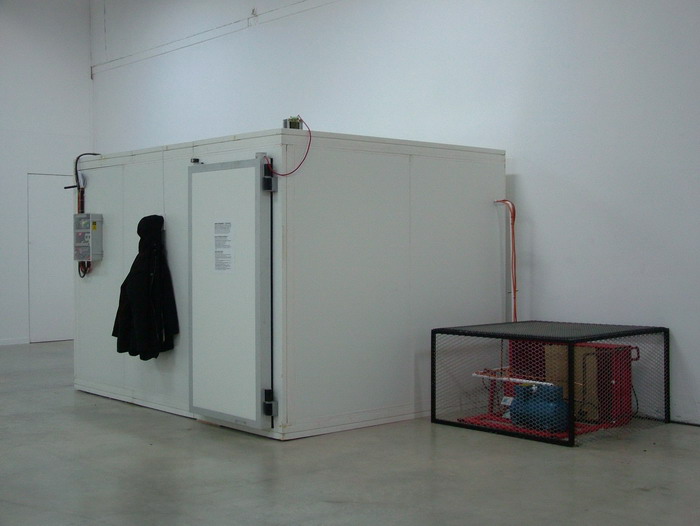
Micol Assael (born 1979) is a young Italian artist skilled in extraordinary spatial installations of objects. She exhibits a refrigerator case presenting Vorkuta, a coal mining town on the edge of Siberia, Russia, which was one of the most unbearable Soviet concentration camps during the Stalin era. In the harsh environment of ice and snow, temperatures could drop to around -60 degrees Celsius; now it is a deserted city. The artist invites viewers to empathize with this extreme environment, allowing only three visitors at a time. The attendant requires viewers to wear prepared coats and states they must stay in the refrigerator for more than five minutes (to truly feel the extra cold). Upon entry, the attendant closes the door tightly; if unable to endure it, one can knock to exit anytime. The dim refrigerator contains outdated objects: an abandoned office desk and chair, an open electrical box, power boxes with lit red bulbs of various sizes, and complex wiring. In this cold environment of -35 degrees, nature dominates human habits and product tools. Here, the artist creates a unique tension, placing viewers in an unusual dangerous situation to accept reality and face the challenge of nature. In this way, the artist responds to the collapse of anti-technology and technical systems with nature.
Christoph Buechel (born 1966) is Switzerland’s most representative contemporary artist, exploring the aesthetics of disaster in post-capitalism, super-consumption, globalization, environmental issues, political geography, and natural/man-made disasters through super-Dadaist subversive behaviors and attitudes. Imagining real social problems and environmental scenes as art, he presents the inevitable nightmares of post-9/11 in Hollywood’s most dramatic and intense settings. Contradictorily involving social inequality phenomena under ideological dominance, such as global capitalism, unprincipled consumption, and religious conservatism. Reality is indeed more shocking, tense, and moving than virtuality. Art acts as a collective metaphor; artworks here represent us, our society, and our situational state, conveying extreme psychological states within the realms of real politics and sociology.
Here, Christoph Buechel exhibits "Spider hole," a simple, small geometric earthen hut seemingly just unearthed from underground and covered in mud. This unusual object depicts Saddam Hussein, the dictator of Iraq, fleeing after the US invasion overthrew his regime. He hid in his hometown Tikrit, enduring the conditions and survival situation of hiding in this humble underground earth hut among multiple escape routes. Remember December 14, 2003, at 12:20 PM? Paul Bremer, Administrator of the Coalition Provisional Authority in Iraq, announced at an official press conference in Baghdad: "We have captured him, the tyrant has become a prisoner, the former dictator will face legal judgment." Then US President George W. Bush addressed the nation: "Saddam Hussein is detained in Baghdad. According to Iraqi officials, during the 'Red Dawn' hunting operation by 600 US soldiers, he was arrested at 8 PM local time on Saturday, hiding in a small underground earth hut in a farm in the Ai-Daour village near Tikrit. He carried a pistol, two submachine guns, and over $750,000 in cash..." The artist uses the metaphor of the fate of the Iraqi strongman and dictator Saddam to criticize the intervention of the US hegemonic political-economic-technical system, which has shaped the current political-economic situation in the Middle East and even globally. This contrasts with Kaczynski’s extraordinary anti-system case and reflection.
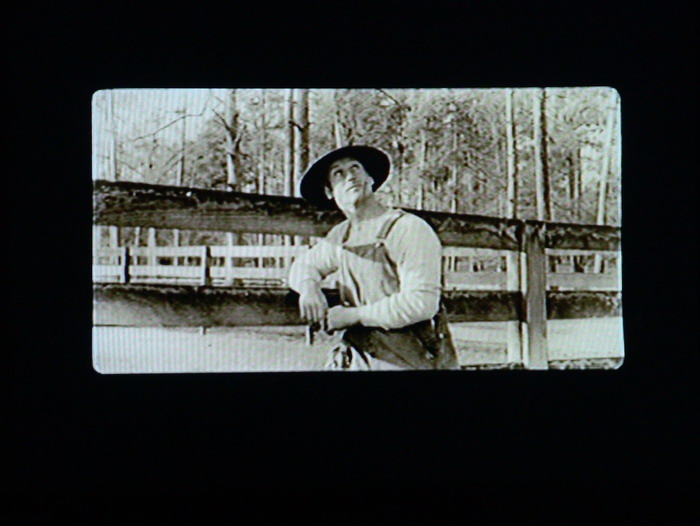
David Fincher (born 1962) is an outstanding video artist from the US East Coast, famous for his dark humor, gloom, and paranoid works. Here, he presents "Benjamin Button’s Strange Story" in a series of six TV screens, intermittently playing each video clip flashing by for only two seconds. Extraordinarily presenting Benjamin Button’s various whimsical tragedies, every dramatic scene ends unexpectedly with a lightning strike: for example, a cowboy repairing the roof is struck by lightning and falls to the ground; another reaches for a letter and is unfortunately hit; another leans on a railing, lost in thought, and is inexplicably struck; another driving through the field is unexpectedly hit by lightning, and so on. These abnormal displays of thunder segments reveal powerful natural destructive forces. Sudden lightning allows a momentary approach to another reality. It implies accidents in the journey of life, especially the indispensable natural forces and their destructiveness.
Tom Friedman (born 1965) is America’s most special artist, creating works on plain materials. Deconstructing, reassembling, piling up, or dispersing under his manipulation reveals an exceptionally ordered chaos. The artist avoids the feeling of the real world and constructs everyday objects fragment by fragment. For example, carving statues on tiny antibiotic pills or making figures on aluminum foil. Tom Friedman aestheticizes all solid objects surrounding him.
Here, he exhibits "Untitled (A Curse)," which almost conceptually presents a white sculptural pedestal (the lack of subject becomes the subject). The feeling unfolds through radical contingency. The theme seems to imply another feeling: the artist provides a type close to incompetent witchcraft. This curse-like pedestal is like a sensitive object. Magical intervention establishes an interruption of ordinary rationality. Invisible dispersion causes relative acceptance to become general value.
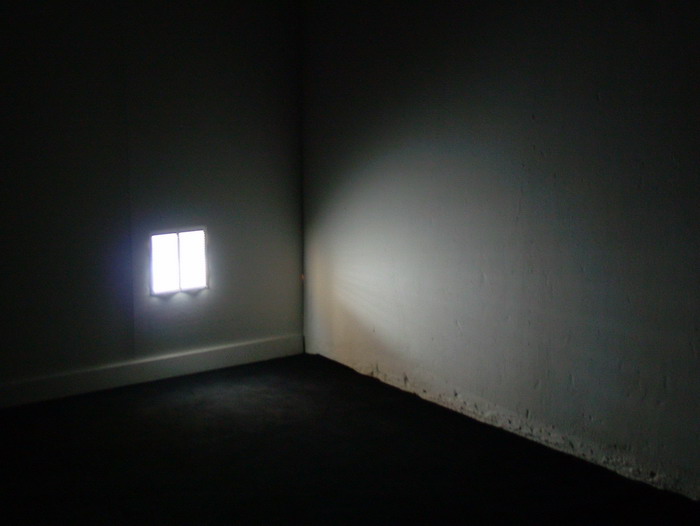
Ryan Gander (born 1976) is a rising star in British contemporary art, skilled at determining spatial fields, mastering and circulating inherent material media, creating poetic and mysterious works. Retaining experimental elements of accidental soul memories of ideas in auto-reference, he provides each viewer with the power to solve the riddles of his works. Here he exhibits "Nathaniel Knows" (2003–09), an extraordinary spatial installation. In a dim, surreal exhibition space, viewers observe two mysterious light beams in the corners of the left and right walls: one is a square ventilation duct cover, the other an irregular crack cave with scattered stones. Outside the cave, wild flowers grow abundantly, overflowing with natural vitality. Mysteriously presenting a world of anxiety and transcendence, the chaotic interior leaves a faint glimpse of the vibrant exterior—a secret garden. The artist grants his viewers narrative inference power beyond the exhibition space. From then on, reality is merely a reference because fiction surpasses reality.
Robert Gober (born 1954) is one of America’s most special artists of the 1990s, whose works are suspenseful and confusing beyond understanding: a leg, a door, a tilted children’s bed, a small sink, etc., become enigmatic sculptural media in unusual scenes. Poetic construction intends to convey a world beyond words. Here, he installs a sink-like ready-made object (an object simulated by the artist) on a large white wall titled "Drain" (1989). This object of passage and transition presents a complex conspiracy of escape that doesn’t seem real, a difficult-to-implement aid type, or perhaps more like spy surveillance equipment (walls have ears). Under the logic of resistance and smooth passage, such a simple small object creates a secret world intended to conquer outside the wall, metaphorically and referentially pointing to Theodore Kaczynski’s alternative ideological world.
Tony Matelli (born 1971) is America’s most controversial contemporary artist, skilled at manipulating recognizable concrete elements and immersing in transitional states to create feelings, ingeniously altering everyday objects to present metaphorical commercial transaction illusions, while simultaneously questioning contemporary personal visions and social commitments. Here he dramatically presents "Fuck it. Free yourself!": burning several 500 Euro banknotes in a refined aluminum box. The fiery flames evoke a celebration ritual and metaphor destruction. Especially greedy capitalism has caused the current financial storm and economic crisis. Obviously, money has become the motive force flowing everywhere in the market, like coal energy today. As French philosopher Gilles Deleuze wrote regarding money: "Only human desire and social status. Nothing else." This seems to be a satire of today’s crazy gold-chasingism and a critique of the capitalist system.
Charlotte Posenenske (1930–1985) was Germany’s most innovative artist of the 1970s. After the European student protests, she resolutely gave up art creation, studied sociology, and joined union struggles. Her works criticized Western capitalist consumer society and industrial production political systems under the context of the ’68 European student movement, intending to propose new concepts of products, distribution, and acceptance to construct a new era. Here, her "Viekantrohre D Series" (1967) consists of sculptures-objects constructed from industrial-standard gray square aluminum products, resembling ventilation pipes in modernist buildings, capable of shaping according to space and time fields. Obviously, this excessively large volume makes people unable to see it; too smooth to attract attention. This series finds a special resonance, a fluent rational form, actually having no definite function: similar to the results of industrial society, it reminds people of the metaphor of a hidden path.
Hannah Rickards (born 1979) is Britain’s most forward-looking audio-visual new media artist, skilled at mastering various unusual media, creating on the almost invisible edge, focusing on transforming natural phenomena, from text, environmental spatial installations to sound arrangements. Hidden beneath seemingly simple appearances are complex design procedures, obviously showing human participation in ecology, demonstrating the impossibility of human language, broadcasting an extraordinary sensory experience. Here the artist presents "Birdsong" (2002) sound installation. In the Palais de Tokyo’s art forest, people often hear the crisp calls of several different birds, warmly evoking natural emotions and consciousness. But upon careful listening, it does not seem very natural. Here, the artist first recorded the songs of six birds (titmouse, warbler, goldfinch, turtledove, lark, and firecrest), then simulated them using their singing scales. This simulation is then adjusted back to the initial state (similar to original sound). When exhibited, not only the sound but also the manufacturing process is presented as a list. This qualitative change of nature and interpretation, like genetically modified varieties, projects the imperceptible qualitative change of nature under today’s technical systems.
Dieter Roth (1930–1998) was Germany’s most multifaceted artist (working as photographer, sculptor, performer, musician), roaming the world like a nomad to live and create, from Hanover (the artist’s hometown), Hamburg, Basel, Iceland’s Reykjavik, London, and the US. His creations were rich and multifaceted, focusing early on constructing conceptual archives. In this exhibition, Dieter Roth presents "Reykjavik Slides" (1970–1975 and 1990–1995) as object and projection installations. This represents the artist’s two phases of five-year life experiences in the freezing capital of Iceland, Reykjavik. Using a massive archive of 33,000 slides, he systematically photographed and archived everything around him, witnessing the essence and precious experience of his nomadic existence. Rich amounts of slides are displayed in slide disc clips in archive form, orderly presented on library movable shelves. On the adjacent wall, a series of eight slide projectors continuously screen thousands of images. Viewers can peep into traces of the city from these thousand images. Obviously, the artist presents collective memory and sociological archives, art and documents, personal memory and shared social consciousness.
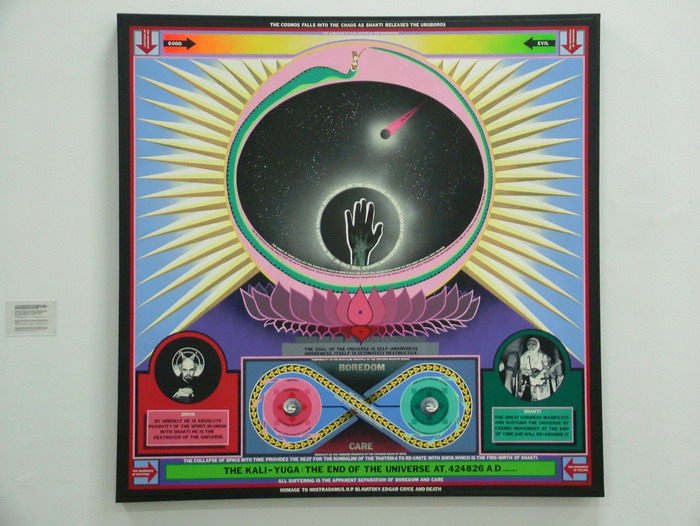
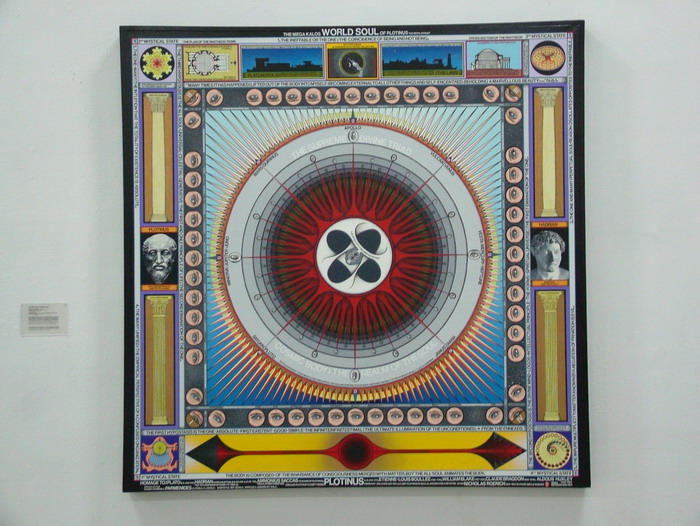
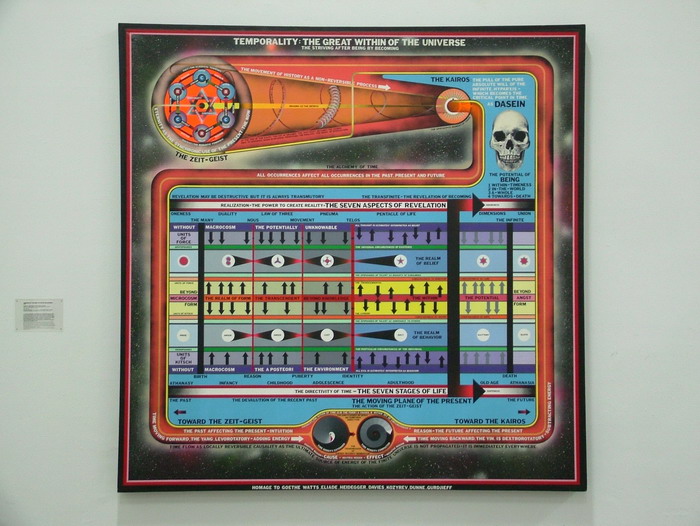
Paul Laffoley (born 1940) is today’s most intellectual and philosophical painter. After an electric shock accident in 1961, he said he experienced the fifth dimension and met living sculptures there, leading him to abandon architecture and the physical world to devote himself to art creation. In 1963, he came from Boston to New York to become an assistant to the famous sculptor and architect Frederick Kiesler. In 1967, he assisted Frederick Kiesler in holding a retrospective at the Han Gallery. Afterwards, he returned to his hometown Boston to begin painting, embarking on a series of diverse philosophical explorations, interpreting Dante’s Divine Comedy through pictures and text. He continued to delve into unified matter and consciousness or those mysterious mandalas, intending to elucidate extraordinary theories and insights on cosmic energy, philosophy of life, astronomy, history, science, and physical phenomena. This unusual system construction full of intellect and ambition exists in the eternal motion form of energetic fifth-dimensional pattern paintings. Metaphysically revealing a knowledgeable world and the theories established by the universe, supernatural science, art history, mysticism, and phenomenology.
(Note 1) Paris Palais de Tokyo Magazine Issue 10 "Chasing Napoleon" Special Review P35-40.