The collapse of technology and technical systems: The exhibition « Chasing Napoleon » (Part 2)
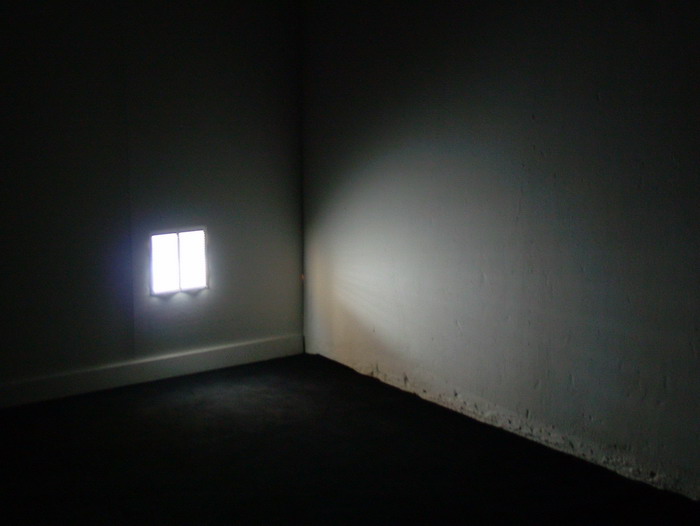
Ryan Gander Nathaniel Knows More Than the Weight of Your Shadow Spatial Installation 2009
The dream of a new world according to Theodore Kaczynski: Robert Kusmirowski (born in 1973), one of the most representative Polish artists of his generation, excels at reproducing and restoring past situations with infinite precision from documents, images, and objects. Here, the artist recreates the cabin where Theodore Kaczynski settled in a wild forest starting in 1971, titled « Unacabine » (2008), with the exact dimensions, materials, and colors of the original. This work, like a ritual profanation of the world, transforms, through striking hyper-realism, the main criminal evidence item of the American FBI into an extraordinary sculptural object. It sensitively presents the myth of the anarcho-primitivist: Kaczynski’s isolated and primitive life in the lush Montana forest, without water or electricity. Built by his own hands, this cabin draws inspiration from Henry David Thoreau, a marginal writer of the 19th century who lived alone in nature for two months and two days, an experience that inspired his book « Walden ».
Gardar Eide Einarsson (born in 1976), a Norwegian artist based in New York, is particularly interested in the idealized figures of those who flee the common Scandinavian utopia. For him, these sought-after characters embody a form of relative idealism; he considers that major American murderers fall under the category of individualist tragedy. Thus, Einarsson redraws the official portrait of Theodore Kaczynski, the American anarchist-terrorist wanted by the FBI in 1996. Appropriating this identity tension, he draws a handsome man wearing sunglasses and a hat in pencil, titled « Portrait of Theodore Kaczynski » (2005), proving from the angle of heroic admiration an unconfessed aspiration to escape.
Ola Pehrson (1964-2006), one of the most significant Swedish artists, had long mastered the manual reproduction of media and documentary images. Two years before Kaczynski's arrest in 1998, the American CIA published a series of documents detailing his life, titled « The Hunt of the Unabomber », broadcast until his capture. These information contributed to demonizing Kaczynski, making him a ruthless figure and an urban legend. In 2005, Ola Pehrson assembled 187 images from these documents into a video film, retaining the title « The Hunt of the Unabomber ». For thirty minutes, thanks to the artist's visual reconstruction, Kaczynski's image becomes more human, suggesting that terrorists and criminals share a universal human goodness.
John Tremblay (born in 1976), a young American artist, uses op-art visual effects and is interested in perspective, design, and technique. In « Bi-valve-uni-bomber portrait », he adopts an innovative approach compared to standard reproduction tools: he photocopies two official portraits of Theodore Kaczynski, then traces on the black-and-white prints a series of organized ellipses of varying sizes. The work highlights the ambiguity of the bomber's portrait.
The Dora Winter group (founded in 2005) reconstructs the library of Theodore Kaczynski, the famous American intellectual terrorist, composed of 250 books mixing various eras and languages, covering mathematics, astronomy, botany, physics, technology, politics, sociology, etc. Notable among them are « La Technique » by French sociologist Jacques Ellul and « Walden » by Henry David Thoreau. The public is invited to cautiously explore this complex and extreme psychological world of Kaczynski, evaluating its danger and originality.
Metaphors and references to the other world of Theodore Kaczynski: Dave Allen (born in 1963), a major Danish artist, devotes himself to music, its history, its function, and its iconography. His films, installations, and drawings explore the rock world and the visual arts, brushing against sonic mystery and silence. In this exhibition, audio equipment is presented in a corner of the wall, playing « For he Dogs » (1912), an improvised piano piece by French pianist and composer Erik Satie intended for dogs. Broadcast at 18 kHz, this frequency is inaudible to the spectators, but their eyes perceive the graphic vibrations of the notes on the device. Through this literary theme, the artist interprets a metaphysical dimension: as if sound were a consciousness, perceptible only intuitively, demonstrating that it exists despite being imperceptible, just like the omnipresent intervention of current technological systems.
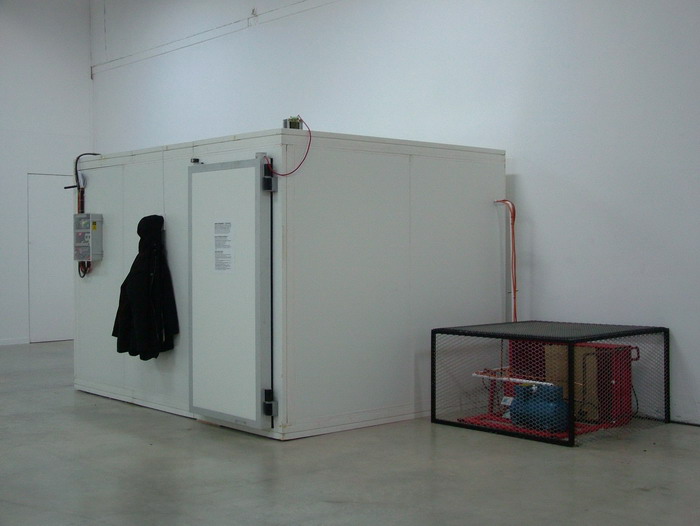
Micol Assael (born in 1979), a young Italian artist specializing in spatial installations of unusual objects, exhibits here a cold room representing Vorkuta, a coal mining town on the periphery of Russian Siberia. It was one of the most unbearable Soviet concentration camps of the Stalinist era, where extreme climatic conditions caused temperatures to drop to -60°C. Today, it is a ghost town. The artist invites the public to feel this hostile glacial environment; a maximum of three visitors can enter simultaneously. The guard requires them to wear provided coats and stay in the cold room for at least five minutes (to truly feel the temperature). At the entrance, the door is locked; if one cannot endure it, one can knock to exit. The dark interior contains obsolete objects: abandoned desk and chair, open electrical box with red bulbs lit, intertwined electrical cables. In this cold space at -35°C, nature dominates human habits and tools. The artist thus creates an innovative tension, placing the public in an unusual dangerous situation, leading them to accept reality and rise to the challenge of nature. Here, she responds to the anti-technological collapse and technical systems with nature.
Christoph Burchert (born in 1966), a major Swiss artist, explores the aesthetics of disaster in a post-capitalist context of super-consumption, globalization, ecology, geopolitics, and natural or human catastrophes, through subversive neo-Dada gestures. Imagining social problems and real sites as art, he presents, in the dramatic and intense style of Hollywood, the inevitable dreams after September 11. He addresses contradictorily social inequalities and dominant ideological forces, such as global capitalism, principle-less consumption, and religious conservatism. Reality is more shocking, tense, and poignant than the virtual; art serves as a collective metaphor. The works here are us, our society, and our states, transmitting extreme psychological states within the framework of real politics and sociology.
Christoph Burchert exhibits here « Spider hole », a small geometric and rudimentary earthen house seeming freshly emerged from the ground and covered in mud. This unusual object describes the flight and survival conditions of Saddam Hussein, the Iraqi dictator, after the American invasion that overthrew his regime. He hid in his residence in Tikrit, wandering for eight months in this humble underground hiding place. Let us recall that on December 14, 2003, at 12:20 PM, Paul Bremer, the American administrator in Iraq, announced at an official press conference: « We have captured him, the tyrant has become a prisoner, the former dictator will appear before justice. » Shortly after, President George W. Bush declared to the nation: « Saddam Hussein is detained in Baghdad. According to Iraqi officials, he was arrested Saturday at 8 PM local time during the operation « Red Dawn » carried out by six hundred American soldiers, while he was hiding in a small underground earthen house in the village of Ai-Daour near Tikrit. He was carrying a pistol, two submachine guns, and more than $750,000 in cash... » The artist uses the tragic end of Saddam Hussein as a metaphor to criticize the intervention of powerful political, economic, and technological systems of the United States, which have shaped the current geopolitical situation in the Middle East and the world, drawing a parallel with the exceptional case of systemic resistance by Kaczynski and his reflection.
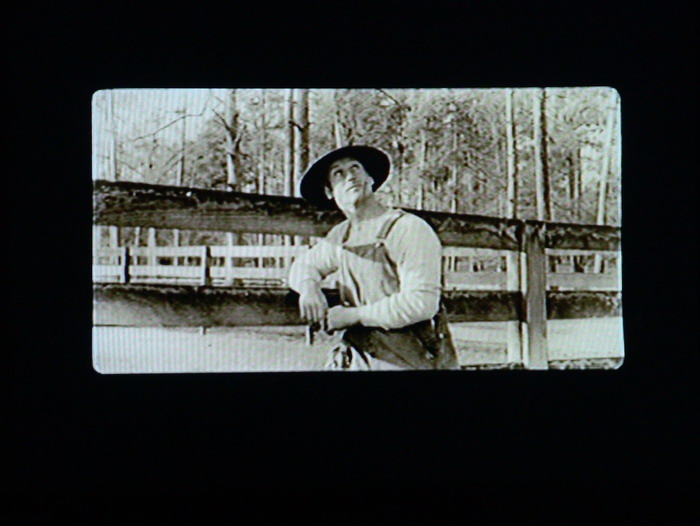
David Fincher (born in 1962), a brilliant videomaker from the US East Coast, is known for his black humor, lugubrious atmosphere, and paranoid themes. He presents here the series « Benjamin Button's Strange Story » on six TV screens, briefly and alternately broadcasting two-second video clips. He unusually shows the various tragic and absurd fates of Benjamin Button: each dramatic scene ends with the accidental lightning strike of the character. In a US western setting: a cowboy on the roof is struck by lightning falling to the ground; another receives a lightning bolt reaching out to take a letter; a third, leaning against a balustrade, lost in thought, is also struck; a fourth, driving through fields, is hit by a flash, etc. These abnormal thunder sequences highlight the sudden destructive power of nature, allowing instant access to another reality. This refers to the accidents of life's journey, underscoring the inevitable natural force and its destructiveness.
Tom Friedman (born in 1965), a unique American artist, works with raw materials. He dismantles, recomposes, stacks, or disperses his objects under his control, revealing an ordered chaos. The artist avoids the sensation of the real world and constructively fragments everyday objects. For example, he sculpts statues on tiny aspirin tablets or creates figures on aluminum foil. Tom Friedman aestheticizes all solid objects around him.
He exhibits here « Untitled (A Curse) », a nearly conceptual work presenting a white sculpture pedestal (the absence of subject becomes the subject), evoking a feeling born of radical chance. The title suggests another sensation: the artist proposes a type close to magical improvisation. This cursed throne acts as a sensitive object. A miraculous intervention breaks usual rationality. The invisible dissipates logical systems, accepting the relative as a general value.
Ryan Gander (born in 1976), a contemporary British talent, masters the scenic space, manipulating and recycling his inherent mediums, creating poetic and enigmatic works. He retains self-reference in experimentation on the soul and memory of ideas, offering each spectator the power to solve the riddle of his work. He exhibits here « Nathaniel Knows » (2003-2009), a remarkable spatial installation. In a dark and surreal exhibition space, the spectator observes two mysterious light beams at the left and right corners: one comes from a square ventilation grille, the other from an irregular cave-shaped crack, scattered with stones. Outside the cave, herbs and wild flowers grow abundantly, overflowing with natural vitality. This enigmatic presentation creates an anxious and unreal world, where inner chaos hints at outer vitality, a secret garden. The artist gives his public a narrative and deductive power exceeding the exhibition space. From then on, reality is merely a reference, because fiction surpasses reality.
Robert Gober (born in 1954), one of the most singular American artists of the 90s, arouses mystery and perplexity with incomprehensible works: a leg, a door, a tilted child's bed, a small sink, etc., become enigmatic medium-forming elements in unusual scenes, poetically constructing a world with implicit meanings. Here, he installs a small sink seeming ready-made (object simulated by the artist) on a white wall, titled « Drain » (1989). This object of transition and evacuation reveals a complicity complexity of escape, difficult to implement, resembling more a spying or listening system (walls have ears). Under the apparent logic of resistance and fluid evacuation, this simple object creates a secret world aiming to conquer the outside, serving as a metaphor and reference to the other world of thought of Theodore Kaczynski.
Tony Matelli (born in 1971), a controversial American artist, manipulates recognizable concrete elements and plunges into transitional states to create sensations, ingeniously transforming everyday objects to present commercial illusions with metaphorical intent, while questioning personal visions and contemporary social commitments. He dramatically presents here « Fuck it. Free yourself! », showing the fire destruction of several 500 euro bills in a refined aluminum box. The red flames evoke a ritual celebration and a metaphor of destruction. Above all, the insatiable greed of capitalism has caused the current financial and economic crisis; money seems to be the energy circulating in the market, similar to current coal energy. As French philosopher Gilles Deleuze wrote about money: « Only human desire and social status. Nothing else. » This constitutes a satire of the frenzied cult of money today and a critique of the capitalist system.
Charlotte Posenenske (1930-1985), an innovative German artist of the 70s, abandoned art after European student movements to study sociology and engage in union struggles. Her works criticized Western capitalist consumer society and the industrial production political system in the context of the '68 movements, proposing new concepts of products, distribution, and acceptance to build a new era. Here, she exhibits « Viekantrohre D series » (1967), object-sculptures consisting of standardized industrial products in gray aluminum, similar to ventilation ducts in modernist buildings, malleable according to space and time. Obviously, these excessively large volumes go unnoticed, too smooth to attract attention. This series finds a particular echo, a fluid rational form, without any determined real function: result of industrial society, it recalls a metaphor of secret ways.
Hannah Rickards (born in 1979), a visionary British artist of new audiovisual media, masters various unusual mediums, working at the limit of the visible, focusing on the transformation of natural phenomena, from texts to spatial installations and sound devices. Behind a simple appearance lies a complex design process, clearly showing human participation in ecology, expressing the impossibility of human language, diffusing an extraordinary sensory experience. Here, the artist presents « Birdsong » (2002), a sound installation. In the artistic forest of the Palais de Tokyo, one sometimes hears the clear songs of different birds, warmly evoking emotion and natural consciousness. But upon careful listening, it seems unnatural. The artist first recorded the song of six birds (tit, kinglet, chaffinch, dove, lark, and wren), then simulated their vocal ranges. This simulation is then adjusted to the initial state (similar to the original). During the exhibition, not only is the sound present, but the manufacturing process is also presented in list form. This natural mutation and interpretation, similar to genetically modified species, project the insidious mutation of nature under current technological systems.
Dieter Roth (1930-1998), a polymorphic German artist (photographer, sculptor, performer, musician), led a nomadic life across the world, living and creating in Hanover (his homeland), Hamburg, Basel (Switzerland), Reykjavik (Iceland), London (UK), and the United States. His creation was rich and multifaceted; he early on became interested in the concept of archives. In this exhibition, Dieter Roth presents « Reykjavik Slides » (1970-1975 and 1990-1995), documentary archives in the form of objects and projection installations. They testify to two periods of five years of life in the icy Icelandic capital, using more than 33,000 slides to systematically photographically archive all surrounding vegetation and landscapes, witnessing the essence and precious memories of his nomadic life. The numerous slides are presented in the form of archives in circular loaders, neatly arranged on mobile library shelves. On the adjacent wall, eight projectors continuously diffuse thousands of images; the public can discover the traces of the city through these thousand images. The artist clearly manifests collective and sociological archives, art and documents, personal memory and common social consciousness.
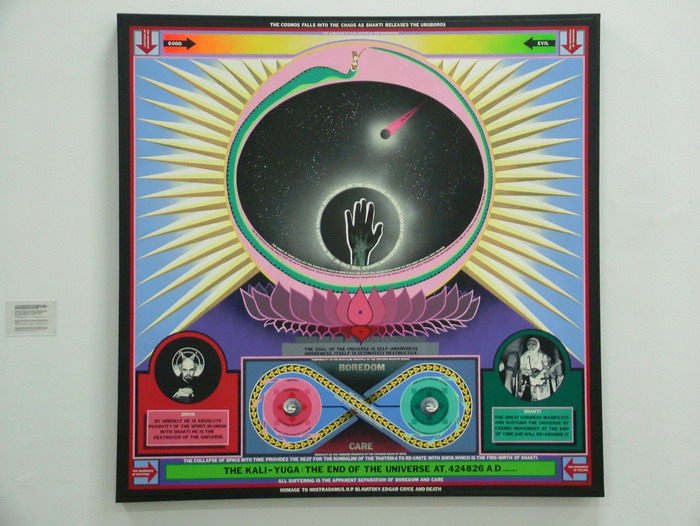
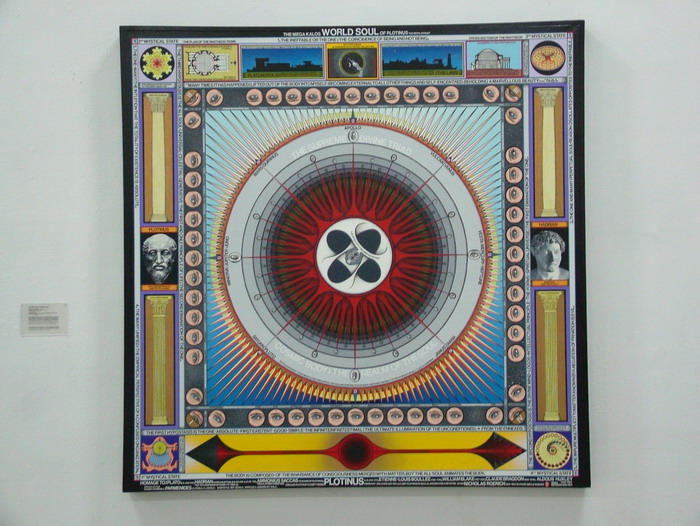
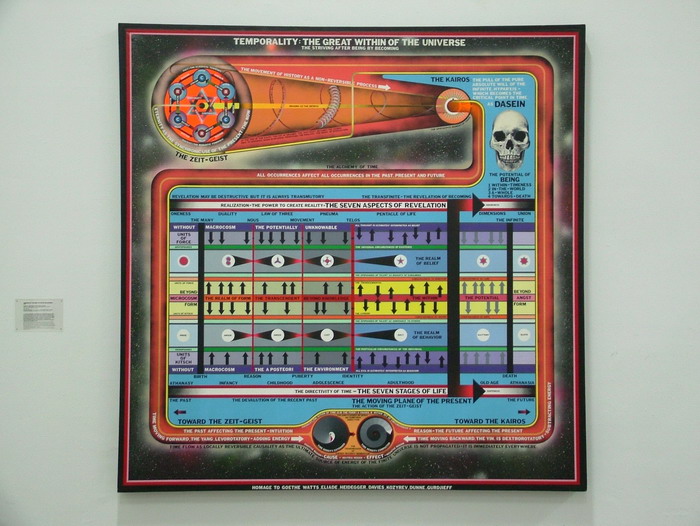
Paul Laffoley (born in 1940), the most intellectual and philosophical contemporary painter, claims to have experienced a near-death experience after an electric shock in 1961, having visited the fifth dimension and met living sculptures, which led him to abandon architecture and physics for art. In 1963, he came from Boston to New York to become the assistant of the famous sculptor and architect Frederick Kiesler. In 1967, he helped Kiesler organize a retrospective at the Hanjin Museum. Then, returning to Boston, he began his painting, exploring a series of philosophical concepts, illustrating Dante's Divine Comedy through images and text, deepening the unification of matter and spirit or mystical mandalas, seeking to explain extraordinary theories on cosmic energy, philosophy of life, astronomy, history, science, and physical phenomena. This intellectual and ambitious systemic construction takes shape in an eternal movement of paintings with energetic fifth-dimensional motifs. It metaphysically highlights a world of erudite knowledge and theories established by the universe: parapsychology, art history, occultism, and phenomenology.
(Note 1) Palais de Tokyo Magazine, Paris, issue 10, special « Chasing Napoleon », pp. 35-40.