Versailles Palace
The Queen's Guard Room, a magnificent hall paved with painted marble patterns, is identical to the Hall of Diana.
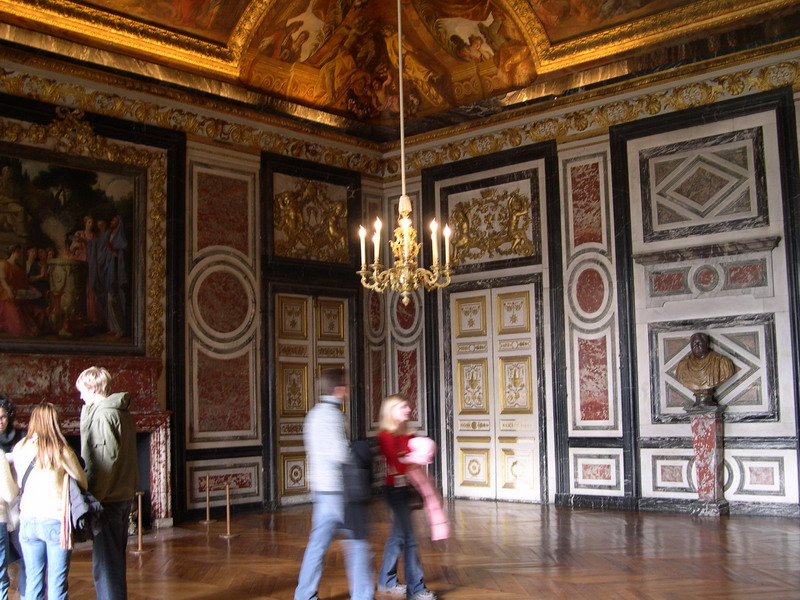
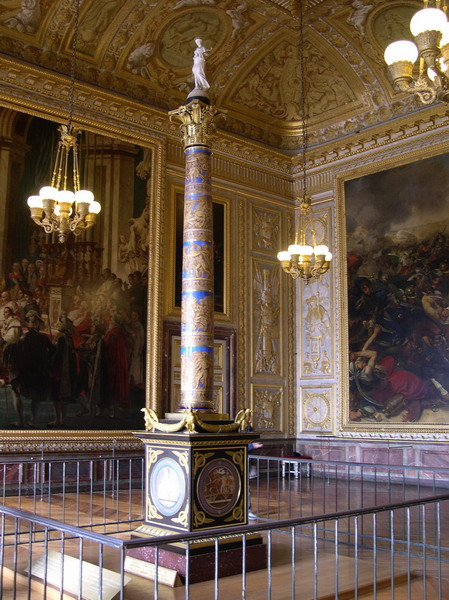
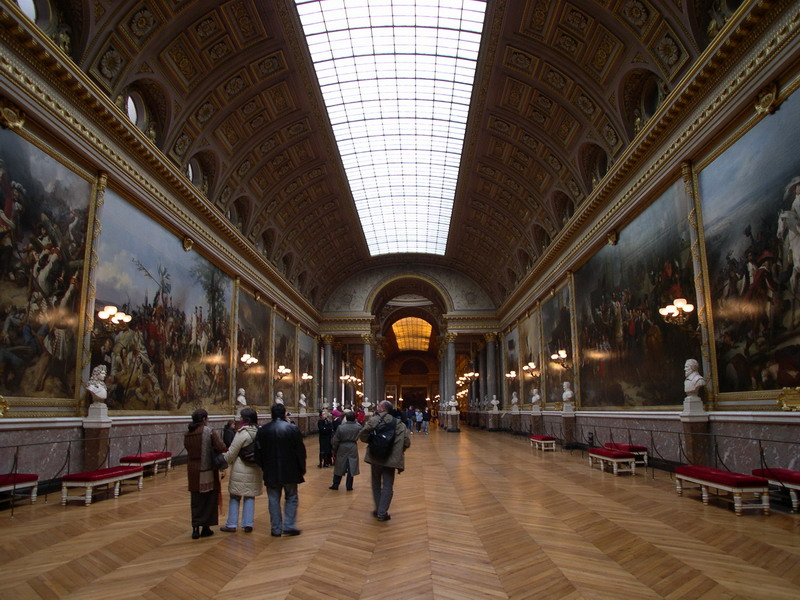
The Gallery of Battles, 120 meters long, displays historical paintings of all 35 great battles in French history. (All images from Versailles Palace provided by Lu Ren-yang)
Versailles Palace and Gardens (Château et Jardins de Versailles) Address: Château de Versailles, 78000 Versailles Phone: 30847400 Opening Hours: 9:00–17:30; Summer: 9:00–18:30 Closed: Mondays Transportation: From Gare Saint-Lazare to Versailles Rive Droite; from Montparnasse to Versailles Chantiers; RER Line C towards Versailles to Versailles Rive Gauche. About 40 minutes from Paris to Versailles; each station is about 10 minutes' walk from the palace. Route A: Royal Chapel, Grand Trianon, Hall of Mirrors, Queen's Apartments, Gallery of Battles Route B: King's Apartments, Royal Opera, 18th Century Salon Visiting Time: Route A and B take about 90 minutes each Garden Visiting Time: About 3 hours Website: www.chateauversailles.fr
When we mention France, besides the Louvre, we also think of the magnificent Versailles. Versailles is not unfamiliar to us; the glorious dynasty of Louis XIV, the Sun King, the grand battles, and the splendid Versailles Palace have become a microcosm of France's golden age. Here unfolded over two centuries of French history, it was the seat of three Kings named Louis who declared "I am the State," and the scene of royal domestic life.
Origins of Versailles Palace: Located in the suburbs southwest of Paris, Versailles was once a small village surrounded by forests and marshes. Louis XIII often hunted here and built a simple hunting lodge in 1624. In 1638, architect Leroy built a brick-and-stone castle, which became the palace sections on either side of the Marble Courtyard. In 1661, the 23-year-old Louis XIV took power, commissioning architect Louis Le Vau to plan the palace, painter Le Brun for interior decoration, and gardener Le Notre for landscape planning. Expanding from his father's original site and adding wings, it formed a U-shape. Around 1668, Versailles became Louis XIV's court. In 1678, First Architect Mansart added the Hall of Mirrors and north and south wings, making Versailles the masterpiece of 17th-century Baroque architecture. In 1682, it became the center of Louis XIV's centralized power. By 1690, Versailles had taken its present form.
Symbol of France: Louis XIV was a pivotal king in European history. Not only the strongest ruler in Europe but also an advocate of arts, he established various art academies (painting, sculpture, architecture) to build Versailles, invited outstanding artists from across Europe to participate in design, and collected world-famous paintings to fill the magnificent courts. He commissioned masterpieces from major artists and developed various crafts. He frequently invited comedy, opera, music, and dance troupes to entertain the royalty. At that time, nearly 20,000 servants served the court. In 1685, over 36,000 construction workers and 6,000 horses participated in the great project of Versailles, feats unimaginable today.
The magnificent Versailles Palace became the cultural center of Europe at the time and an object of emulation by palaces worldwide. It showcased the artistic achievements of the Louis XIV era and became a symbol of France.
When the strongman Louis XIV died in 1715, the new king (Louis XV) was still a child. The court moved back to Paris under various pressures. In 1738, Louis XV returned to Versailles, renovated the Grand Trianon, furnished the Small Salons, and rejected grand court ceremonies. However, good times did not last. France's overseas power waned, and by Louis XVI, people suffered, monarchical rule crumbled, and the royalty immersed itself in vanity and pomp, becoming increasingly isolated. Paris became the political and intellectual capital. On October 6, 1789, when revolutionaries stormed the palace, the royal dream was shattered. Louis XVI was forced to convene the National Assembly at Versailles for the first time. Four years later, he was sent to the guillotine, and the old regime completely collapsed.
Thereafter, Versailles Palace continued to play some historical roles. For example, during the restoration of the French regime in 1837, Louis Philippe renovated the forgotten Versailles Palace and turned it into a museum to "dedicate the glory of France." In 1871, Prussia's William was crowned there in the Hall of Mirrors, claiming to be the Great German Emperor. In 1875, the French Republic was proclaimed here. After World War I, the Treaty of Versailles between Germany and France was also signed here.
Royal Chapel: This exquisite small chapel was Louis XIV's final masterpiece at Versailles. Completed in 1710 by First Architect de Cotte based on Mansart's architectural plan, the splendid chapel praises Louis IX (also known as St. Louis). The building has two levels: the upper level consists of exquisite ancient Greek garden columns, and below the colonnade are many solid columns decorated with faux marble. Royal members were above, while servants were below. The magnificent wall decorations are elegant, with a sacred altar at the front featuring an organ. The dome painting depicts the main figures of the Trinity: the eternal Pope brings glory and saves those who make vows (a work by painter Coypel). The semi-circular apse depicts the resurrection of Jesus (a work by painter La Fosse), a typical masterpiece of Baroque Classicism. The chapel was the place for royal Masses and various important religious ceremonies, military triumphs, baptisms, and prince wedding rituals. Most famously, the grand wedding of the young Louis XVI and the beautiful Marie Antoinette was held here.
Chapel Salon: Enter through the wing of Louis XII, go up one floor to reach the Chapel Salon. The palace tour begins here, offering a view of the Royal Chapel through the large doors. Therefore, the position where we gaze is where the King and Queen attended Mass—the King on the left, the Queen on the right.
King's Wing - Great Halls: These halls were places where the King held banquets, balls, and received foreign guests in the past. Originally there were only seven great halls. In 1710, the Hercules Hall was added to connect to the Chapel Salon, allowing the King direct access to attend Mass at the Royal Chapel. The design inspiration for these eight halls came from the Pitti Palace in Florence, Italy, especially the ceiling decorations, which all featured cosmological sun myths. The name of each hall comes from the exquisite ceiling decorations. Since Louis XIV identified himself as the Sun King, these seven halls were decorated with the seven great planets surrounding celestial bodies. Finally, the ancient hero Apollo was added because Louis XIV considered himself the incarnation of the Sun God.
Hercules Hall (Le Salon d’Hercule): When we enter the Hercules Hall, we are immediately attracted by the large painting The Last Supper at Simon’s House by the Venetian painter Veronese. In this Baroque-style work, the wealthy life of the Venetians at that time is displayed, and Jesus Christ is also invited to participate in the communion. This painting was a gift from the Venetian Republic to the Sun King. To match this work, the painted marble floor was replaced. However, what attracts attention is the ceiling decoration, praising Hercules (the hero in Greek mythology known for extraordinary strength and courage). There are more than 140 mythological figures in total. Under the divine brush of famous painter Le Moyne, the triumphant Hercules is depicted riding a chariot and receiving the Olympic gods. On January 26, 1739, Louis XV held a wedding ball for his daughter here, with over 300 musicians playing to enhance the atmosphere!
Hall of Abundance (Le Salon de l’Abondance): This magnificent hall was Louis XIV's collection room for rare art treasures and fine paintings, Louis XV's entertainment hall, and the place where previous kings held various luxurious banquets. Now, it displays Louis XIV's personal collection of ancient busts, portraits of princes, and solemn and sacred portraits of Louis XV, presenting the wealth of the royal family.
Venus Hall (Le Salon de Vénus): This was Louis XIV's reception room. The entire wall is made of painted marble, framed by Ionic stone columns. In the niche stands a statue of the Sun King in Roman battle armor. Another wall features two perspective paintings that are lifelike. This was also the place where the royal family received relatives and friends in the past.
Diana Hall (Le Salon de Diane): This was Louis XIV's billiard room (it is said the Sun King was a skilled billiard player). The hall is paved with patterns of painted and white marble. A handsome bust of Louis XIV is a masterpiece by the Italian Baroque sculptor Bernini.
Mars Hall (Le Salon de Mars): This red hall was formerly a guard room and later became a concert hall. The King liked to come here every night to listen to music. The decorative pattern on the ceiling draws inspiration from the heroic battle scenes of the God of War Mars.
Mercury Hall (Le Salon de Mercure): This was the luxurious suite of the former Sun King. In this Baroque decoration, the center of the ceiling features the heroic posture of Mercury driving a chariot, painted by famous painter Champaigne. Every night, this was the royal entertainment room. When the Sun King died in 1715, the King's coffin was displayed here.
Apollo Hall (Le Salon d’Apollon): This is the most luxurious of all the halls. It was originally Louis XIV's suite and later became the audience hall, where the Sun King sat on a finely carved silver throne (2.6 meters high). During the day, state affairs were managed here; at night, it became a royal ballroom. The exquisite ceiling decoration is a masterpiece by famous painter Le Fèvre. On the bright red walls, the most striking is the portrait of Louis XIV at the age of 63, smiling, wearing a fashionable wig, dressed in magnificent coronation robes, holding a scepter, showcasing the charisma of the Sun King. Opposite is the portrait of Louis XVI, full of scholarly temperament.
War Hall (Le Salon de la Guerre): The War Hall, Hall of Mirrors, and Peace Hall are the main body of the west castle of Versailles Palace. Built in 1678 by Louis XIV's First Architect and decorated by Royal Painter Le Brun, they were completed in 1686. This hall connects the entire palace. All walls are decorated with rare marble, and the series of ceiling paintings records the complete process from war to triumph, quite magnificent.
Hall of Mirrors (la Galerie des Glaces): This magnificent and dazzling hall is the most breathtaking among all royal palaces in the world. The Hall of Mirrors is 73 meters long, 10 meters wide, and 12.3 meters high, connecting the War Hall and the Peace Hall. Facing the garden side, there are 17 arched floor-to-ceiling windows. On the opposite wall, there are also 17 arched mirrors reflecting the water and shadows of the green garden. Two rows of sparkling crystal chandeliers on the ceiling and 24 gilded classical statues arranged along the hall are quite spectacular. This is where the King receives delegations from countries around the world and holds grand celebrations. For example, from December 11 to 14, 1697, the Sun King held the wedding of Duke Bourgogne here; on February 25, 1745, Louis XV also held a prince's wedding here.
Queen's Wing - Peace Hall (Le Salon de la Paix): The Peace Hall is exactly opposite the War Hall. The entire wall is also decorated with painted marble, adorned with gilded bronze armor and weapon patterns. Here one can overlook the beautiful garden scenery. The magnificent ceiling, painted by famous painter Le Brun, narrates the prosperous and stable France announcing peace, thriving and vigorous. In the 18th century, this was an entertainment room, combined with four consecutive salons next door to form the Queen's Apartments and suites.
Queen's Suite (La Chambre de la Reine): This suite was renovated in 1735 by architect Gabriel. The magnificent Baroque style was replaced by delicate and elegant Rococo decorations. Elegant wall panels are decorated with various floral patterns. In the center, a bed with rich patterns has exquisite floral pattern curtains. The ceiling is decorated with elegant paintings by 18th-century famous painter Boucher. Two exquisite jewelry cabinets on the left and right corners of the wall were gifts presented to Queen Marie Antoinette by the Paris City Council. Three queens lived in this suite: Marie Leszczyńska, wife of Louis XV; Maria Antonia, wife of Louis XVI; and two princesses. The first two queens passed away here. The third queen, Antoinette, fled from the small private chamber by the bed after revolutionaries stormed the room on October 6, 1789, during the French Revolution, and never returned.
Salon of Nobles (Le Salon des Nobles): This delicate and elegant salon was originally the waiting room for Queen Marie Leszczyńska and later became the gathering room for Queen Marie Antoinette and the reception room for nobles. It perfectly preserves the ceiling decorations of the time. In the center is a masterpiece by painter Corneille, and on the apple-green walls is a tapestry portrait of Louis XV in coronation robes.
Antechamber of the Grand Couvert (L’Antichambre du Grand Couvert): This was originally the Queen's Guard Room and became the Antechamber of the Grand Couvert in the 18th century. The royal family dined at the table in front of the fireplace. Louis XV sat on the central sofa chair, while other members sat on stools, surrounded by ministers and nobles, dining while receiving visitors. In 1764, 8-year-old Mozart played to enhance the atmosphere at a royal banquet. Since it was originally a guard room, the ceiling decorations depict heroic and martial military scenes, and the walls feature portraits of the Queen and princes.
Queen's Guard Room (La Salle des Gardes): This magnificent hall, paved with white marble mosaic patterns, is almost identical to the Diana Hall in the King's Apartments. It was originally the platform of the Queen's staircase, converted into the War Hall in 1678, and later became the Guard Room. Back then (on the morning of October 6, 1789), a group of revolutionaries broke in here, fought with the guards. One guard ran hurriedly to the Queen's antechamber, shouting "Save the Queen!" and fell dead. On the door's gilded relief, we can see the French lily and the letters of the King's surname.
Coronation Chamber (La Salle du Sacre): The name "Coronation Chamber" comes from David's famous painting The Coronation of Napoleon I. The painting here is a copy; the original is in the Louvre Museum. The ceiling decoration depicts the allegory of the "Coup of Brumaire" (Brumaire is the second month of the French Republican calendar, corresponding to October 22–23 in the Gregorian calendar), a work by Callet.
1792 Exhibition Room: This room exhibits portraits of heroes from the French Revolution to the Napoleonic Wars. We also see the heroic achievements of Louis Philippe at Valmy and Jemappes.
Gallery of Battles (La Galerie des Batailles): In this great gallery 120 meters long, paintings of the spectacular scenes of all great battles in French history are exhibited. There are 35 large paintings in total, from the Battle of Tolbiac (496 AD) of Clovis I, the first king of France, to the Battle of Wagram (1809) of Napoleon I of the French Empire.