Corot
Corot, View of the Bridge at Narni, 34 x 48 cm, 1826-1827, collection of the Musée du Louvre, Paris.

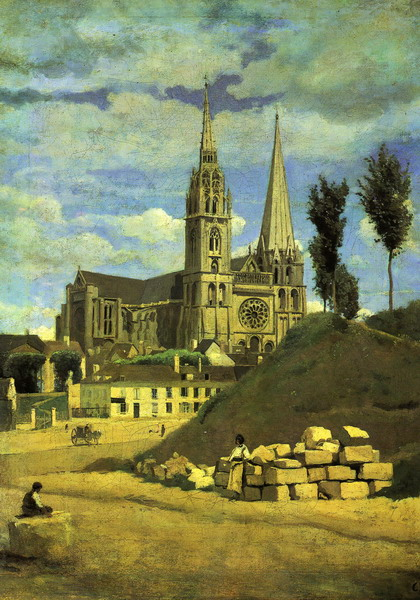
Corot, Chartres Cathedral, 64 x 51.5 cm, 1830, collection of the Musée du Louvre, Paris.
Corot (1796-1875) was another master of the Barbizon School. As early as 1826, he leaned towards natural scenery. In his early period, within the elegant style of Neoclassicism, he moved from poetic mythological landscapes like the morning dance of Nymphs to grand and magnificent natural vistas. After 1850, his works became more introspective. During his lifetime, he was famous for his bright and beautiful landscape paintings, and beyond those, he also produced remarkable figure paintings with a striking indoor, leisurely atmosphere.
This bridge scene is an early work from Corot's stay in Italy in 1826-1827. He very early on tended towards analyzing natural light (as seen clearly in this 1830 painting of Chartres Cathedral). His magnificent and spectacular depiction of the ruined bridge, with its sensitive brushstrokes and bright, warm tones (greens and browns), perfectly renders natural light and atmosphere. If one does not pay close attention, one might even think it is the work of an Impressionist painter. Corot's perception of nature was uniquely insightful, having an enlightening effect on the new aesthetics of the century. Théodore Rousseau of the Barbizon School explained: "In the 1830s, Corot held a revolutionary concept for French landscape painting and was a major pioneer." Light had long penetrated Corot's canvases; bright, luminous color became the core of painting, thus heralding a new, imminent aesthetic.