Daniel Buren – The Brilliant "Eccentric Wheel" Monumental Exhibition
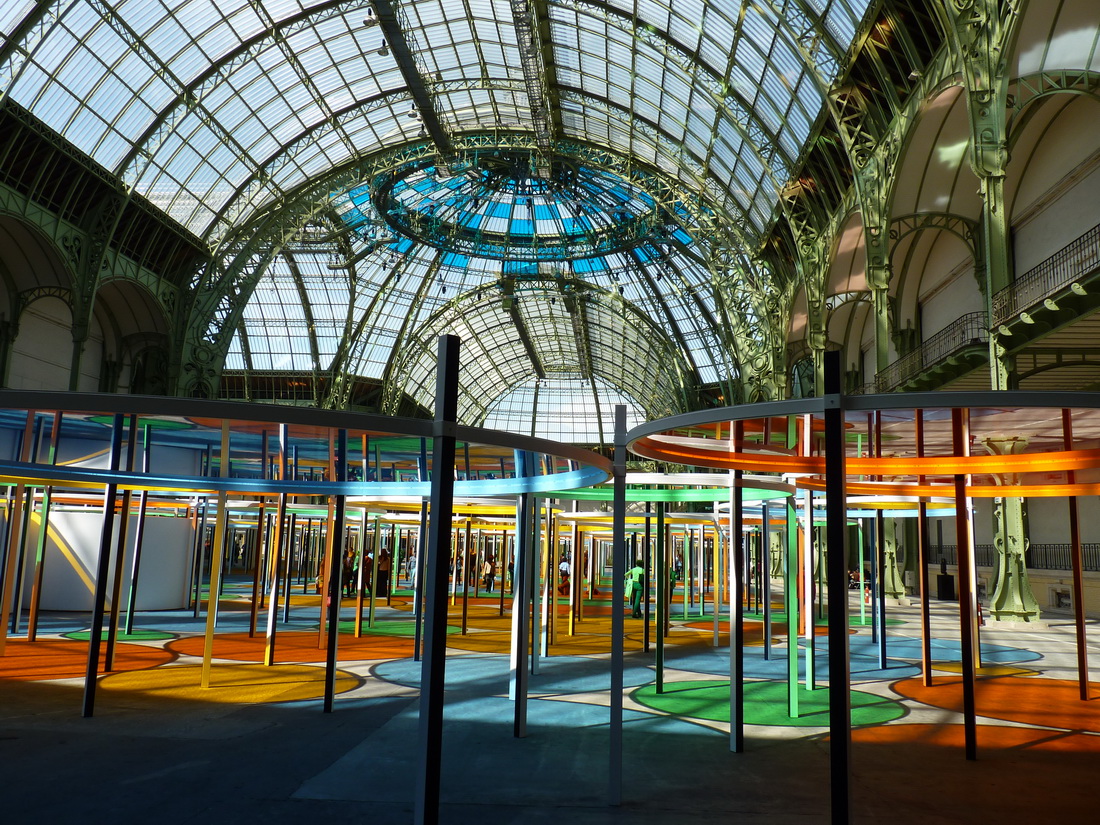
The brilliant "Eccentric Wheel" monumental exhibition - A majestic view from above
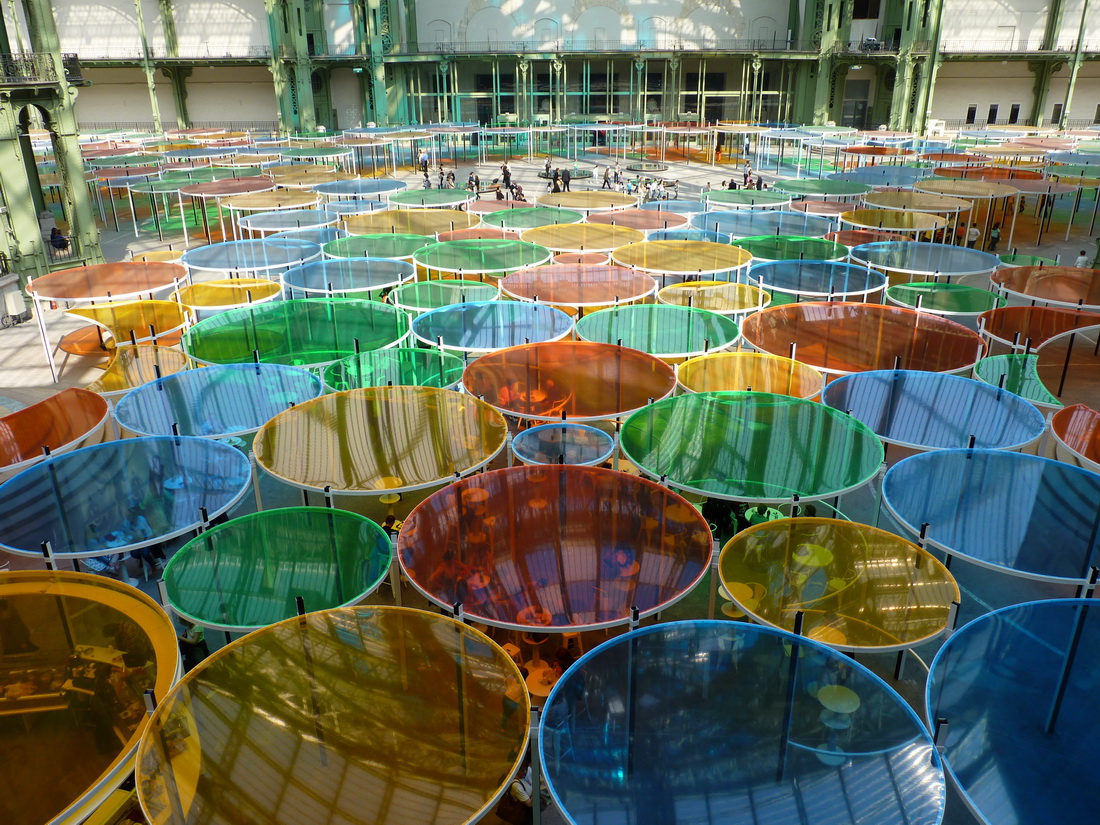
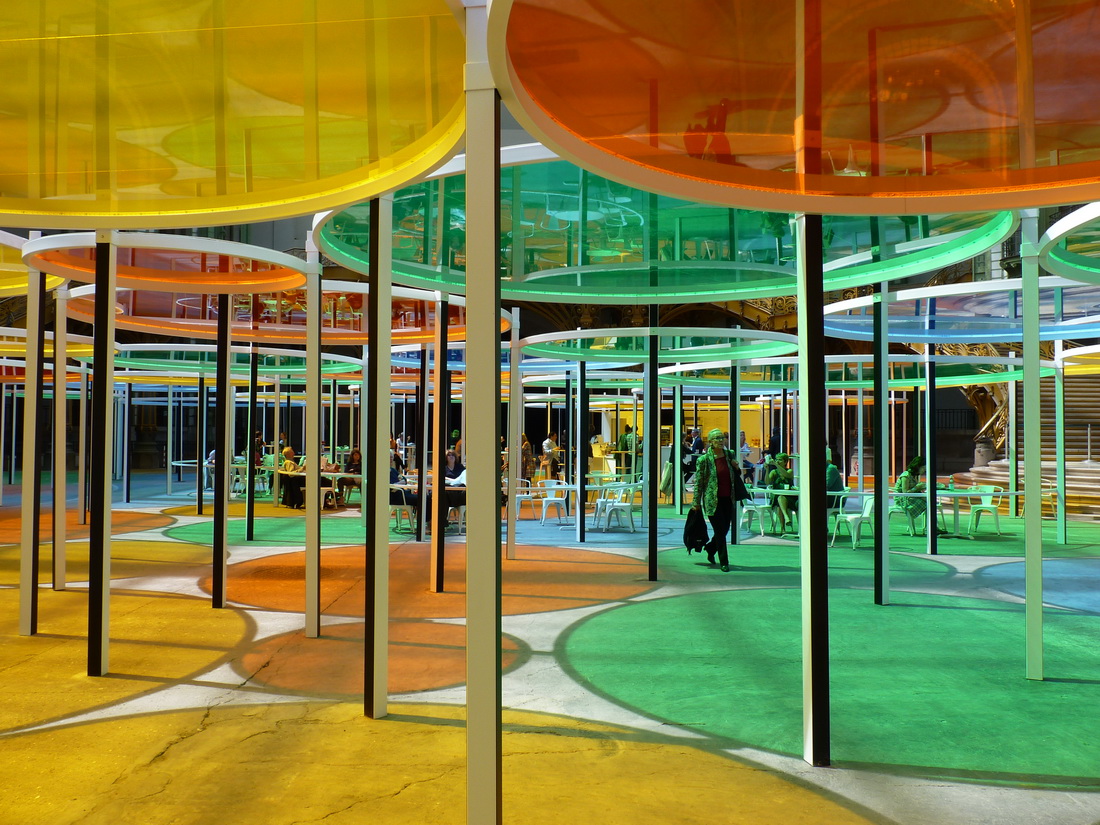
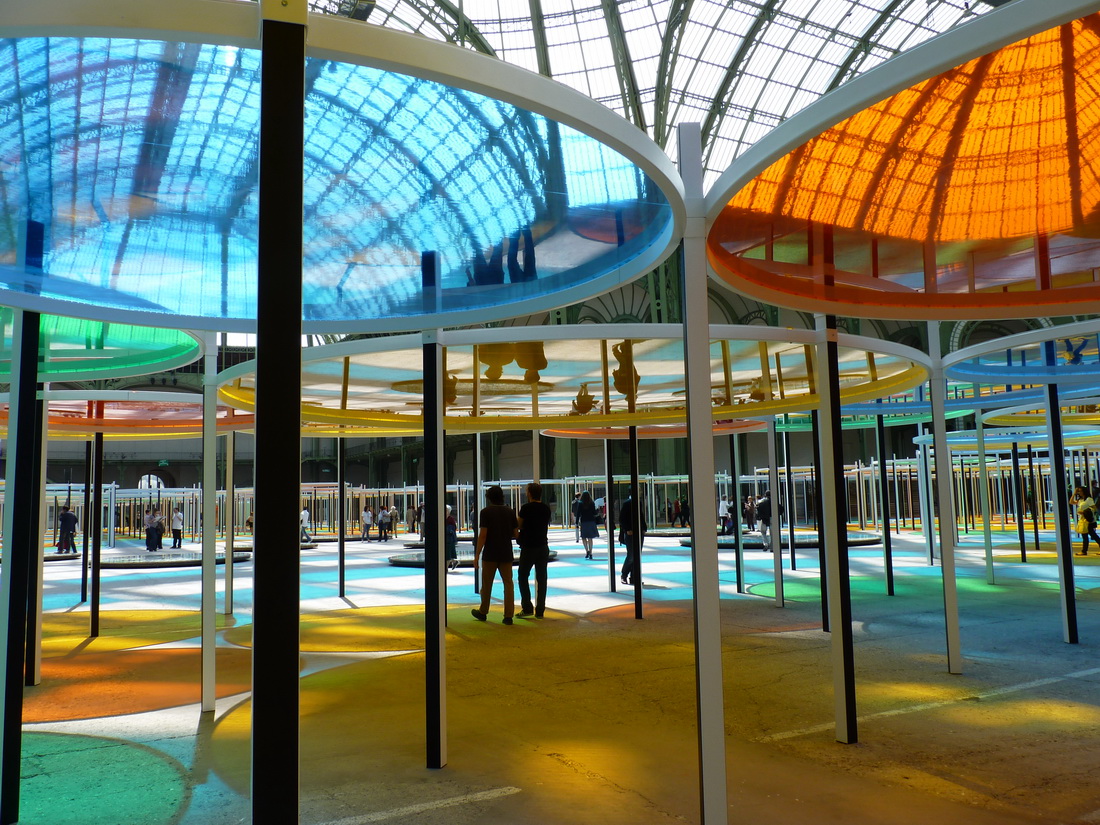
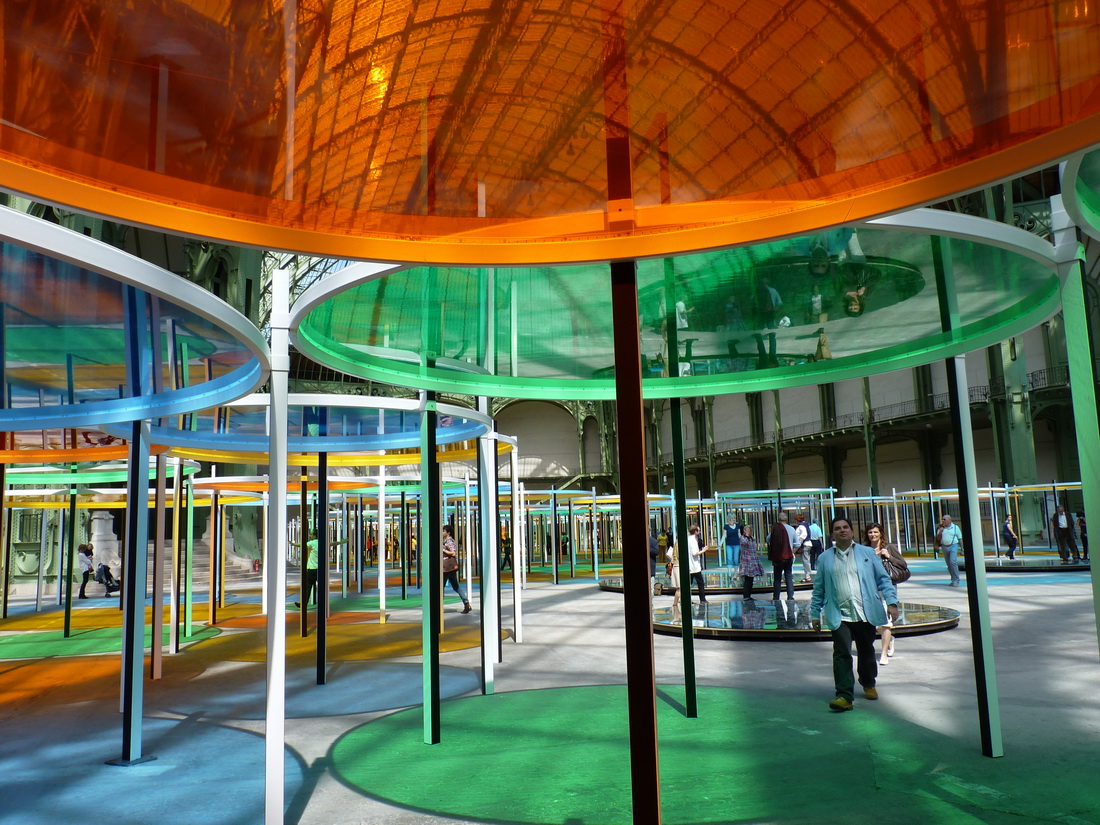
Daniel Buren – The Brilliant "Eccentric Wheel" Monumental Exhibition: May 10 to June 21 – Grand Palais, Paris. By Chen Chi-Hsiang.
Preface: Daniel Buren is one of the most international artists and theorists in contemporary French art, famous for his minimalist vertical stripes of 8.7 cm, which he calls "visual tools." These visual tools function like measuring instruments, revealing characteristic volumes and vocabularies that become the identity and style of his personal artistic construction. Clearly, he is also a master of contemporary "in situ" creation—creating works tailored to space, affirming the effect of the work on its location, changing and transforming the site, and engaging in dialogue with the space. He has never had a studio; under freedom and autonomy, he reveals the meaning of the site, providing a new vision of place and work. The artist believes: "The environment of painting (...) seems more important and rich than the painting itself" (Note 1). What matters is creating, viewing, and experiencing at the location, because Buren’s works cannot be separated from their position; without their established place, the works do not exist. He is the most radical artist questioning art, history, and culture since the 1970s in France, and the most controversial, especially for his black-and-white marble column public art installation in the courtyard of the Palais Royal in Paris in 1985-86, which has now become a tourist attraction for pilgrims to Paris.
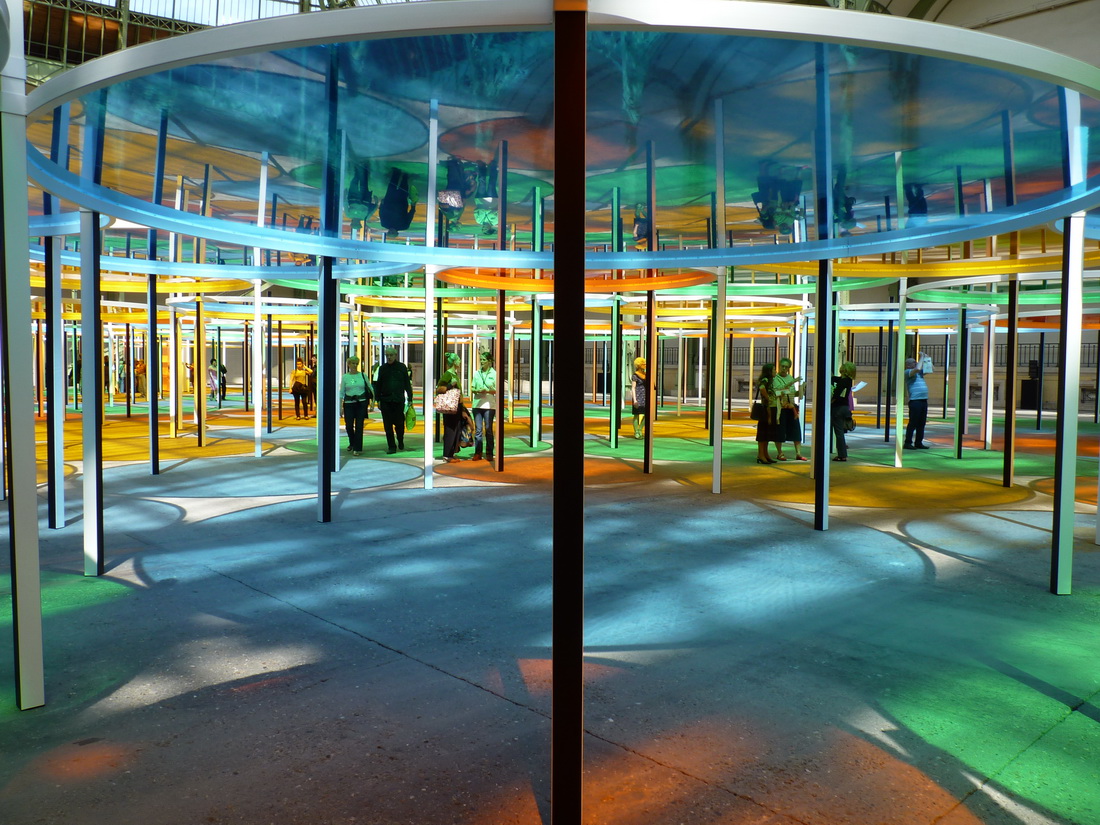
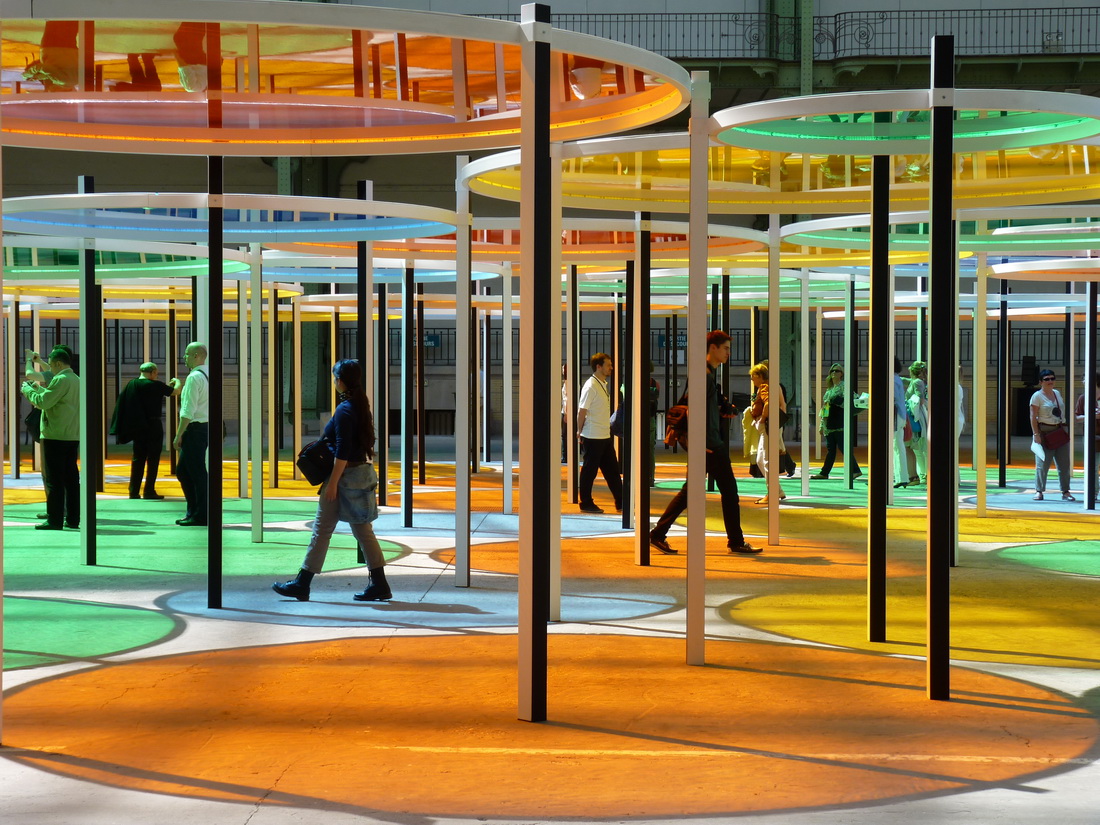
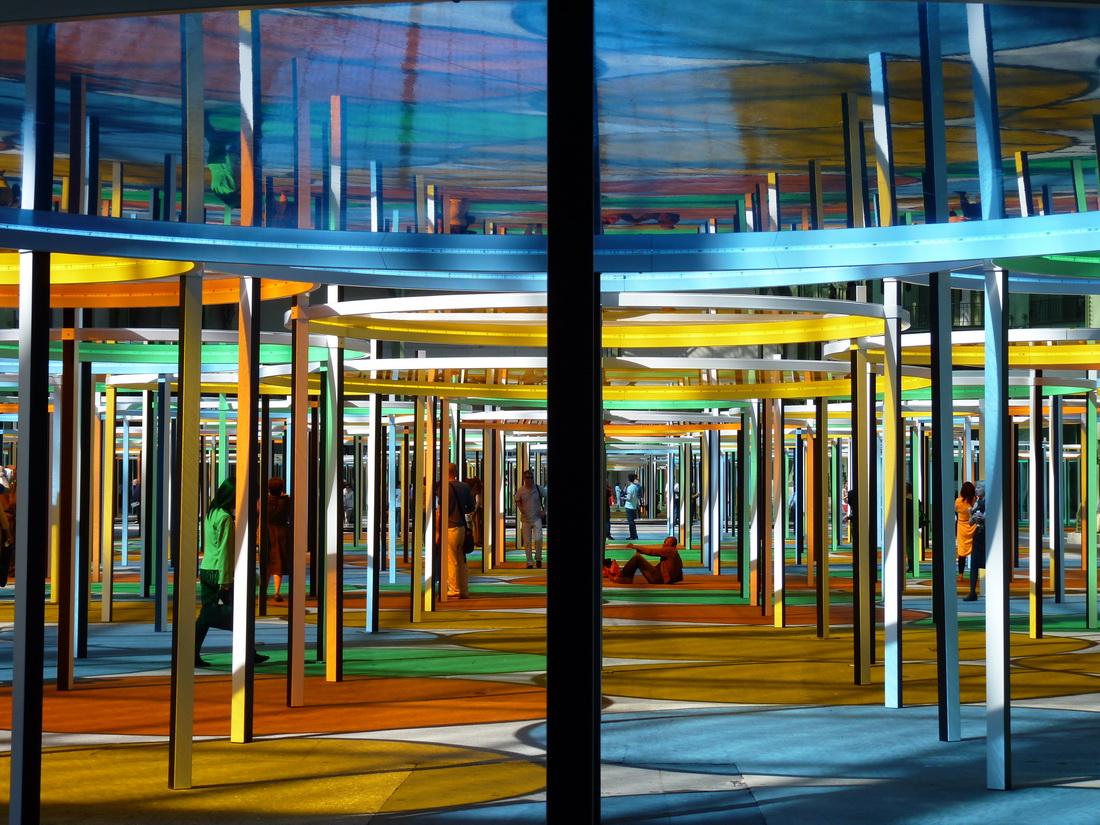
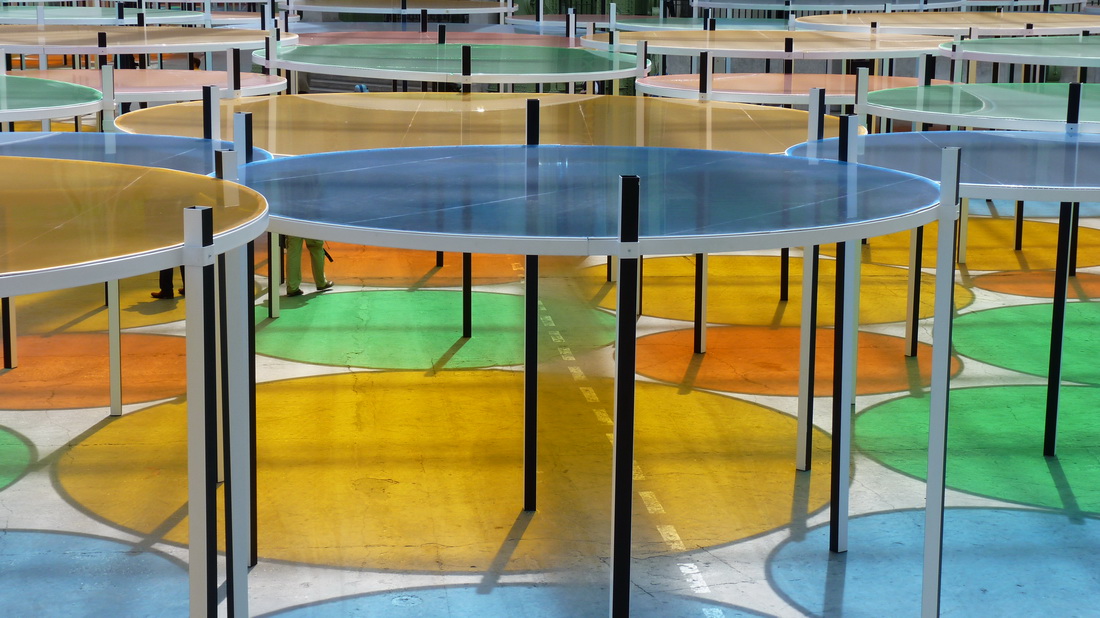
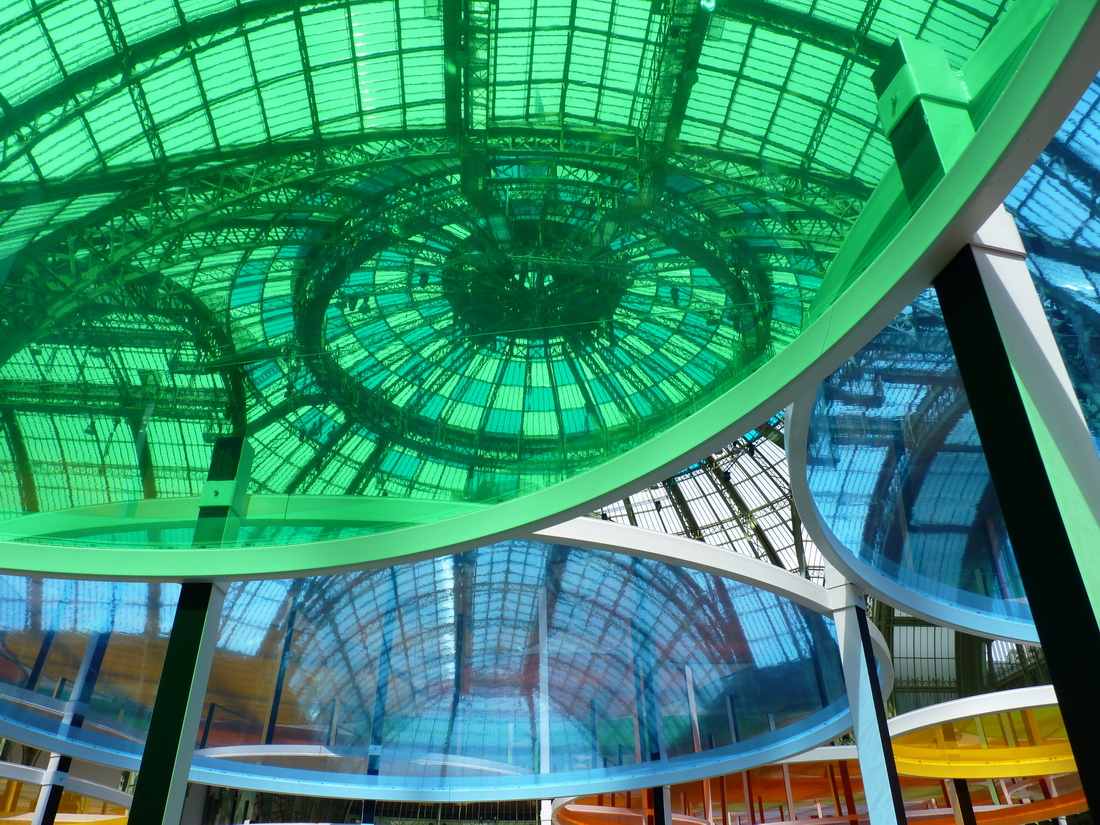
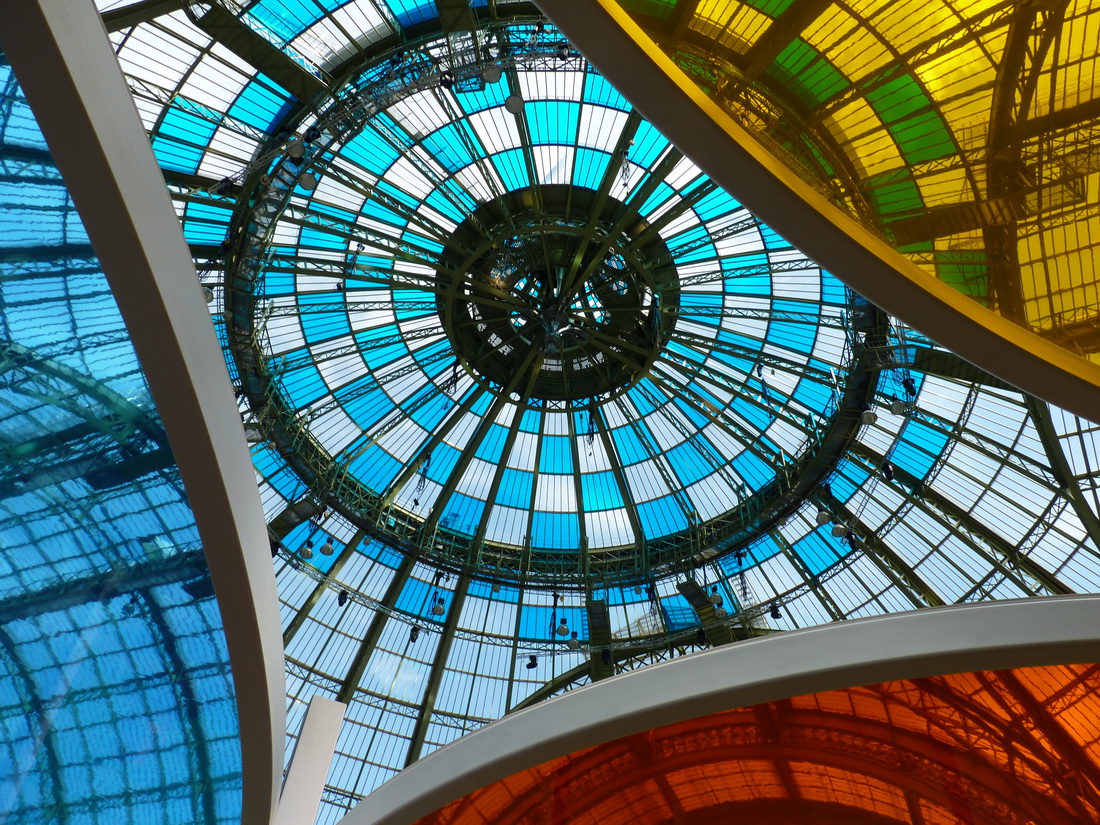
This year’s monumental exhibition is particularly brilliant, with colorful hues becoming the main body. Under the harmonious, perfect, and joyful carnival atmosphere, people are happily bathing in the magic and energy of color. Color awakens people's perception and consciousness, symbolizing the return of spring and the renewal of all things. The overall spatial installation features an asymmetrical lightweight architectural structure, linking together large and small pieces into a mesmerizing sea of colors. Each eccentric wheel pavilion is monochromatic, both decorative and abstract, confusing yet delightful. During the day, the works dance to the rhythm of natural light through the transparent glass of the Grand Palais; at night under the starry sky, they take on a unique atmosphere under artificial lighting. This year’s special exhibition is different; for the integrity of the works, the entrance was changed to the north entrance near the Champs-Élysées, entering a huge space. Color, light, volume, mirrors, sound, and field allow the audience's body and mind to quickly bathe in the brilliant colors, contemplating and walking in an extraordinary visual maze, merging with the artworks and the Grand Palais as one.
Artist Daniel Buren: Born in 1938, Buren early on affirmed "painting zero degree," resolutely adopting this unique vertical line as his personal pictorial semiotic form language starting in 1965: 8.7 cm vertical lines (black and white or other colors), which he called "visual tools." He wrote: "I explore a visual solution, close to what I describe as 'zero-degree painting.' When I went to the Saint-Pierre market, I found these straight-lined fabrics. I bought them, and in one glance, she possessed all qualities, which I hadn't found in my work" (Note 2). This exploration is similar to Stella but does not influence Buren expanding the scope of his art. In 1967, he co-founded the most revolutionary "BMPT" group with Mosset, Parmentier, and Toroni. Buren used this visual tool to construct various forms, organize space, making vertical lines his most basic vocabulary element, rejecting traditional painting as objects exchanged in capitalist society. Buren is interested in the space of each exhibition, where he establishes the site and constructs works according to the space, which he calls establishing position (in Situ).
These vertical lines, whether black-and-white, red-and-white, blue-and-white, yellow-and-white, or green-and-white, are applied freely on various supports: canvas, wallpaper, plastic sheets, glass panels, wooden boards, walls, floors... etc., incorporating space into a striking spatial attribute. Generally, he constructs his work within the realm of art institutions such as museums, art centers, or galleries, exploring problematic artworks and their own limitations, in a dialectical relationship between aesthetic codes and display spaces. For Buren, museums and galleries are a systematic inquiry into historical conditional systems; they establish products and accept artworks. Their manufacturing and arrangement methods, their main installations and displays. This operation becomes the dominant concern of art production itself, and the core of Buren's creation.
Buren explores the problem of display; what results from display involve the sites he chooses: galleries, museums, public places, any indoor or outdoor spaces, etc. This exploration brings about a re-determination of the artwork. For example, in March 1970, he pasted his iconic straight lines like posters in 130 Paris Metro stations, questioning the nature of art and the conditions of the work. In 1971, invited to participate in the Sixth International Art Group Exhibition at the Guggenheim Museum in New York, USA, Buren exhibited a giant black-and-white vertical striped piece (20 meters long by 10 meters wide) hanging in the museum atrium. At the opening, some artists (minimalists Flavin and Judd) demanded the organizers remove Buren's work because it was too eye-catching, causing surrounding works to lose their luster. Perfectly establishing space allows the realistic visual of the work to produce an excellent dialogue with the environmental space, thus allowing the pictorial surface in architectural space to be seen similarly to sculpture.
In 1972, participating in Documenta V in Germany, with the consent of the exhibition organizers, Buren covered the entire exhibition space with two types of white vertical lines, while hanging works by American minimal artists: Bruce Nauman, Robert Ryman, and Sol LeWitt on these walls. In this lowest visual homogeneity, Buren's work became the support and decorative background for other works, blending in with them. Famous American art critic Benjamin Buchloh wrote: "Buren's work adds surface (vertical lines) to architectural surfaces, without factually changing those elements; it enters the reasoning determined by tradition as decorative." He continued to comment: "However, displaying this beautified decorative function is actually a Marxist perspective in art, intended to make people forget. Buren 'publicly' operates this according to his inherent terminology, 'ideological domination, the artist's intention to construct is through all disguises'" (Note 3). So! For Buren: "Art, that is to say, is uniquely political, an analysis of form and cultural categories that must be so (not either/or), in which art exists internally and dialectically" (Note 4).
In 1974, participating in the MoMA group exhibition "Contemporary Artists," Buren not only constructed his work in the museum but also pasted these vertical lines on private shop windows in SoHo and large public advertisements, and hired people to carry his visual tool signs wandering on the streets. Art is like advertising, emphasizing dissemination and communication; this anonymous semiotic image is no longer the darling of art lovers but belongs to the general public, completely from the standpoint of Marx's "production and distribution." Buren believes: "Between art and the world, between art and essence, the difference is that the world and essence are perceived in real (physical, sensible, and intellectual) actions. That visual art is a fact involving the artist's view of the world. However, it involves the product, art—that is, what is seen by the 'consumer'—is such a precise fact, its proposal is arbitrary (despotic), the deformation of facts expresses the individual's view of the world through personal needs. So! It is not the expression of fact, but the making of such a reality illusion" (Note 5). In 1975, at the Van Abbe Museum in Eindhoven, Netherlands, with the theme "Inconsistency and Coordination," and in 1976 at the Brussels Museum in Belgium with the theme "Resurrection," each exhibition was an opportunity for thoughtful planning. Buren often worked on abnormal cultural art institutions: internal-external (i.e., inside the museum and outside on the road), walls and (hanging) pictures, sculptural construction, spatial management, works shifting and transforming over time.
In 1977, during the Centre Pompidou Modern Art Museum's special exhibition "Paris-New York," commissioned by Buren with the theme "Color," he created 15 painted vertical striped flag-like works, hung on major monuments in Paris (such as the Grand Palais) or on the roofs of large department stores. People could gaze at these semiotic works through telescopes placed on the walkway on the roof of the Centre Pompidou. These "painted" flag-like planes became facades, presenting perfect painting and three-dimensional objects or sculptures. Critic Buchloh referred to this as "aesthetic functional objects."
During the 1976-1978 Centre Pompidou Modern Art Museum collection exhibition titled "Form: Painting," Buren's five black-and-white vertical striped works were hidden under five masterpiece paintings selected by museum staff: Modigliani, Utrillo, Koko, Duisburg, and Picabia, shaped according to the pictorial format size. People saw nothing, only identifying them through labels next to the paintings, quite conceptual and political. Buren wrote about this "Form: Painting": "Painting, ultimately, can only serve to beautify culture beyond structural, social, and political conditions" (Note 6).
In the 1980s, Buren continued to expand his visual scope and the dialectics of art and politics, from more conceptual to architectural proposals. In 1983, at the Paris Municipal Modern Art Museum's "Point of View or Instrument for Viewing Long Corridors" and the Contemporary Art Museum in Bern, Switzerland, using his most expressive visual tools, he constructed multiple viewpoints "The Great Maze" according to space, a highly sculptural architectural structure where the body becomes part of the work, in his exceptional sense and unconstrained space. In 1984-85 at Rivoli Castle in Italy, in 1985 at Ushimado, Japan, in 1986 at the Musée des Arts Décoratifs in Paris, and the same year, the French Ministry of Culture commissioned Buren to create black-and-white columns for the landscape environment of the Palais Royal garden, and he participated in the Venice Biennale.
In 1991, the Contemporary Art Museum in Bordeaux held Buren's large-scale installation exhibition "Domination-Forecast, Corner Seat as a Space," which is his greatest masterpiece regarding mirror installations. In 2002, the Centre Pompidou held Buren's "in situ" major exhibition. In 2004, Versailles Palace "Effect and Counter-effect"; in 2005, the Guggenheim Museum in New York "Around the Corner"; in 2011-2012, Lisson Gallery in London "One Thing to Another," etc.
Symphony of Light: Light determines all visuals and perceptions, awareness of objects and space, creating atmosphere and feelings just like color. The overall site and work contain light; light becomes the most basic element changing the spatial field, and the site or work will dance along with the light symphony. Of course, through natural or artificial light, it changes or enhances color and formal volume, undeniably and greatly involving people's vision and atmosphere. Buren had long incorporated light into his work. Lighting, the simplest is naturally borrowing natural light, followed by mastering light by setting up artificial sources, or by special lighting, etc. Buren further weaves the symphony of light through some special materials: such as reflective (mirrors), transparent (plastic sheets), semi-transparent (glass), etc., utilizing the attributes of light at every moment to shape light, shadow, form, volume, and space, transforming the work and its environment.
In the brilliant "Eccentric Wheel" Monumental Exhibition, under this huge transparent glass palace, natural daylight provides various possibilities for display expression, creating special spatial fields and atmospheres. Light becomes the symphony of the work and a visual feast. During the day, large and small eccentric circle transparent colored plastic sheets change with the light; when the light is strong, the colors become denser and deeper, simultaneously projecting onto the ground and the audience, forming a colorful, brilliant world, akin to the atmosphere of a happy carnival. When the sun sets or the weather is rainy, the large and small eccentric circle transparent colors appear lighter, the symphony varies into light music, the poetic ground whispers slightly with tones and time, narrating the context of time and space. When night falls, under artificial lighting, akin to the unique atmosphere of myriad lights, the works become even gentler and more poetic.
Mysteries and Melody of Color: Color is the most basic and primary element in visual art; it is the body of plastic arts and the soul of art. Color is people's most direct feeling and perception; it cannot be described but can express unexpressible emotions, possessing a certain ineffable mystery. Buren said: "People cannot transmit color in a very explicit way, just like philosophy and language, music and sound. People can only look at color as it is, because it has a noble personality." He continued: "Art through color, in arranging color, I do not express good or bad taste. I adopt monochrome and its contingency, letting it generate another value, more conceptual" (Note 7). Buren has always favored color, perceiving it quite directly. Although considered heavily decorative, he fully affirms: "In this method, art continuously focuses on its decorativeness" (Note 8).
In the colors of the brilliant "Eccentric Wheel" Monumental Exhibition, Buren uses pale blue, green, red, and orange four-color transparent industrial plastic sheets. These four colors happen to be existing factory colors; the artist accepts these ready-made colors. He said: "I did not choose; I use the only existing transparent colored plastic sheet from the factory. My intention is to make people question color" (Note 9), revealing the magic and mystery of color through contingent placement. The artist said: "I am aware of using color; it involves one of the most basic elements of visual art. It is a precious element that artists can handle and touch; it is a pure way of thinking. It cannot be converted into music, language, philosophy, or anything! It is natural" (Note 10). Using six sizes of eccentric circles, the largest 6.8 meters, the smallest 2.2 meters, cleverly crafted and constructed under the principles of tenth-century Arab mathematics to fill the vast space of the Grand Palais.
Transparent industrial plastic sheets have interesting diverse visuals. When you stand under the pale blue eccentric circle, the canopy of the Grand Palais becomes a pale blue world; when people are under the red pavilion, the world becomes red; under green, everything turns green naturally. This means: "Whatever eyes you use to see the world, the world presents itself according to your eyes. Obviously, everyone creates their own reality." Transparent industrial plastic sheets also have a mirror effect; we not only see confusing colors but also see the reflections of audiences walking among them. In this constructed complex maze of diverse visuals, shuttling between reality and illusion, fantasy and dreams, reality and imagination, space and imagery.
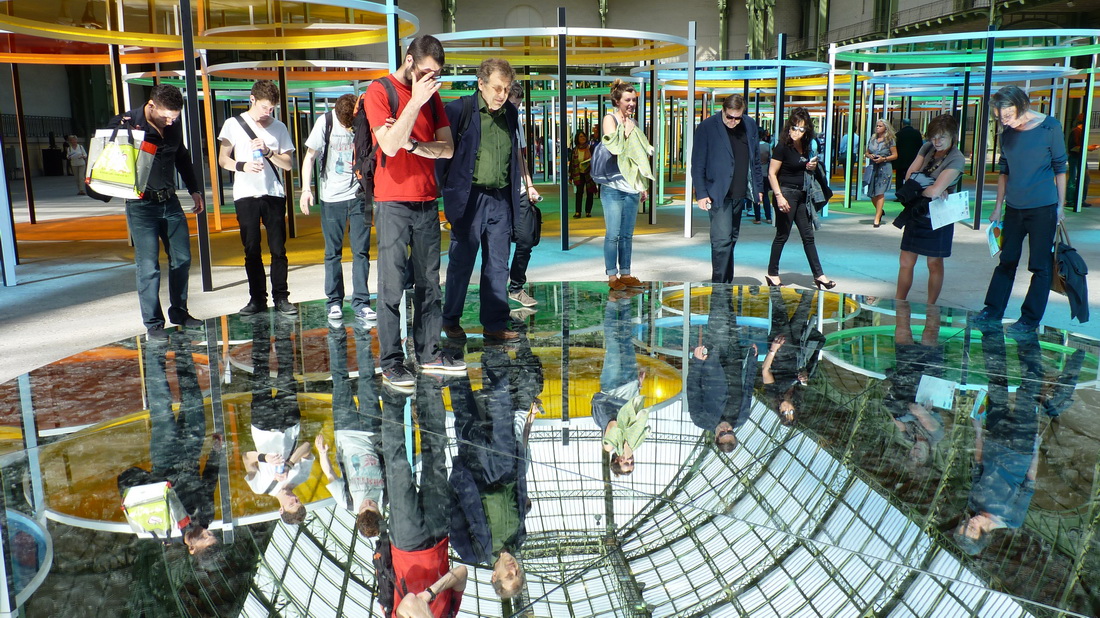
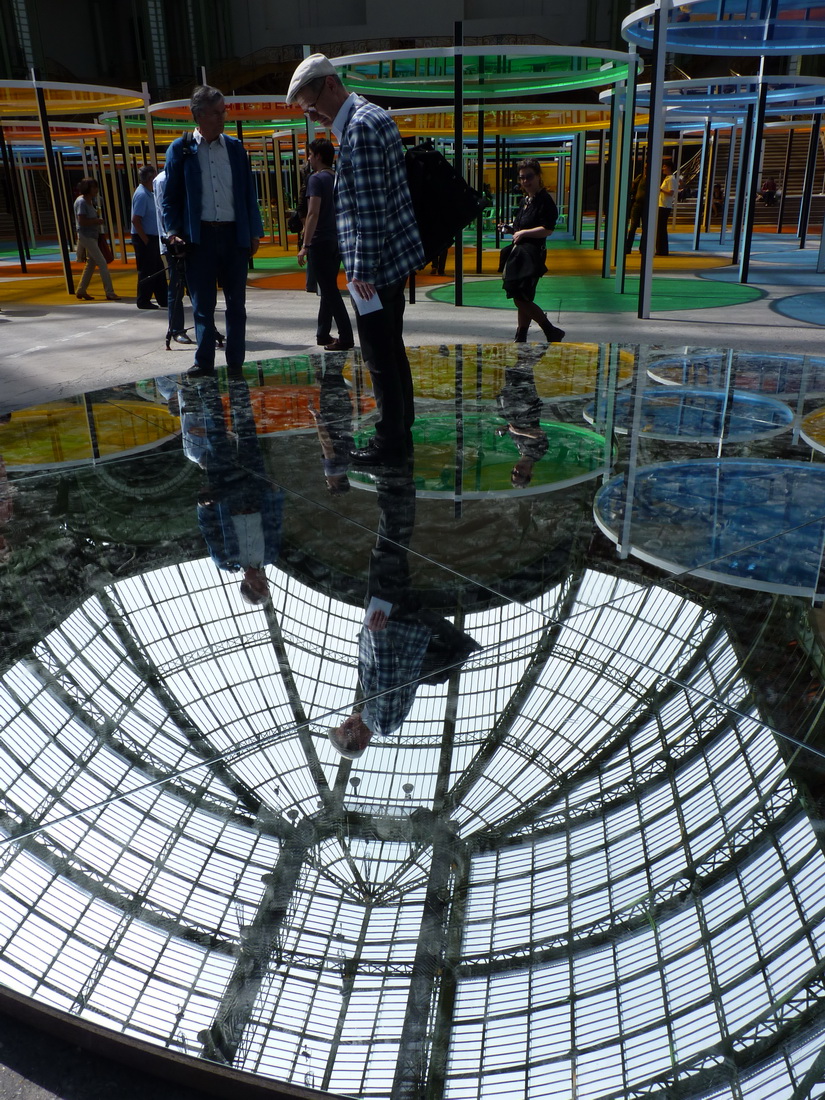
Dramatic Third Eye "Mirror": Mirrors have long been a space for painters' whimsical ideas, intending to express the realm beyond the realm, highlighting metaphysical space. Many artists in the twentieth century were fascinated by the problem of real mirrors, exploring extraordinary visuals and dramatic spaces, especially mirrored reflections. Buren frequently questions how to view works? Is it the work itself that attracts people's attention? Or its surrounding environment? Viewing one site from another? Viewing through windows? Is a window a painting? Viewing through mirrors? Seeing is diverse and varied, depending on various conditions. He calls mirrors the "third eye"; mirrors expand the visual field, allowing people not only to see what is in front but also behind, providing another way of seeing with dynamic methods and dramatic visuals and spaces. The artist says: "There is no particular ambition, only to reveal these novel things, the only possibility is mirrors. I would also say mirrors have never had any comparison; what they show are usually other things. Moreover, they transform space and allow seeing more and different visuals" (Note 11).
In the brilliant "Eccentric Wheel" Monumental Exhibition, unexpectedly, Buren placed nine large and small eccentric circle mirrors on the ground in the center of this sea of color pavilions, the largest 6.8 meters, the smallest 2.2 meters, brilliantly reflecting and mirroring the spatial field of the exhibition, as well as the scenery of people walking around. When people approach (without looking up), they can clearly see the huge (blue-and-white rhythmic) canopy of the Grand Palais and the overall steel and glass structure, peeking at the huge palace structure and surrounding pavilions from different viewing angles as the audience moves. Besides, inviting audiences to step onto the large mirrors, the dramatic Grand Palais is stepped on by people's feet, expanding extraordinary visuals and theatrical spatial fields, also constructing a psychological space. Audiences seem to feel fear or acrophobia crisis of stepping high on the big glass palace, in virtual and real, physical and psychological, perception and imagination, having a unique feeling.
Revealing the Unseen Sound: Sound is a listening language revealing unseen perceptions. In twentieth-century plastic arts, there existed novel explorations, especially from Italian Futurism, through Dadaism to the audiovisual combination of video art in the 1960s and 70s, until today, more young artists have invested in this direction of exploration. Buren's exploration of sound started from his debut. In 1967, with his BMPT partners, when exhibiting at the Young Artist Salon, they made paintings on-site at the venue, while a loudspeaker repeatedly recited in three languages: "Buren, Mosset, Parmentier, Toroni suggest making you smarter." Clearly, painting no longer satisfied young artists; speaking directly to the audience was incorporated into the work. Sound is not just reading or reciting, but also singing out feelings with music. In the 1982 German Documenta VII, Buren's "Garland" work accompanied classical music fragments chronologically from Purcell to Offenbach. In 2002, at the Centre Pompidou's "Closed Cabin: Urban Rumors" environmental space installation exhibition, it was no exception.
Now in the brilliant "Eccentric Wheel" Monumental Exhibition, Buren once again accompanies this environmental space installation with a soft voice, placing one loudspeaker in the center and one on each left and right edge. Walking in this pleasing audiovisual field, if you are careful enough, you will hear light and pleasant sounds coming from afar, repeated in 37 different languages. On the left, people will hear numbers (1, 2, 3) being narrated; in the middle, they will hear the soft melody describing the four colors (blue, green, red, orange) in this exhibition; when you go to the right, you will hear the repeated narration of letters (A, B, C). Sound becomes Buren's novel fourth-dimensional spatial field, achieving bodily and mental liberation between sight and hearing, rhythm and rhyme, perception and meditation.
Note 1: Referencing Daniel Buren – Brilliant "Eccentric Wheel" Monumental Exhibition Press Release, Jean-Marie Gallais "Some Important Concepts" Article P6. Note 2: Studio Without Walls, by Jean-Mac Poinsot, published by Art édition Publishing House in 1991 P48. Note 3: French Contemporary Art 1960-1985, published by Larousse Publishing House in Paris in 1986 P160. Note 4: Daniel Buren, Limites Critiques, published by Yvon Lambert Gallery in Paris in 1970. Note 5: Benjamin Buchloh, Essais Historiques II Art Contemporain, published by Art édition in Paris, France in 1992 P68. Note 6: French Contemporary Art 1960-1985, published by Larousse Publishing House in Paris in 1986 P163. Note 7: Referencing Le Figaro May 8th Buren Interview, Reporter Valerie Duponchelle, P36. Note 8: Referencing Daniel Buren – Brilliant "Eccentric Wheel" Monumental Exhibition Press Release, Jean-Marie Gallais "Some Important Concepts" Article P8. Note 9: Referencing Le Figaro May 8th Buren Interview, Reporter Valerie Duponchelle, P36. Note 10: Daniel Buren Studio, by Mrion Chanson, published by Thalia Publishing House in Paris in 2007. Note 11: Referencing Daniel Buren – Brilliant "Eccentric Wheel" Monumental Exhibition Press Release, Jean-Marie Gallais "Some Important Concepts" Article P9.