Daniel Dewar and Gregory Gicquel Solo Exhibition
(Top left) The alluring "Granitoid trans goa rascal koi koi" carp (2007). (Top right) "Granitoid trans goa rascal koi koi" fortune truck (2007). (Center left) Monumental Shimenawa mamba (2007).


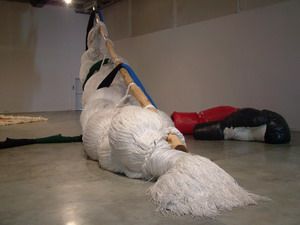
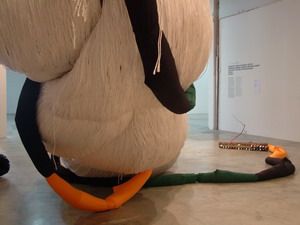
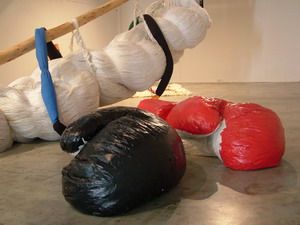
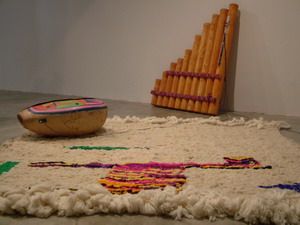
(Top left) The alluring "Granitoid trans goa rascal koi koi" carp (2007). (Top right) "Granitoid trans goa rascal koi koi" fortune truck (2007). (Center left) Monumental Shimenawa mamba (2007). (Center right) Dragon of Shimenawa mamba (2007). (Bottom left) Boxing gloves of Shimenawa mamba (2007). (Bottom right) "carpet and digital projects for musicians" (2007). Daniel Dewar and Gregory Gicquel's solo exhibition "Sculptures, Tuning, Hand-mades abd Haikus" is on display at the Palais de Tokyo Contemporary Art Museum in Paris from March 22 to May 6. It is a distinctive exhibition within "News from the upside-down," and currently the most dramatic one in Paris. Daniel Dewar and Gregory Gicquel are among the most representative contemporary artists from Peru, South America. Their unusual works, spanning sculpture, folk crafts, industrial objects, and installations, along with magnificent images and dramatic spatial scenes, lead the audience into a world of poetry and extraordinary imagination. Their creation is rooted in the imaginative sources of primitive art and South American Maya folk art, as well as contemporary industrial design, striving to develop a comprehensive artistic connection between folk art and contemporary art, constructing works that bridge handcraft, industry, art, design, popular culture, and conceptualism. Daniel Dewar and Gregory Gicquel address these issues and establish systems of extraordinary transformation, using traditional and modern materials and media with excellent craftsmanship to create works that completely defy expectation, shaking up existing conventions in contemporary sculpture.
This solo exhibition features three major works: First, "Granitoid trans goa rascal koi koi" (2007), carved from over ten pieces of pink granite of varying sizes, featuring a decorative carp on one side and a fortune truck image on the other, stacked and constructed within the realms of craft and sculpture, filled with extraordinary imaginative imagery rich in social and cultural metaphors. The most striking piece, "Shimenawa mamba" (2007), is a monument-form object installation occupying the core of the exhibition space, woven from white synthetic fiber threads into bundles of regular and irregular shapes hanging from large wooden beams suspended from the ceiling to the floor, with blue, black, and red lines wrapped around the beams, forming an unusual image. On the ground to the left, extending from the blue and black lines on the beam, is a cleverly crafted object resembling a "dragon" – a sculpture made of fabric, wood, iron, and branches. To the right, a pair of oversized boxing gloves in red and black creates unexpected combinations of imagination and magic, culture and symbolism, primitive and modern, material and form. Another distinctive work, "carpet and digital projects for musicians" (2007), features a tall pan flute (composed of a series of rhythmic wooden mallets) leaning against the wall and two ocarinas (egg-shaped wind instruments), one resembling a cicada painted with traditional Peruvian patterns, and the other bird-shaped, surrounded by a traditional Peruvian cotton carpet (featuring a giraffe image). These three instruments are connected by wires, playing the youngest electronic music within folk craft traditional imagery, truly unimaginable; in the postmodern world, nothing is impossible.