Dancer Bowing to the Audience — Edgar Degas
Bowing to the Audience, pastel, 58×42 cm, 1876–1877, held at the Musée d'Orsay, Paris. In this work of a dancer bowing to the audience, Degas adopts an unusual high-angle viewpoint from his seat in the top-tier box.
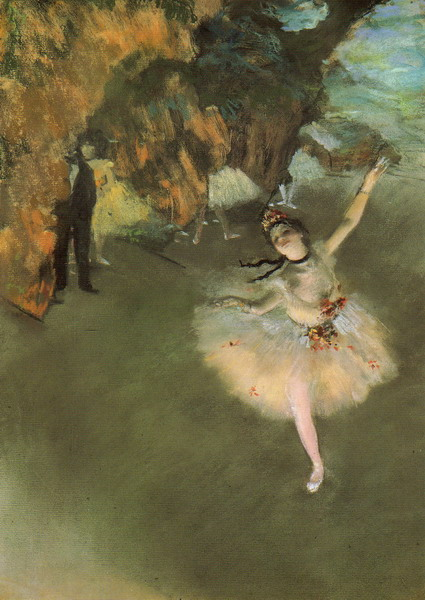
Bowing to the Audience, pastel, 58×42 cm, 1876–1877, held at the Musée d'Orsay, Paris. In this work of a dancer bowing to the audience, Degas adopts an unusual high-angle viewpoint from his seat in the top-tier box. Here, Degas carefully depicts the dancer bowing to the audience. Her bright and cheerful face, hands extended in a gesture of respect, and transparent, light dance skirt, through the contrast of forms between the foreground and the diagonal background, reveal the stage space; figures in the scenery (sketched with just a few strokes) are thus immersed in the soft glow. Degas stated: "People call me a painter of dancers, but they do not understand that dancers are merely my interesting pretext. The important thing is to capture fleeting light and form in an instant to express their physical movements and emotions." Clearly, the subject depicted was merely a means for Impressionist painters, not their ultimate goal.
From Degas's and other Impressionists' numerous images and compositions, there is a significant relationship with photography of the time. In this modern era, Impressionist painters began to extensively borrow photographic imagery and composition techniques, as seen in this work, Bowing to the Audience.