Bacon (F. Bacon) - Three Figures in a Room
Three Figures in a Room, each 198×147cm, 1964, Centre Pompidou collection. Image from www.Centre Pompidou.com
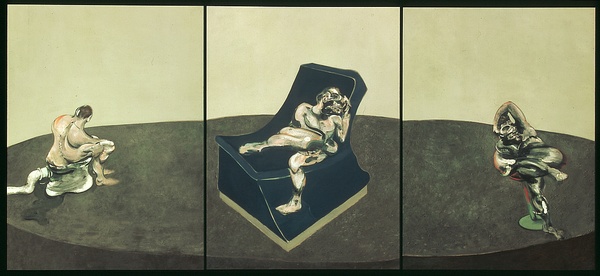
British painter Francis Bacon (F. Bacon, 1909–1992) was the most prominent figurative painter of the post-war era. Influenced early on by Surrealism, he thoroughly distorted and deformed the human image through Picasso’s influence, extracting something entirely irrational from his subjects. In the myriad aspects of life, he dramatically presented existential anxiety and unease. This intent wanders between figuration and abstraction, often expressing continuity through juxtaposed images.
Bacon’s triptych format began with his early work Study for the Base Piece of Crucifixion (1944), becoming a signature form for his paintings. The juxtaposition of three independent works provides three different perspectives. After interpreting Velázquez’s portraits and Van Gogh series in the 1950s, Bacon returned to painting self-portraits and friends in the 1960s. Like this triptych, unified by the imagery of a large oval pedestal forming a vast space (a room), each panel depicts a modern figure filled with unease and anxiety. On the left, a naked body sits heavily on a toilet (portrait of friend Diego); on the right, a figure sits twisted on a bench, scratching behind their back with their left hand (painter friend Firth); in the center, an impatient body lies on a heavy dark blue sofa, expressionless, with a nervous hand near the mouth as if screaming or wailing—this is Bacon’s own self-portrait. Bacon wrote: “Distortion can sometimes make the image more powerful... If we want to transform the feelings and sensations of life, this is the only way we can.”