Bacon (F. Bacon 1909-1992) - A Representative of Post-War Figurative Painting
Study of the Human Body 198x147.5cm 1982 Collection of the Centre Pompidou, Paris
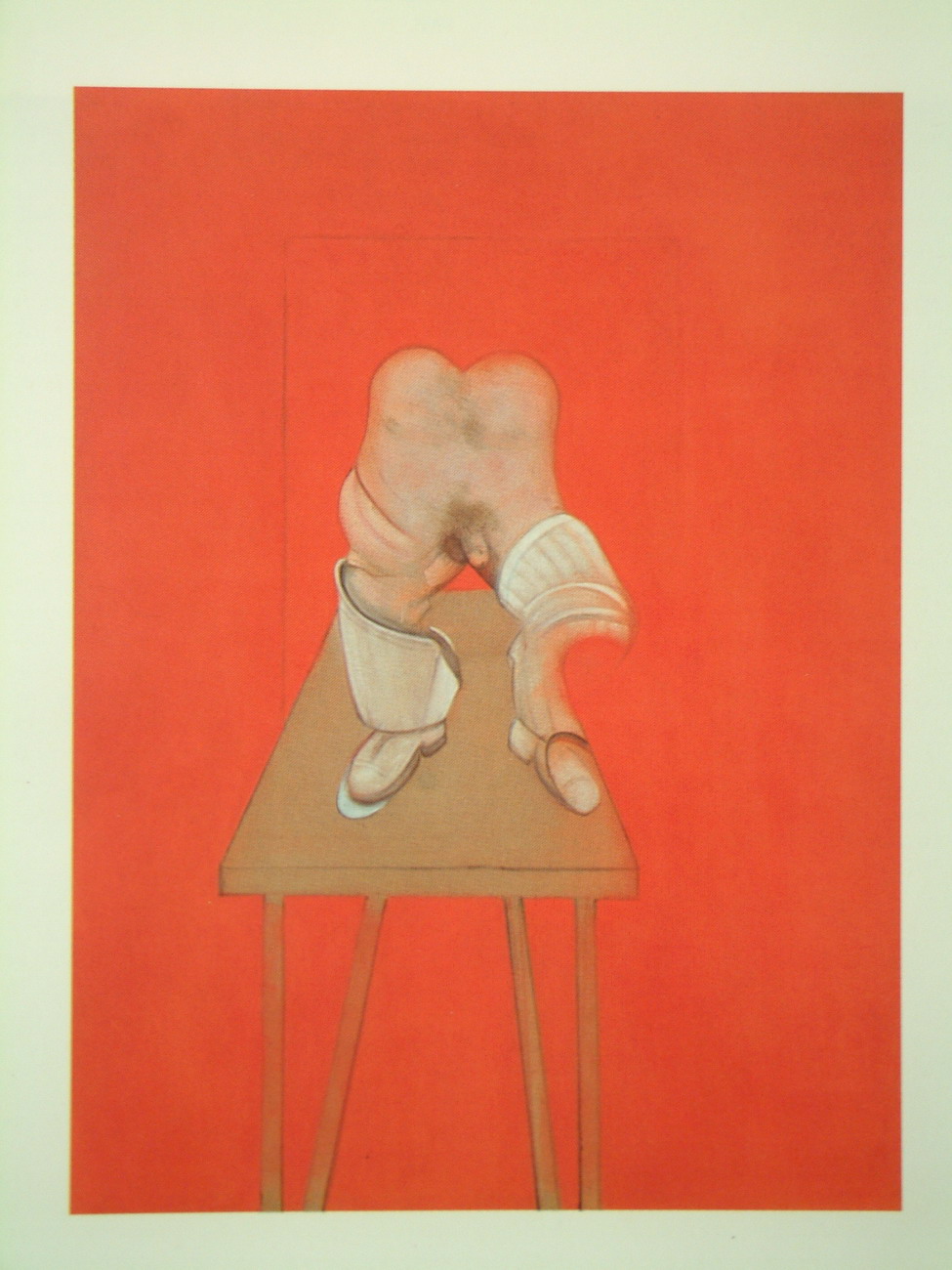
Bacon (F. Bacon 1909-1992) settled in London in 1925. Unlike Balthus, he was a self-taught painter. He lived in Berlin and Paris from 1926 to 1927 and began creating from 1929 onwards. Until 1944, he destroyed almost all the paintings from these more than ten years, leaving only about ten pieces. His first solo exhibition was held post-war in 1949 at the Hanover Gallery in London, thus beginning his professional painting career (earlier, he made a living designing furniture and carpets in London). Subsequently, he went to New York in 1953 and exhibited at the Rive Droite gallery in Paris in 1957. Initially deeply influenced by Surrealism, he later experienced a comprehensive influence from Picasso's works involving radical distortion of human imagery. He sought development in the modeling of figurative organic forms, further extracting something entirely irrational from the subject, as seen in the 1944 triptych "Three Studies for Figures at the Base of a Crucifixion." In these intensely violent and radically altered human images, set against a red background, they exhibit the ultimate existential anguish and sorrow. The juxtaposition of three independent panels into one creates a unique, unified image presenting a dramatic scene. These lonely, extremely unsettling images became Bacon's means of revealing the essence of existence through his subconscious instincts, forming his unique personal temperament and establishing his principal style.
Besides being influenced by Picasso's distortion of human imagery, the main sensual inspiration for his imagery came from the famous 17th-century Spanish painter Velázquez. Bacon held Velázquez in the highest esteem. He reinterpreted Velázquez's masterpiece portrait of Pope Innocent X according to the sensual vision inspired by his own imagery. As early as 1946, the figure in the painting {Slaughterhouse} was an image of the Pope, intuitively revealing that terrified, uneasy aura of death. For Bacon, such extremes lie entirely within the scope of the "Crucifixion." So! Under Velázquez's divine brush, the Pope is unique and sacred. After Bacon's interpretation, the portrait of Pope Innocent X (painted in 1953) becomes terrifyingly uneasy, pained, and sorrowful, pulling the Pope from heaven to hell. The Pope is like a condemned man in the final moment of execution on an electric chair. Later, studies of Van Gogh's portrait, and then deep investigations into portraits of himself or friends around him, all utilized photographic references, extracting from the images something entirely irrational. As Bacon said: "For instance, a portrait, a portrait of someone, when I analyze it carefully, I cannot tell—or it's hard to recognize—so I don't know how the form can be painted, because the image hovers between the figurative and the abstract; it emerges from the abstract, yet is completely unrelated to it. It is a more intense, more violent attempt to bring the figurative to the nervous system" (Note 1).
From the establishment of the style in "Three Studies for Figures at the Base of a Crucifixion"—through the 1950s variations on Velázquez's portrait of Pope Innocent X, via the turbulent Van Gogh, to self-portraits and satirical portraits of friends—he continued in subsequent years to present strongly distorted, twisted images of lonely, innocent figures in the spatial forms of everyday life, or frank, contorted portrait figures. In these portrait works, a unique composition of rough brushstrokes creates a dynamic texture, making the contorted facial expressions more vivid and lively, breaking away from the stiffness of traditional portraiture, and presenting them dramatically in triptychs or series: for example, the portrait of George Dyer on a Bicycle (1966), Woman Emptying a Bowl of Water and Paralytic Child on All Fours (1965), portraits of George Dyer and Lucian Freud (1967), Study for a Bullfight (1969), etc. In these pictures, we see bicycles, interior scenes, a kitten, bullfights, and crowds outside the window, etc. The unified imagery of the new crucifixion triptychs frequently reappears, such as Three Figures in a Room (1964), Triptych–Crucifixion (1962), Study for a Crucifixion (1962), etc. In these new triptych images, they are no exception, becoming even more solid, clear, and in some aspects, more agitated. These distorted figures cower in rooms with dazzling, flickering light, suggesting not only luxurious residences but also human torture-chamber-like bedrooms. These figures are not only lonely but also destitute; even the few disguises they have left are stripped bare (Note 2).
Later, he incorporated organic geometric forms to structure the space within the clear figurative imagery. Within a rigorous structure, he expanded the planar visual lines through the projection of lines, color fields, and the shadows of bodies. For example: Self-Portrait (1972), Figure at a Washbasin (1976), or most works from the 1980s are no exception, focusing on rigorous pictorial treatment, more concisely incorporating the imagery of the subject figure into points, lines, and planes, unifying the body and space, or using spatial isolation to cut off narrative. Capturing time from static images is all part of Bacon's unique painting style. He believed that a picture has its own complete life; it lives autonomously, just like the imagery we often try to capture: it lives autonomously. Only thus can it more profoundly convey the essence of the image. Thereby, the artist can reach the key to inspiring sensibility, thus more violently bringing the viewers back to life (Note 3).
(Note 1): Conversations with Bacon, by David Sylvester, translated by Zhang Zhenyu, Modern Art No. 35, published by Taipei Fine Arts Museum. (Note 2): Reference Post-War Visual Art p. 66-67, by Edward Lucie-Smith, translated by Li Changjun, published by Continental Bookstore. (Note 3): Reference Conversations with Bacon, by David Sylvester, translated by Zhang Zhenyu, Modern Art No. 35, published by Taipei Fine Arts Museum, p.26.