Francis Picabia - "Cacodylic Acid Eye"
Cacodylic Acid Eye 146×114cm 1921 Collection of the Centre Pompidou Museum of Modern Art
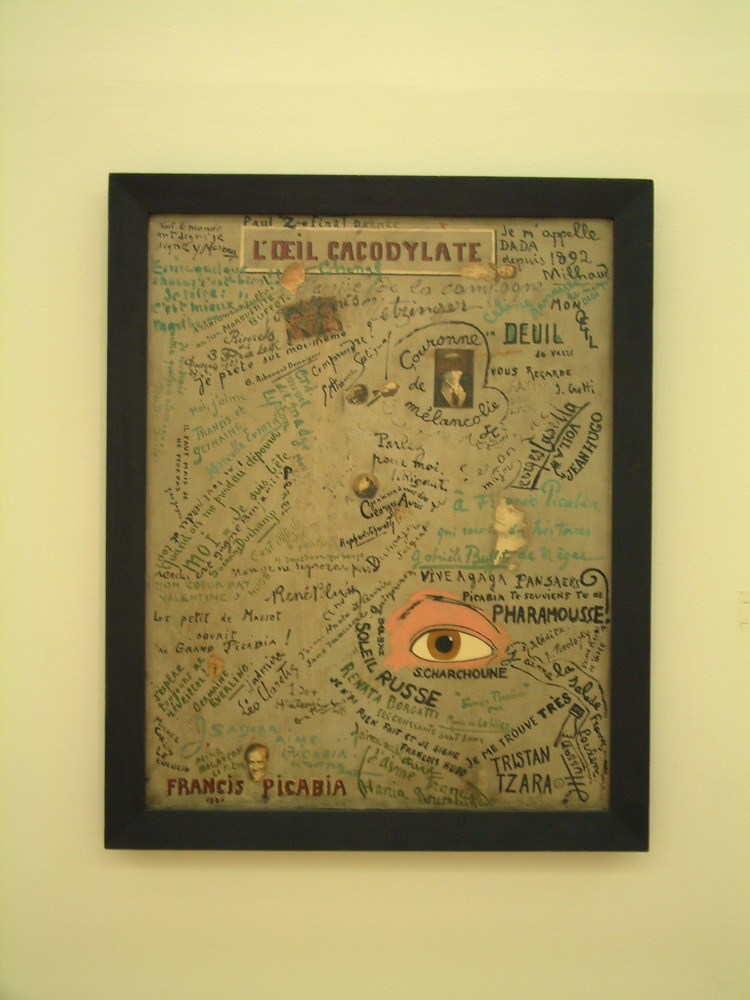
"Since the beginning of this century, all this so-called art... including these significant sequential interruptions, this particular art, despite the words of anti-art or non-art, more or less implies these painters, poets, musicians. That Francis Picabia is the most representative figure of the new century's spiritual outlook." Francis Picabia (1879–1953), a French artist, was initially influenced by Cubism and later moved beyond it to become one of the pioneers of abstract art. He participated in the Dada movement, becoming one of its most representative radicals, soon left Dada, and moved closer to Surrealism, demonstrating multiple artistic styles (abstract, figurative, non-figurative) throughout his life.
This is Picabia's epoch-making representative work from his Dada period. Within the ontology of lyrical literature, Cacodylic Acid Eye is purely a play on words; the entire picture is filled with short phrases considered vulgar or in poor taste, such as "I am Dada," "Long live excrement," "Russian sun," "sorrow," "signature," etc., each unrelated to the others. Among them is a large eye and a self-portrait of the artist. The title is written properly in printed characters, prompting the question: if this is a painting, what are the conditions for a painting? A painting of words, perhaps! But whether it is a painting of words or a painting of images—it is undoubtedly a painting. The transformation of concepts for a new era begins precisely here.