Lippi (Fra Filippo Lippi, ca. 1406–1469) — The Banquet of Herod (ca. 1464)
The Banquet of Herod (ca. 1464), approximately 4 meters 5 centimeters long, fresco, Cathedral of St-Etienne, Prato. He is one of the most representative painters of the early Italian Renaissance, and was the teacher of the famous painter Botticelli. In his early period he was deeply influenced by Ma
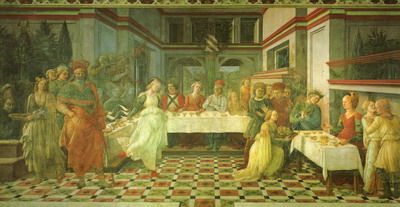
The Banquet of Herod (ca. 1464), approximately 4 meters 5 centimeters long, fresco, Cathedral of St-Etienne, Prato. He is one of the most representative painters of the early Italian Renaissance, and was the teacher of the famous painter Botticelli. In his early period he was deeply influenced by Masaccio and Angelico (who was Lippi's renowned master), and later by the sculpture of the famous sculptor Donatello and Northern Flemish painting. Within this kind of natural realism, he displays the aesthetic beauty of Renaissance humanism through poetic lines, forms, unified light, and soft colors, with a rigorous structure. His late works are suffused with religious sentiment and are even more lyrical and perfect. This lyrical and poetic style thus profoundly influenced Botticelli.
The story of The Banquet of Herod comes from the Bible. The entire painting dramatically depicts a chilling banquet of death. On a unified and complete pictorial surface, it presents a series of narrative episodes like an epic poem or a film, similar to the distinctive narrative scenes depicting "St. Peter" by Masaccio. This unprecedented banquet scene takes place in a palace, where geometric architectural forms and the marble tiles on the floor create a three-point perspective space. A U-shaped white table is set with distinguished guests seated around it, grandly witnessing the dramatic performance of this young and beautiful woman — the story in which her mother Queen Herodias asks Salome to bring her the head of St. Jean-Baptiste: thus, on the far left, standing behind her tall father King Herod dressed in a red robe, is the scene where Salome receives the head of St. Jean-Baptiste. Then, in the center, Salome dressed in a pure white gown dances joyfully, becoming the visual focal point of the entire painting. On the far right, the young and beautiful Salome kneels and presents the head of St. Jean-Baptiste on a bronze platter to her mother seated at the table, while two female attendants beside them whisper softly to each other. The entire painting is displayed with inventive poetic expression within poetic forms, harmonious colors, and a rigorous symmetrical structure. This manner of narrative presentation would continue to be seen in Botticelli's works, such as in the Stories of Moses of 1481–1482.