Francois Morellet "When I Was Young, the Works I Created Were Not Big" Special Exhibition
(Fig. 1) Morellet exhibition venue. (Fig. 2 Left) Triangular Painting 1952x4 no10 2006 160x280cm - Original small painting 40x70cm. (Fig. 2 Right) Painting 1952x4 no5 2006 160x200cm - Original small painting 40x50cm. Francois Morelle…


(Fig. 1) Morellet exhibition venue. (Fig. 2 Left) Triangular Painting 1952x4 no10 2006 160x280cm - Original small painting 40x70cm. (Fig. 2 Right) Painting 1952x4 no5 2006 160x200cm - Original small painting 40x50cm. The special exhibition "When I Was Young, the Works I Created Were Not Big (Blow-up 1952-2007 Quand j etais petit je ne faisais pas grand)" by Francois Morellet was on display from June 20 to September 9 at the Paris Municipal Museum of Modern Art. Born in 1926, Francois Morellet is a veteran French artist who, since 1952, has been rooted in Piet Mondrian's geometric abstraction and Swiss artist Max Bill's concrete art (Art concret), deeply influenced by Atlantic primitive linear totemic art. Within his objective and rigorous concise system, neutrality is established through logical exercises of repetitive and evenly distributed regular lines and geometric shapes, extending the canvas beyond the picture plane to the wall and into infinity, positioning him between Op Art and late minimalist styles.
This special exhibition is quite unique; using a game-like method, it is based on 11 small paintings created in 1952. Fifty-five years later, these 11 small works are all reproduced and enlarged into monumental forms for exhibition. The theme "When I Was Young, the Works I Created Were Not Big" clearly conveys the artist's intent. This innovative exhibition simultaneously displays 11 small paintings alongside 11 large ones. The artist also hopes to demonstrate his diverse artistic explorations through two major works from the 1970s, showing the development of his linear logical exercise system: "Two Interacting Lines" (1971), a spatial installation constructed from 16 neon tubes of 100cm each; and three black-and-white grid structure monumental paintings in 0-degree, 30-degree, and 60-degree angles (1975). These are the largest paintings in Morellet's oeuvre, composed of eight 400x200cm panels. Upon entering the venue, viewers are immediately drawn into these black-and-white grid paintings, navigating the mathematical structural system within this geometric diagonal maze before emerging from the picture plane.
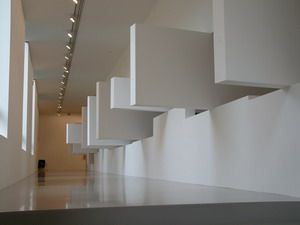
The entire scene and artwork arrangement is quite captivating. A pure white partition wall in the center creates a facade with rhythmic variations in length (a total of 11 walls of varying sizes), opening up the overall wall space, reminiscent of Morellet's recent environmental installations. Each of these facades hangs an original small painting from 1952 (approximately 40x60cm), offering an appreciation of musical high and low rhythms, guiding viewers poetically into the core of his work.
Following this, the series of 11 large paintings (approximately 160x280cm) presents mathematical systematic geometric abstraction: linear logical exercises involving straight lines, horizontal lines, diagonal lines, intersecting lines (grids), circles, and triangles, along with substantial colors that extend infinitely beyond the limits of the canvas, confusing the viewer with visual rhythm and mysterious light. This series is labeled as 11 x 4=11 or features interesting work numbers like 1952x4 no10. After 55 years of reproduction or reinterpretation, the tension and poetry of the large works have not diminished but increased. Mathematical geometry becomes an eternal law, unmovable by time or space. Once the origin is found, the disillusionment and rebirth of all things become one. Unlike fashion trends which can be discarded once outdated, the preciousness of art transcends material and spiritual realms, crossing the chasm of time and space; life is no different.