Braque (G. Braque, 1882–1963) - Man with a Guitar
Man with a Guitar (130x74cm) 1913 MoMA, New York
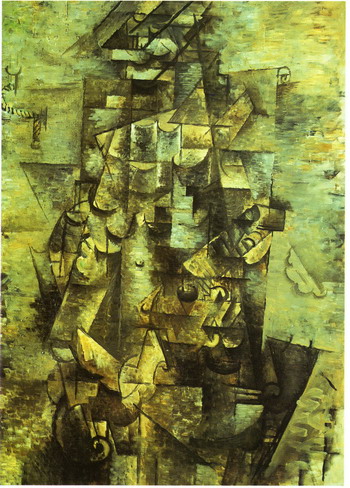
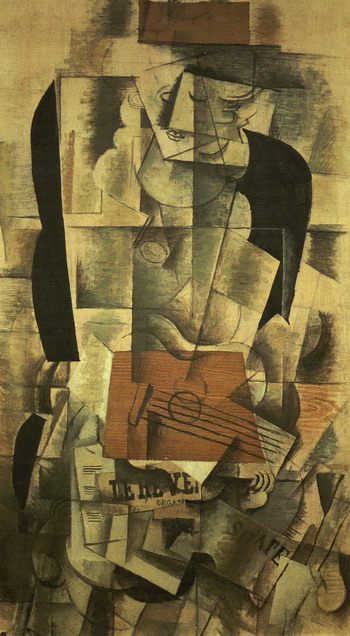
Braque (G. Braque, 1882–1963) was a French painter and one of the founders of Cubism, initiating the wave of modernism. Influenced early on by Fauvism, he later established his own style within Cubism. All the scenes in the paintings are reduced to this surface; perspective is eliminated but depth is not removed. The surface is divided into small facets, restoring the image in a crystalline form. Thus, a new language of painting is established through simplification and flatness. After the war, he returned to traditional still-life creation, continuing to explore the possibilities of painting. While Picasso maintained the stance of a formal artist, exploring diversity, Braque remained primarily a painter, investigating space and the consistency of painting. No longer strictly Cubist, despite the appearance and complexity of his paintings, they contain unnatural simplifications along with subjective imagery and color. Clearly, all of Braque's works adhere to this consciousness he referred to; although considered Cubist, he further strived to break free from its constraints.
The two works, Woman with a Guitar and Man with a Guitar, are among the most representative series of Braque's analytical Cubist paintings. They depict figures holding instruments (guitars or mandolins), which was also Picasso's favorite subject during this period. These two pioneers of Cubism were like twin brothers; comparing their works closely reveals that the deconstructed natural forms are rigorously constructed in simplified, flattened vertical and frontal fragments, almost identical. Neither is signed (can you tell whose work it is?), relying solely on the adjacent titles for identification.