Paris Palais de Tokyo - "Gakona" Special Exhibition
Cela Floyer - "Taking a line for a walk - 1 litre": A three-wheeled line-drawing machine carrying a one-liter bucket of white paint, object installation, 2009.



Roman Signer: 15 chairs and a lawnmower space installation, 2007.
Preface: The "Gakona" special exhibition was held at the Palais de Tokyo in Paris from February 12 to May 3. Following the extraordinary series of exhibitions with dramatic logic in 2008, this year's exhibition focuses not only on visual impact but also poses questions. "From one revolution to another," today's "Gakona" special exhibition continues its intention to expand beyond all theoretical and aesthetic habitual interpretations, through an optimistic and enterprising viewing spirit. The exhibition is built upon the eternal fluctuation between opposing mainstream art trends.
"Gakona," an extraordinary contemporary art exhibition, serves as a scientific or physical laboratory, presenting new perspectives and bodily sensory experiences. Electricity, static electricity, and electromagnetic waves become the driving force of art. The relationship between art and technology has long existed, originating in the kinetic art of early 20th-century modernism, where technology and avant-garde experimental art shared a close relationship. Today, digital, 3D, biochemical, and high-tech imagery have also changed the face of contemporary art.
The theme of the "Gakona" exhibition comes from a secret U.S. military electromagnetic research base in Alaska, known as HAARP (High-frequency active auroral research program). Established and directed by scientist Nikola Tesla, it specialized in studying electricity and ionospheric conduction in the upper atmosphere that changes with solar cycles. It possesses the ability to absorb or reflect electromagnetic waves. Due to its involvement in military activities and opaque functions, it aroused public suspicion. Furthermore, due to fears of electromagnetic radiation, HAARP became a source of endless rumors and discussions in public discourse, such as controlling climate, global communication, human behavior, or various undisclosed practices. This forest of antennas, filled with magical imagination and sci-fi elements, became the core exploration of this exhibition.
"Gakona" oscillates between flying rumors and discussions, reality and illusion, science and imagination, the visible and invisible, and material and immaterial. Here, four dramatic solo exhibitions are composed within environmental site-specific installations and magical objects: French young artist Laurent Grasso recreates the unusual antenna forest base scene of the U.S. "HAARP." Italian young artist Micol Assael bases her work on the electrical power generation device of Soviet scientist "Chizhevsky Lessons." British young artist Cela Floyer develops a negative space. Roman Signer presents a series of events—sculptural objects. Numerous immaterial, untouchable, almost invisible yet perceptible works trigger the audience's magical imagination and space, accompanied by a strong, unsettling force surrounding the site and more subtle experiences.
Caution - Space of Forbidden Grounds: Laurent Grasso’s Monumental Antenna Forest environmental space installation and Micol Assael’s "Chizhevsky Lessons" environmental space installation both possess a paradoxical atmosphere, resembling an outer space or sci-fi technological laboratory venue. Visitors must pass through guard checkpoints; one cannot simply trespass. One must first read warning signs carefully: No badges, headphones, or other electronic accessories allowed; pregnant women and children under eight are prohibited; children must be accompanied by adults; all electronic devices—phones, cameras, computers, MP3 players—must be turned off; touching other visitors' faces, especially eyes, is forbidden. After careful inspection, sign to assume responsibility before entering. Venue signage warns against crossing boundaries, with cautionary notices everywhere. In this unusual and bizarre space, viewers immediately feel unease, sensation, and imposed curiosity: What is the artist up to? An alternative scenario, similar to entering outer space or a sci-fi experimental scene, under dim lighting, the body becomes sensitive immediately. Under strong voltage, a sense of danger rises (people clearly hear the sound of several kilovolts). The venue is filled with subtle static electricity and electromagnetic waves, under visible and invisible, psychological and physical sensations. Moving cautiously, the body and consciousness remain alert. Bodies, coats, and sweaters react to the static field; the psyche is fraught with danger, always uneasy. Especially under Micol Assael’s innovative "Chizhevsky Lessons" installation, viewers’ hair stands on end. Electromagnetic waves pass through the body, causing discomfort. Forcing viewers into the forbidden space contrasts not only physically but psychologically, involving not just matter but immateriality, leading to magical imagination and extraordinary artistic experience.
Laurent Grasso (born 1972), a French young artist, won the 2008 French Contemporary Art Duchamp Prize. His artistic creation, like an astronomer, is built on science, film tradition, and literary narrative exploration. His works develop mechanisms of expression, modeling, de-contextualization, and interpretative possibilities. Grasso has been curious about astronomical science since childhood. A few years ago, he became fascinated by the mystery of the U.S. Alaska military secret electromagnetic research base, HAARP, and his whimsical ideas about electromagnetic waves and outer space expanded his virtual world and imaginative space, entangling his artistic creation. In this exhibition, the artist specifically constructed the HAARP scene based on the U.S. Alaska location. The Palais de Tokyo’s large hall magically became an extraordinary "HAARP": an antenna forest base. Systematic groups of antennas, orderly brackets, crisscrossing cables, transformers, communication equipment, etc., organically formed an extraordinary information or physical laboratory, resembling a platform connecting observatories with outer space. In form and space, illusion and reality, vision and imagination, physiology and physics, it manifests the space of global communication and the distant foreign world.
Micol Assael (born 1979), an Italian young artist, resembles a physicist and mechanic, skilled at converting mechanical and physical principles. Through ingenious material space installations, her works reveal not just visual but bodily effects. Original exploration is built between physical science and machinery, approaching outdated scientific theories or forgotten machines. By updating and strengthening the unusual relationship between space and the audience, she leads viewers into her physical and mysterious world—immersing them in a negative ion static field space, causing viewers to lose their orientation, forcing a contrast with this ineffable space, while personally experiencing physical and psychological states. In this poetic and eerie space, they share a special artistic experience.
Here, Micol Assael, based on the space installation, suspends twelve square copper plates symmetrically on either side in the middle of the large hall. In the center, a series of sunlight spotlights are placed, creating an eerie atmosphere. Next to it, a generator, a transformer, and a system of cables (all hidden) specially convert air negative ions, thus creating a static magnetic field in the space. Titled "Chizhevsky Lessons," it pays tribute to early 20th-century Soviet scientist Chizhevsky. His most famous research is the effect of air ionization on humans. His theory is based on the correlation between sunlight and humanity, particularly pointing out historical events of war or revolution. This "Chizhevsky Lessons: Environmental Space Installation" is simple, elegant, and supra-visual. When viewers enter the work’s site, their sensitive bodies awaken a crisis awareness. Not only do they hear the sound of high voltage, but they also perceive the static induction of negative ions in the air, making their hair stand on end. How does the electromagnetic field affect human psychology and physiology? In these extreme sensations, viewers are forced to confront the magnetic field with their bodies and undergo a baptism of a new artistic experience.
Suspense - Negative Space: Laurent Grasso and Micol Assael’s works dramatically awaken viewers’ bodies and crisis awareness, experiencing the visible and invisible, conveying meanings beyond the physical realm. Then, Cela Floyer and Roman Signer’s works present suspense and uncertainty. In minimalist expression, they reach a point of absurdity and unease. They condense reality sharply, like riddles; viewers must exert maximum imagination to pierce through time and space to see the truth. Clearly, both artists appropriate and transform everyday insignificant objects. For the former, objects become media, images become indices, and time is injected into space, pointing to a dual reading of objects, creating an intellectual concept and negative space. For the latter, they combine and construct dramatic objects, performing deceptive magical object energy in time and space, using delayed reversal functions to surprise viewers, forming a theatrical situation and playful space.
Cela Floyer (born 1968), a British young artist, won the 2007 Young Art Award at the National Gallery in London, UK, and is one of the representative artists of current new conceptual art. Visiting his exhibition leaves the deepest impression of being quite minimalist, so concise as to be suspenseful and unsettling, even somewhat incomprehensible. Insignificant objects, under a certain behavior and attitude, emphasize simple forms and media, intending to expand the concept of object confrontation with time-space and multiple meanings. His overall creation is built on appropriating, transforming, and possessing daily life objects, such as a light bulb, a water bucket, or an iron bed mixed with natural phenomena like boiling water or flickering flames.
Skilled in diverse creations: objects, installations, drawings, video, or sound, these serve as formal indices, often revealing double meanings under his inherent images. As early as 2002, at the Palais de Tokyo group exhibition "Fifty Million Years," he displayed the process of adjusting images. Directly using a projector through intentional or unintentional lens adjustments, he revealed the substantial diversity of projection. Indeed, Cela Floyer appropriates and possesses ordinary daily objects, leading viewers away from object viewing, entering a possible dialogue between images or their installations. Cleverly borrowing the deviation of object confrontation with work themes, this intellectual word game often carries strong humor and irony, puzzling people like riddles, and establishing a negative space from it. Here, in the vast venue, Cela Floyer displays three small works: "Taking a line for a walk - 1 litre": A winding white line on the ground draws people’s gaze to a three-wheeled line-drawing machine carrying a one-liter bucket of white paint. In the corner, "Light switch": At the height of a light switch position, a slide projector projects a light switch head, seemingly fake yet real, true meaning disguised as false. "mu sound music" installation: Two speakers installed on a column continuously play monotonous mu sound music. Under minimalist, hypnotic music, one enters a fantasy state. These seemingly insignificant objects hide uncertain puzzles; what information do they convey? Works submerged in vast space, delving deep creates suspense and negation.
Roman Signer (born 1938), a Swiss artist, remains vigorous and pioneering, exploring new territories based on the delayed reversal function of science and physical principles. There is no tension before the explosion sound; miracles appear in succession. Although smoke disperses, the drama is not over; indeed, the good show is yet to come. Such delay creates a suspenseful state and makes viewers unable to predict. Hidden behind these object images and smoke, it points to uncertainty, expanding the concept of time there, refining reality with possibility. Specifically, behind the image, there is nothing but a puddle of fog. Indeed, there is absolutely nothing. It is in this minimal "nothingness" that Roman Signer exerts maximum imaginative space, subtly responding to the final message in insignificance.
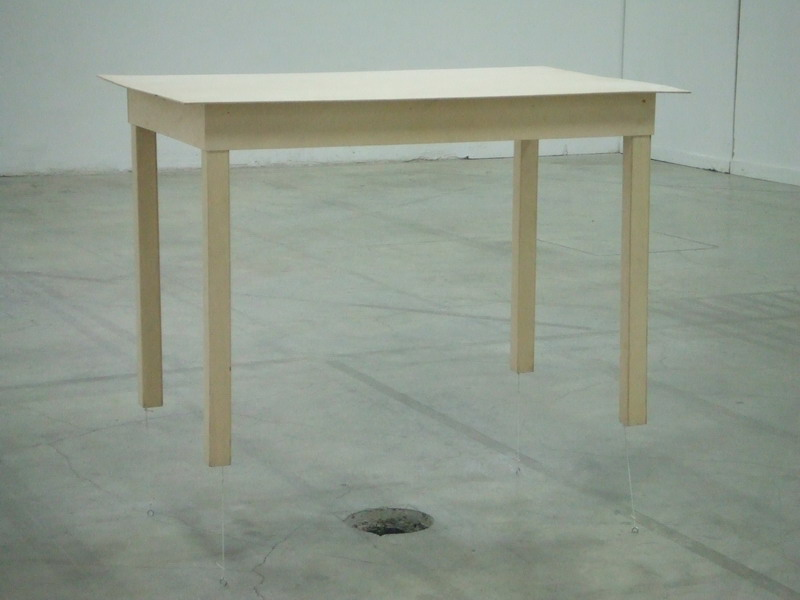
Since 1973, Roman Signer began combining and constructing innovative sculptures, objects, performances, photos, and film materials. Since then, he has relentlessly pursued manifesting the power of nature, the quiet power like gravity. He is skilled at appropriating and transforming existing ready-made objects, using unusual explosives, even helicopters, implying the development of four-dimensional space and temporality. These works can be called "time sculptures." Each work is a processed plot and liberated energy. Here, Roman Signer exhibits three dramatic works: "Floating Table": An industrial fan placed underground blows a table halfway into the air through super-strong wind. "Two Umbrellas": A red generator resembling two open hands, with black umbrella machines facing each other at the top—object-machine pieces, intermittently emitting dramatic lightning. "15 Chairs": Fifteen chairs are placed in the space; a lawnmower constantly moves and rotates in the space, passing through chairs or pushing them forward, an endless game. In poetic and dramatic mechanical object-sculptures, reality is transformed into sci-fi, exploring the possibilities of art between reality and imagination, time and space, physics and psychology.