Gilbert and George "Grotesque British Flag" Solo Exhibition
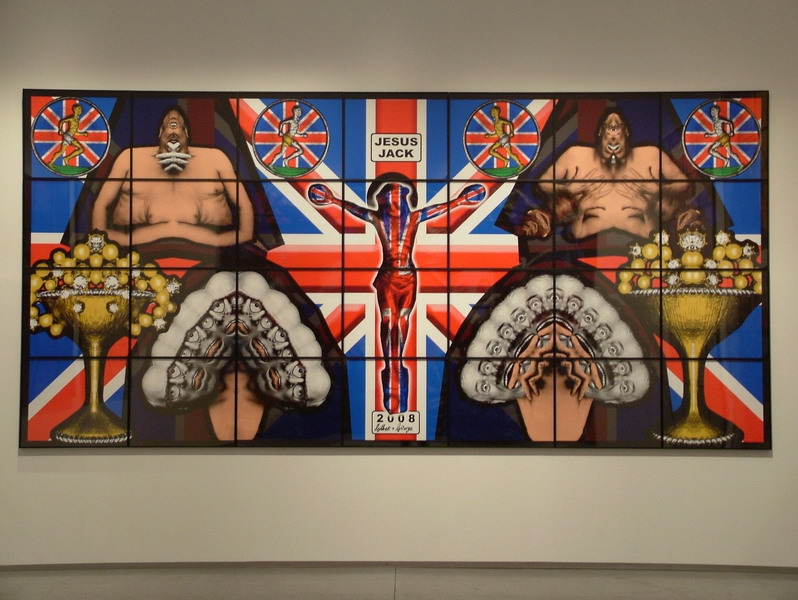
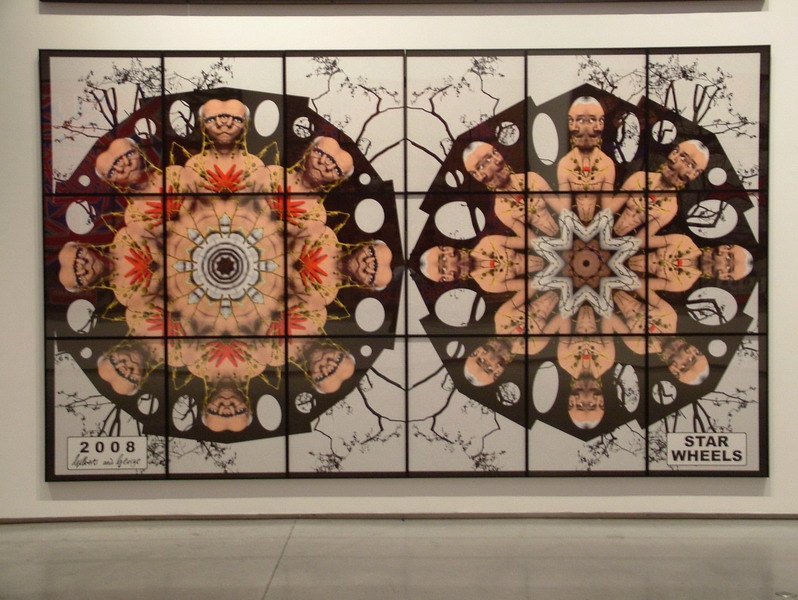
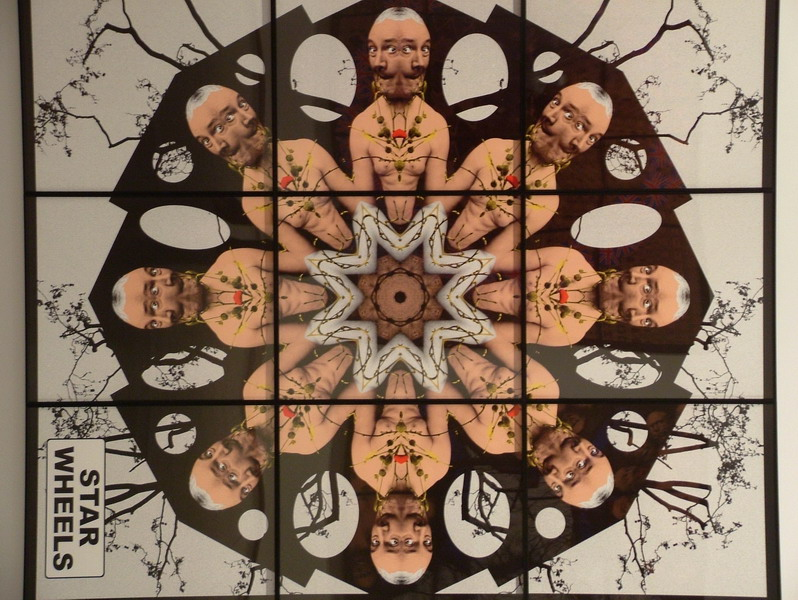
One of the "Jack Freak Pictures" series. Varied geometric symmetrical forms resemble a kaleidoscope. 2009
Text/Chen Chi-Hsiang | Time: June 19 to July 25 | Location: Thaddaeus Ropac Gallery
Gilbert (born 1941) and George (born 1942) are among the most representative artists of British performance art, rare "two-in-one" figures in the international art world, and since the 1970s have been provocative and inflammatory figures, famous for their large-scale self-portraits deeply embedded in society. "Jack Freak Pictures" is Gilbert and George's latest and most important creative series, continuing to depict modern people's paradigms in urban environments, revealing this existential consciousness through these deeply alkaline aspects.
This series revolves around the striking images of the red, white, and blue of the British flag, involving various different connotations and diverse possibilities of interpretation. The ever-changing images emphasize graphics such as the British flag, tree branches, street scenes, red walls, and of course, exaggerated and distorted artist personas (they are the soul figures of the works), with vibrant colors and varied geometric symmetrical forms resembling a kaleidoscope. Striking in this series are the artists' own extraordinary images (bodies or heads) constantly proliferating decorative forms, combined and constructed within symbolic patterns, involving conventional commemorative symbol graphics, carrying a kind of honorific gendered embellishment, alluding to contemporary Western life situations and consciousness.
If we associate this theme of the "Jack Freak" exhibition, it may reflect modern humanity's orientation toward madness, subject to the whims of the contemporary world, presenting a mishmash of the development of personal and national identity concepts. The meaning of the flag, a symbol of Britain, reversed and linked with the word "Freak," implies a critique of social (racial) exclusion. Art critic Michael Bracewell wrote: "Jack Freak Pictures are works by Gilbert and George never created before, the most symbolic and inspiring series produced under the most explosive and divergent gaze" (Note 1).
Gilbert and George: In the late 1960s, when the Western art world was still in the storm of abstract and pop art, Gilbert and George affirmed the body (from 1969 onwards) as material substance and visual tool, deciding to display their bodies as objects to create unprecedented "living sculptures." Regarding this decision, Gilbert and George stated: "It is simple: when we left school we had nothing, no studio, nothing. We could only command ourselves, so: we decided to practice with our own bodies themselves, that is art" (Note 2). They believed that "man is a more extraordinary fact and everywhere there are appearances of art—those colors and forms—only pre-provide themes, without anything inherently important. We spit on art for art's sake; we oppose the absolute with the absolute" (Note 3).
The roots of their living sculpture come from the concept pioneered by Italian artist Manzoni (1961), using the body as a tool for performative expression. From the most extreme and contradictory positions, wearing stiff, plain suits from the 1920s, holding canes like English gentlemen, faces and hands sometimes painted gold, sometimes red, acting mechanically like robots, sometimes standing motionless on chairs or tables, or in the stairs or corners of museums or galleries, like sculptures; sometimes transforming everyday behaviors into novel forms of living sculpture: walking, drinking water, singing, reading, writing, or talking to the audience... etc., stating: "All that we feel is involuntarily used in our work; we never choose" (Note 4). An extreme gamble, adventure, with no rejection, abolishing the distance between private and public. They declared: "We never regret art as art (that is, art is art); then art has never been the root of art, but life" (Note 5). Clearly, Gilbert and George dissolve the fence between art and life, practicing the idea that "the source of art is life." They further emphasized that "their activities belong to morality"; according to them, art is not gratuitous, nor indifferent; it can also contribute to what is inherent or subverting happening. Further declaring: "For us artists, there must be a moral relationship with the audience. This morality in our use is to maintain the goals of Western civilization, which is there, necessary and subversive, necessary there, and always changing; in this attempt, we wish to stand at the forefront" (Note 6). Is this not the spirit and attitude of Dadaists, formalists, and the international Fluxus group?
Gilbert and George are believers in "art for everything," their art concept built on the motto "art is for all beings." Thus, art is no longer the art of a minority bourgeoisie or elite; in their abnormal methods, they establish totality in art, considering their political and social environment, and declare: "We want to speak clearly and without hiding our flaws: thought, pain, sexuality, and all these belong to humanity" (Note 7). While engaging in performance, they also displayed traditional charcoal sketches or paintings, such as the 1971 series "We Are in Nature," autobiographical paintings, literary depictions narrating their comfortable lives in natural landscapes. Starting from 1971, they began presenting photographic archives, gaining increasing weight; early on displaying black-and-white photos of their outdoor life similar to performances, later combining social environment images, constructing memorial-form pictures through multiple photo collages, such as the 1974 work "Human Slaves," constructed from nine photos forming a Nazi cross symbol, or the dramatic "Japanese Cherry Blossoms" series, all within symbolic and metaphorical images. After 1974, they introduced primary colors (yellow, red, and green), strengthening a symbolic aspect, returning to realistic social and political criticism, such as the 1975 series "Corner Ashes," or the 1977 works with strong ideology like "Smashing Red" or "Peeing" series, moving from past inner poetic feelings and comfortable worlds to increasingly filled with unease, negativity, eroticism, and violence issues, targeting the social atmosphere of Britain at the time (factory relocation, unemployment causing various social problems), and international political situations (Southeast Asian refugee waves, Soviet invasion of Afghanistan, etc.). Gilbert and George took all of society: unemployed youth, drunks, police, prostitutes, patriots, communists, corrupt figures, troublemakers, drug addicts, marginalized people, prisoners, immigrants (Pakistanis or Blacks), and the arrogant... etc., social phenomenon figures, becoming excellent compositional elements of their works, in a form of tragicomedy performance with strong social criticism, under themes such as Death Monuments, wall graffiti, or sunset series. Their works thoroughly become social allegories; black humor transcends exaggerated imitation, possessing strong social tragedy and satire; this comical aspect stems from total despair towards society! They even said humorously: "We like more and more young people being unemployed, desperate..." (Note 8).
Works from the 1980s still revolved around their own performative images, more diverse, lively, with stronger colors, more elegant works; irony and grotesquerie replaced past tragedy and seriousness, such as the 1982-83 work "Prayling Garden," the 1983 work "Black Death," these memorial-form series, almost Gothic; the characteristic they attempted was an almost Eastern monument, a very skilled formalist beauty. Undoubtedly extremely rigorous Englishmen; these works were not very natural, somewhat artificial. Not an exception in the 1986 "Jungle" or "Us," or even the 1994 "Flying Shit" series. Quite attractive, more elegant within these situational categories, immoral or meaningless, sexy or violent; they hoped their works would "produce a strong impression before the audience has time to think" (Note 9). And declared: "We are unhealthy, in two eras, obscene, depressed, cynical, empty, weary, extremely mediocre, decadent, dreamy, rude, arrogant, conceited, knowledgeable, self-pitying, upright, victorious, diligent, thoughtful, artistic, religious, fascist, cruel, teasing, destructive, ambitious, chic, deadly, stubborn, twisted, and outstanding; yet we are artists" (Note 10).
Note 1: Refer to exhibition press release. Note 2: Bernard Marcadé, Eloge du Mauvais Esprit, published by La Différence, Paris, 1986, p. 223. Note 3: Reference Centre Pompidou National Museum of Modern Art guide card No. 57 Art and Attitude. Note 4: Ibid. Note 5: Bernard Marcadé, Eloge du Mauvais Esprit, published by La Différence, Paris, 1986, p. 225. Note 6: Ibid. p. 226. Note 7: Ibid. p. 229. Note 8: Ibid. p. 232. Note 9: Dictionary of 20th Century Painting and Sculpture, published by Larousse, Paris, 1991, p. 320. Note 10: Bernard Marcadé, Eloge du Mauvais Esprit, published by La Différence, Paris, 1986, p. 228.