Courbet (Gustave Courbet) - The Studio
The Studio, 359×598 cm, 1855, held at the Musée d'Orsay, Paris. This is one of the most important works of the mid-19th century, centered on the artist to reveal the realistic allegory of the studio.
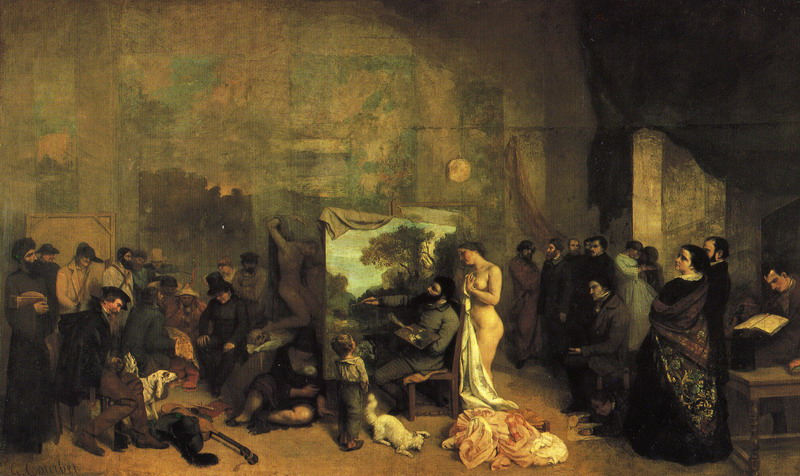
The Studio, 359×598 cm, 1855, held at the Musée d'Orsay, Paris. This is one of the most important works of the mid-19th century, centered on the artist to reveal the realistic allegory of the studio. Thus, the studio itself is a reflection of society; the artist is the founder of the painting world. In 1854, Courbet clearly explained this painting: "My studio is a physical and moral story: Part One shows those who serve me, support my views, and participate in my actions. Part Two depicts people's vivid life experiences. Their nobility and baseness, from top to bottom, are all in the painting. In short, it is society viewed from my perspective, the world coming into my painting, this scene so through my Paris studio."
This painting was rejected by the Salon of the Universal Exposition in 1855, so Courbet simply organized his own Realist Pavilion solo exhibition. After visiting, the Romantic master Delacroix wrote in his diary: "I found a great masterpiece; its only flaw is that there is a patch like a real sky in the painting. It is a pity that people rejected this era's most significant work. With its diverse rich themes, different interpretations, and painting quality, it is enough to become one of the most important works of French painting."