Gustave Courbet - The Burial at Ornans
The Burial at Ornans, 315×668 cm, 1849, held at the Musée d'Orsay in Paris. This is Courbet's most magnificent and solemn masterpiece from his youth (he was only 30). Like contemporary news reports (reminiscent of David's "The Coronation of Napoleon"), it fully displays the solemn folk burial form w
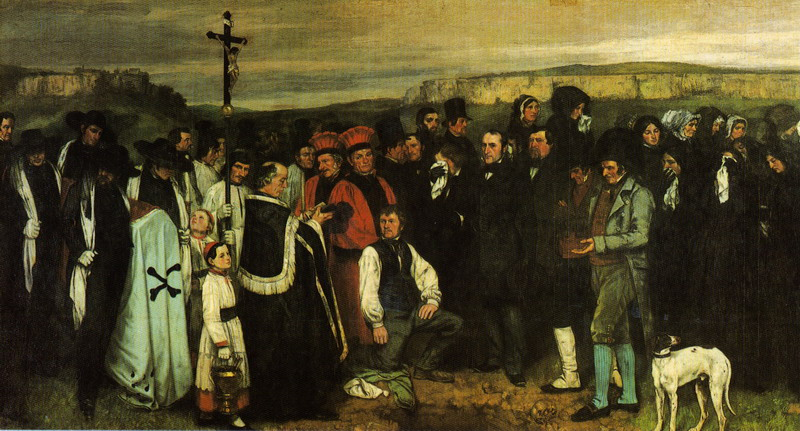
The Burial at Ornans, 315×668 cm, 1849, held at the Musée d'Orsay in Paris. This is Courbet's most magnificent and solemn masterpiece from his youth (he was only 30). Like contemporary news reports (reminiscent of David's "The Coronation of Napoleon"), it fully displays the solemn folk burial form within a dramatically complex, perfectly organized horizontal composition. Here, Courbet did not beautify this world; certainly, this world might be mundane and vulgar, and there seems to be no lyrical message in this solemn ritual.
The Burial at Ornans takes place in the wilderness. Dressed relatives and friends attend this solemn funeral. The dramatic ceremonial scene centers on a man kneeling before the grave, listening to the pastor's sermon. On the far left, the church priest team, wearing black suits and hats, carries the coffin. Next are religious societies surrounding the pastor presiding over the funeral rites, two priests in red robes and red hats, and behind the pastor, two attendants in white follow him. Clearly, under the dim twilight, the cross of Jesus Christ rises above the distant undulating mountain horizon, revealing the divine protection of the "Lord" high above.
On the right, relatives and friends participating in Oudot's (Courbet's relative) funeral, dressed in black suits, are enveloped in a mournful atmosphere. The solemn faces of the men and the wailing expressions of the women appear particularly desolate. Constructed in black, white, and red tones with extreme realism, what is striking is that the artist specifically emphasized the expressions and characteristics of each figure. The woman wailing while holding a little girl behind the kneeling man is the painter's mother. Behind two men, three women are Courbet's three sisters, and so on. Thus, a new painting style—Realism—is established.