Gustave Courbet - Realism
Good Morning, Mr. Courbet 129x149cm 1854 Collection Montpellier Fabre Museum

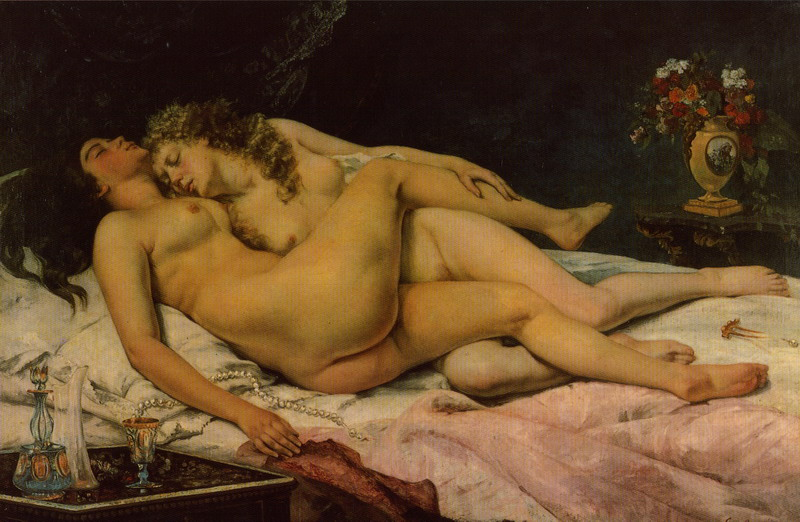
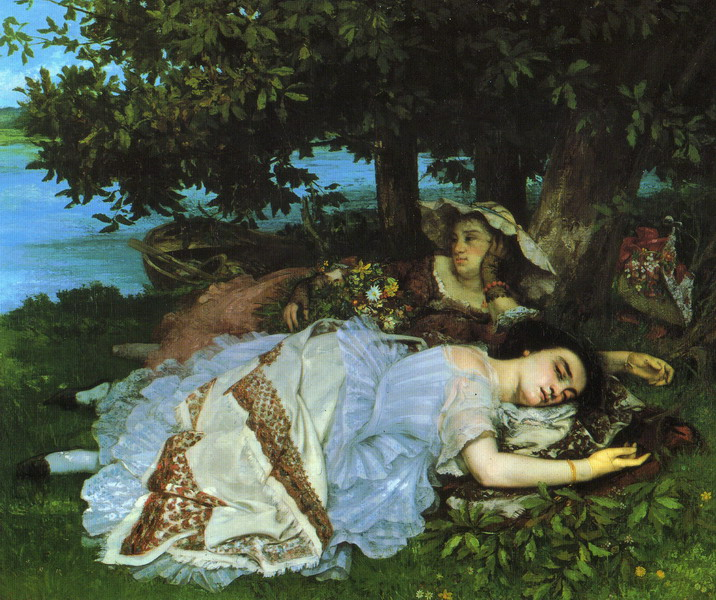
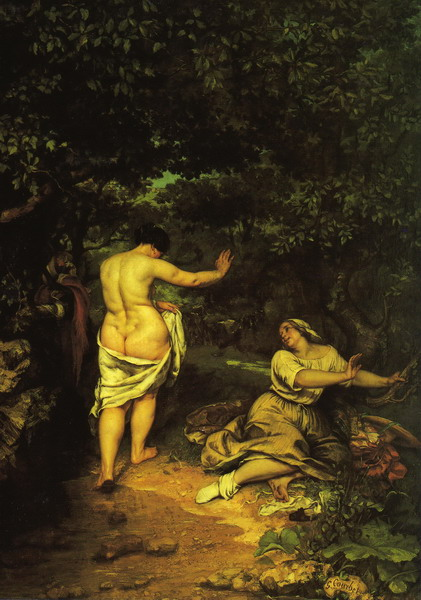
Bathers 227x193cm 1853 Collection Montpellier Fabre Museum
Courbet (Gustave Courbet 1819~1877) is the most representative master of Realism in the 19th century. He studied law early on but frequently copied works by masters such as Rembrandt, Velázquez, Géricault, and Delacroix at the Louvre. He first participated in the Salon in 1844, exhibiting there until 1870.
Courbet's most famous masterpieces include A Burial at Ornans, Good Morning, Mr. Courbet, and The Painter's Studio. These were all rejected by the official Salon and caused widespread controversy because they were too realistic, failing to meet the academic standards of "beauty." Instead, he was accused of being "the representative painter of the Ugly School." As contemporary art critic Malvano (L. Malvano) sarcastically remarked with disgust: "Even if Courbet's nudes fell into a river, not even a crocodile would bite them (because they are too ugly)." This allows us to imagine the conservative aesthetic views of the time.
Courbet only painted the world he could see. He declared: "I believe painting is the most concrete of arts; it can only manifest things that truly exist. It is a tangible language; for me, a painting is composed entirely of visible objects. Abstract objects, those unseen or non-existent, do not belong within the scope of painting." He added: "Delacroix paints angels, so I do not, because I have never seen one." We can thus envision how profound Courbet's realism was.
From 1848 onwards, the young Courbet participated in revolutionary events of the time. Like his predecessor Delacroix, the artist became a follower of liberal democracy. From 1850, he frequented the Andler café, engaging in radical discussions about Realism and new schools with artists such as Corot and Daumier. He was particularly close to socialist philosopher Proudhon. Social commentators like Champfleury and avant-garde poet Baudelaire also stood on his side, often publicly supporting Courbet's views. Courbet himself identified as a socialist, particularly a republican liberal, especially under these realist stances.
In 1870, following his republican ideals, he refused an honorary medal awarded by the state and participated in the Paris Commune. He was accused of being the mastermind behind the destruction of the imperial column in the Vendôme Square, sentenced to six months in prison and a heavy fine. Exiled to Switzerland in 1873, he died abroad in 1877, ending his life tragically for his ideals, much like the Spanish painter Goya.