Chen Chi-Hsiang's Works: "Observing the Mind, Surveying the Realm" (Série Jeu du Miroir) 2007
Observing the Mind, Surveying the Realm Image Photo -16 (Série Jeu du Miroir Photos -16) 2007 each 100x80cm
Author - Ms. Yen Hsueh-hua: Director of the Chinese Cultural Relics Council, Executive Director of Nan San San Small Collection, art enthusiast, and collector. In early autumn 2005, Mr. Hung Cheng-tung, a painter from Kaohsiung, introduced me to Mr.
Chen Chi-Hsiang, a painter and art critic who had returned to Taiwan from Paris for a family visit. That day, at my home, we viewed the paintings stored there; his sincere words and gaze clearly expressed his passion for art.
Over the following two weeks, he invited Professor Hung Shang-hsiang, traveling from Spain, to visit our home. We sat together admiring old ink wash albums, and amidst lively conversation, sighs and praises were frequently heard.
The three of us felt as if we had known each other for sixty years; sincerity has no borders, no age, and no gender distinctions, for what we shared was a pure love of art, without hypocrisy or pretense.
Watching Shang-hsiang shed tears while reading the "emptiness" in Xu Gu's paintings, every one of us present was moved. Chen Chi-Hsiang silently guarded that emotion without saying a word; is this not the fermentation of artistic purity?
That night, everyone's heart was filled with happiness and joy, and late at night, Chi-Hsiang picked up frangipani flowers scattered on the ground in the garden, carrying a fragrant heart, and walked home under the moonlight.
Born in Pingtung, Taiwan, in 1956, Chi-Hsiang graduated from the National College of Arts in 1979 and went to France to study in 1982, engaging in artistic creation and research.
During his more than twenty years in France, besides refining his artistic creation, he participated in many contemporary art exhibitions.
Loving Parisian culture, he not only married a French woman but also published Paris Art Journey in 1996 and Flower City Flower Picking in 1998, followed by European Postmodern Art in 2002.
Using a close-up perspective and on-site exhibition images, he clarified the overall art scene of Europe in the 1980s, providing thoughtful insights into the current art situation. In March 2008, Chi-Hsiang visited Beijing and gave two in-depth lectures to young artists.
Regarding this trip to Beijing, unexpected surprises were fully revealed in his writings: "In this globalized map, as long as one possesses a macroscopic vision and a sincere attitude, isn't it true that all people within the four seas are brothers?" (From Chen Chi-Hsiang's blog).
He also said, "Respecting differences has become the most excellent gift of friendship today. As D.H. Lawrence said: 'Each continent has its own great spirit of place, each nation has its characteristics, that is home, that is hometown.
On this earth, different places have different vitality, different oscillations, different chemical smells, different stars, different qualities. You can call it whatever you want, but the spirit of place is a great reality.'" (From Chen Chi-Hsiang's blog).
From these words, we can see his inclusiveness in traveling the world and striving for art promotion, which is the spirit of "selflessness" and "altruism." And "selflessness" and "altruism" can only start from "sincerity"; without "sincerity," nothing would happen.
We all know that artistic creation cannot be separated from the exploration of life and the perception and understanding of life. Artists often experience the spiritual power of the middle way through repeated refinement and clarification.
The middle way is the meaning expounded by the essence of life; it is a supra-conscious standpoint. Artists often transcend relativity in the expression of the relationship between things and self, and may even perceive harmony in conflict.
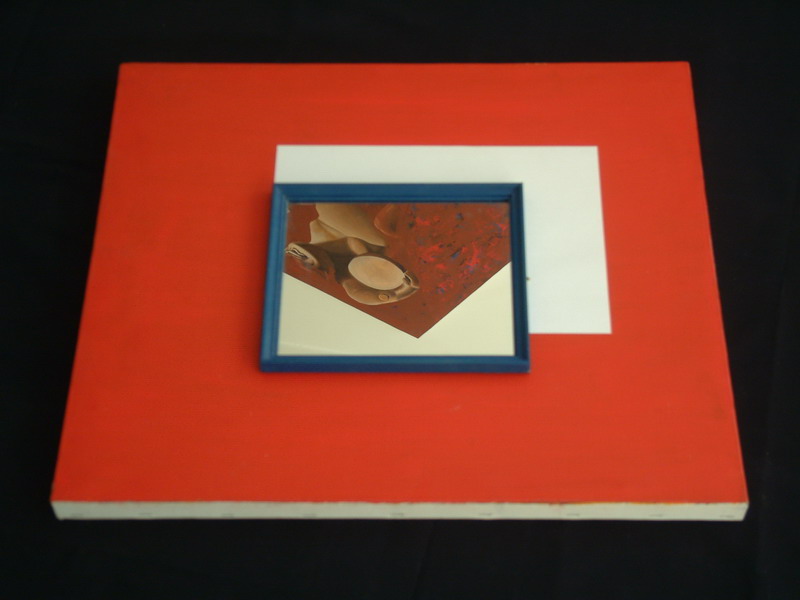
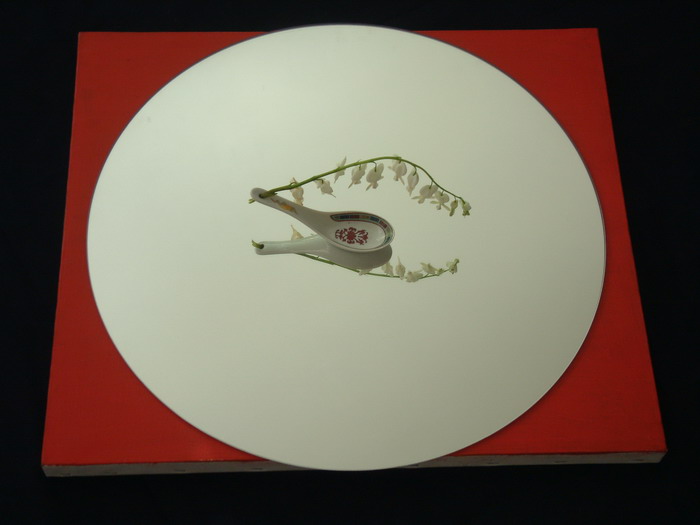
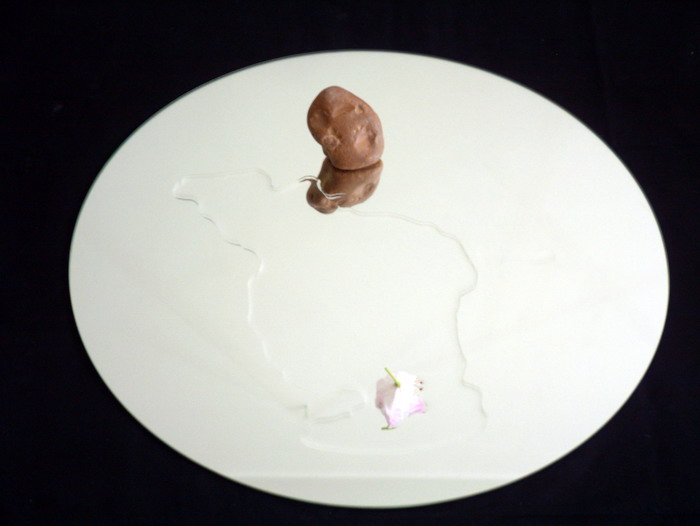
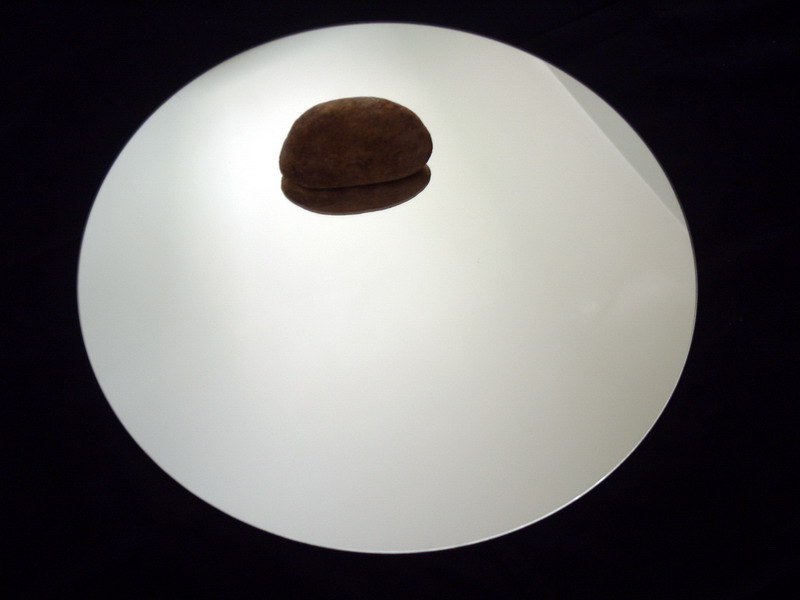
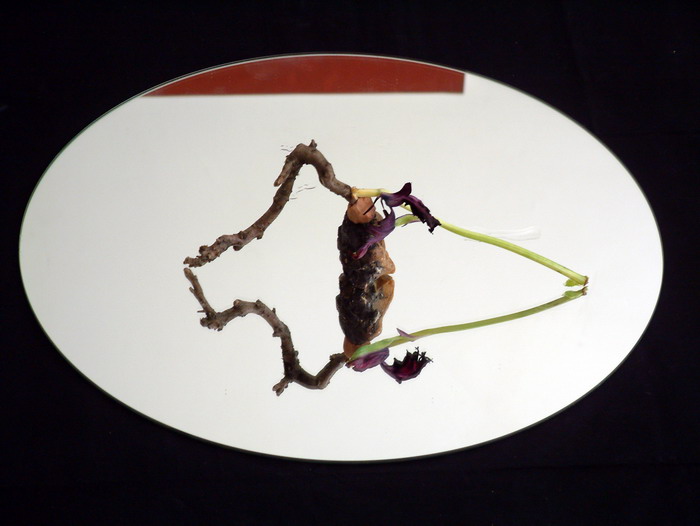
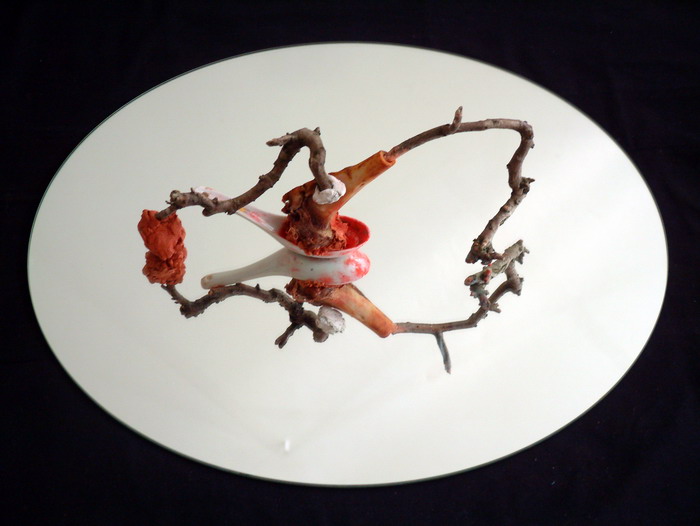
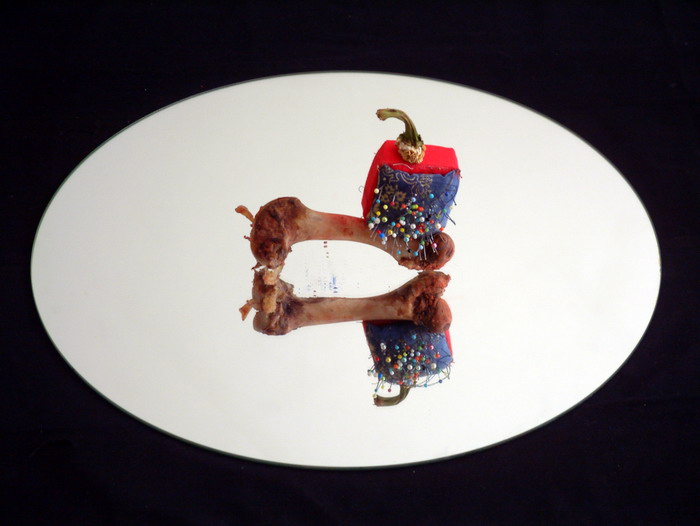
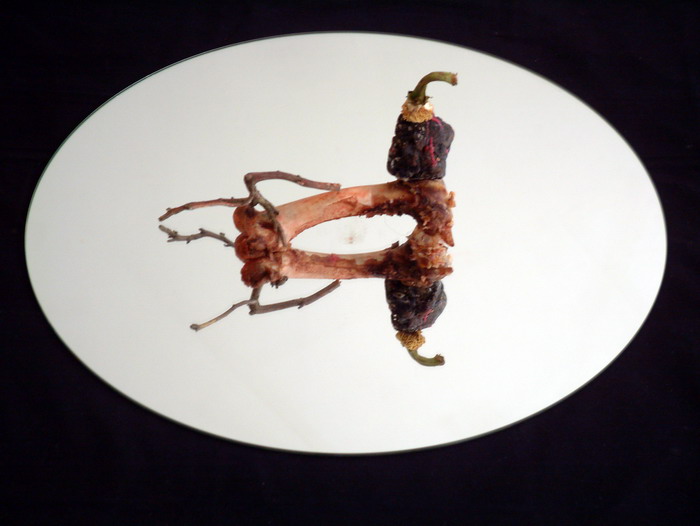
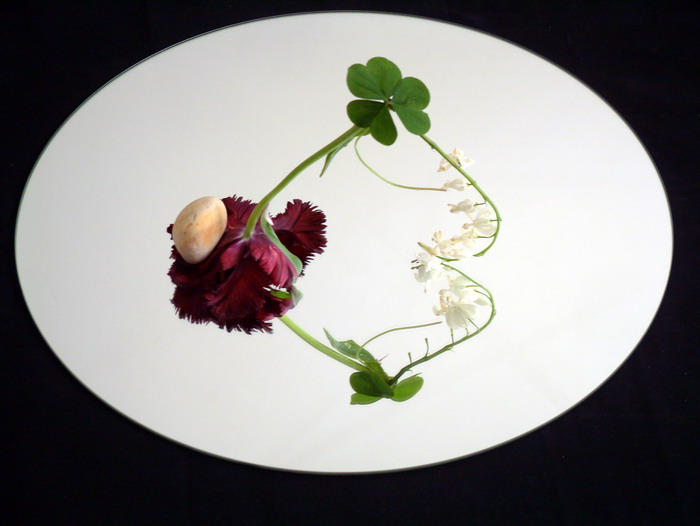
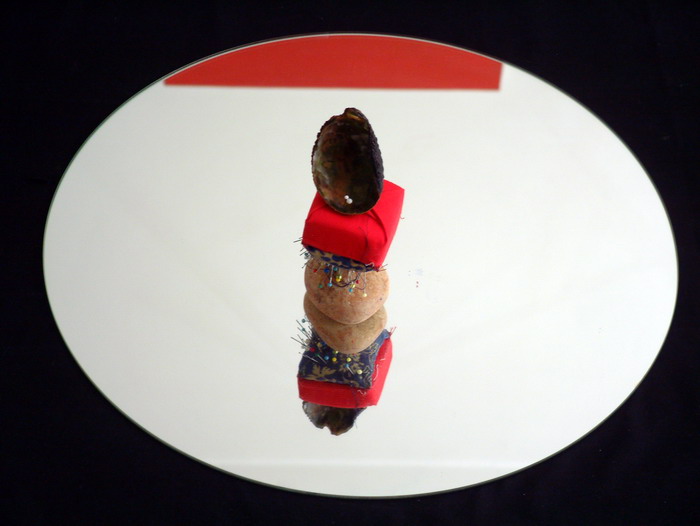
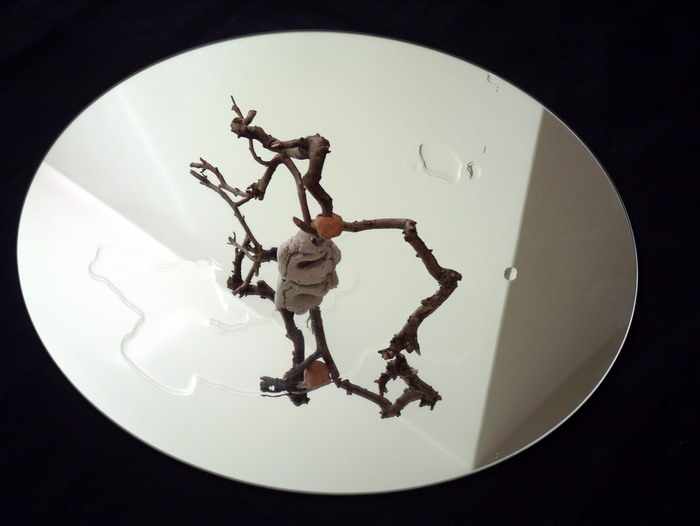
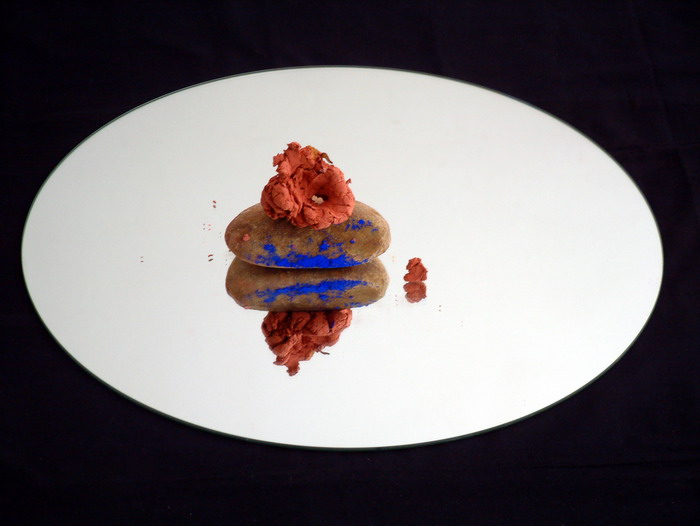
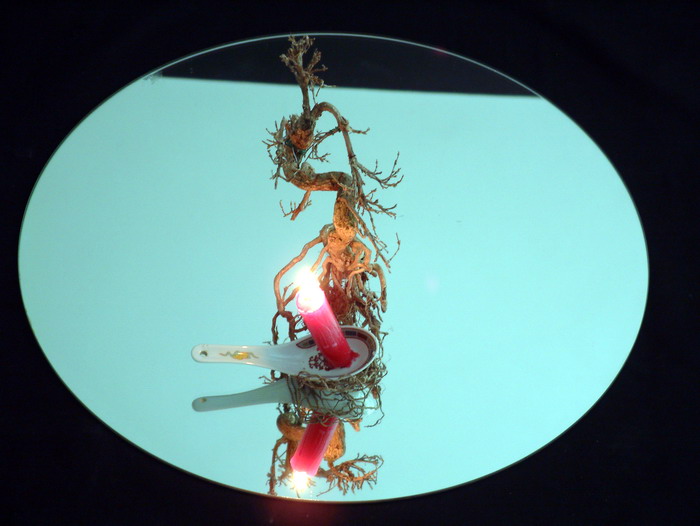
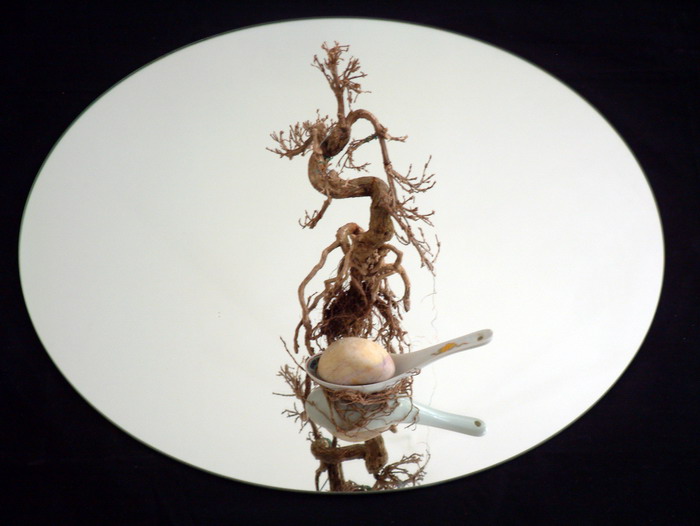
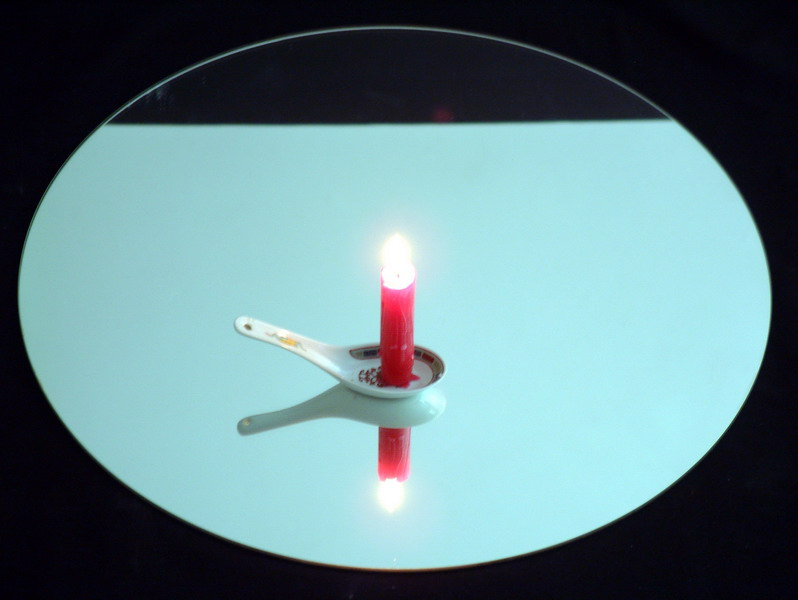
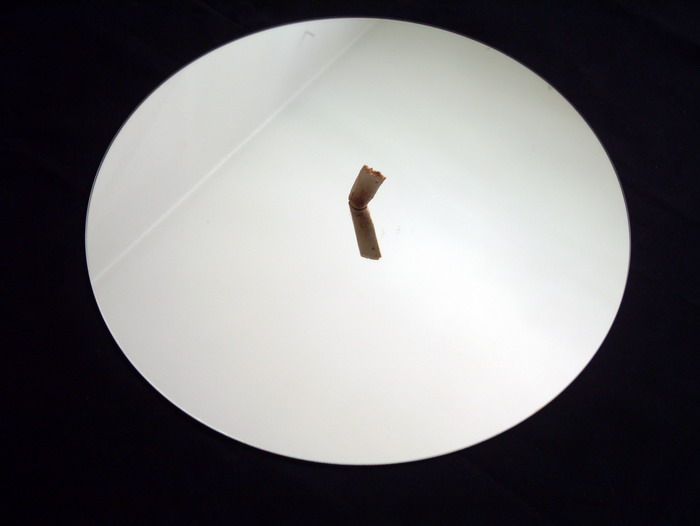
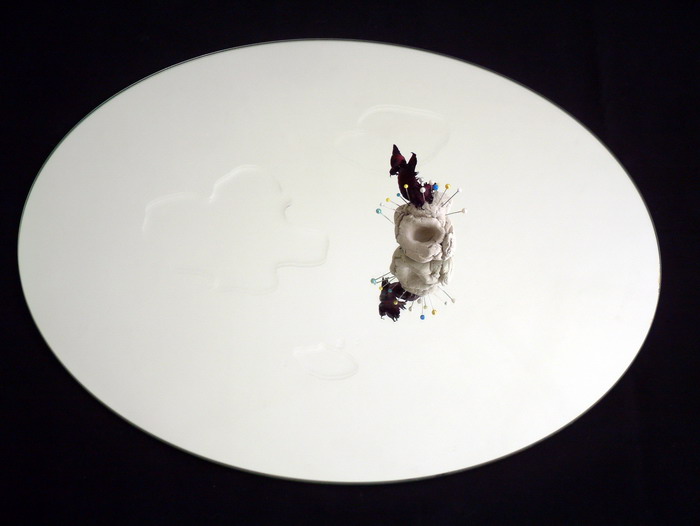
Viewing Chen Chi-Hsiang's series creation "Observing the Mind, Surveying the Realm" in 2007, he sometimes decorates the mirror surface with monochrome solid objects to reflect a beautiful background, then places flowers, stones, dry bones, spoons, etc., on the mirror surface to create effects of virtual and real, and then photographs them as works.
From Chi-Hsiang's creations, it is easy to perceive his aesthetic ideals full of humanism. He collects objects visible, usable, or even disposable in daily life as materials for creation, yet he endows these withered or static lives with infinite vitality and power.
He presents the interesting virtual and real pictures reflected in the mirror with extremely calm and rational beauty, letting glory and withering reflect each other into a Zen state, and also using the water surface randomly splashed and shaped on the mirror surface to metaphorically imply the disappearance of time and space.
The artist places withered flowers on the mirror surface, and the lines of dry branches best express cold beauty; they present the quiet elegance of Chinese ink wash linear art, or paint a touch of blue or red on already dried bones.
The latter is full of the color implication of victory (triumph), suggesting the conflict of life and the magnificence of death.
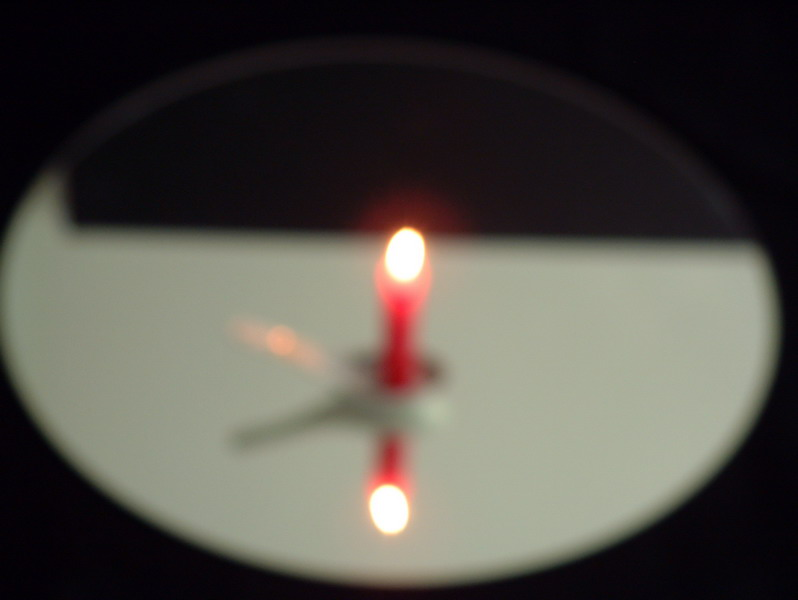
Or a cold gray stone is quietly placed on the mirror surface, allowing it to reflect the purity of beauty, or a lit candle is placed on the mirror surface to penetrate its temperature and brightness.
The "Observing the Mirror, Observing the Mind" series works not only transcend relativity but also absoluteness.
In these extremely rational creations, we not only see the artist's ardent desire and pursuit of life, but also present the balance of three-dimensional space with an extremely warm heart.
The artist's inner happiness is almost palpable, dancing romantically between modern and classical without leaving traces.
What "Observing the Mirror, Observing the Mind" wants to express is just as Qingliang Chengguan, the patriarch of the Huayan sect, said: "To reach the pure source of the mind, one must know that my form is empty; what are the virtual and real of appearance?
Thoughts originally have no origin." In postmodern aesthetics, the integration of "abstract" and "figurative" is often the area artists most want to express, and in this area, they loudly proclaim its inviolability.
In the work I5-16 Work 1 of the "Observing the Mind, Surveying the Realm" series, the artist painted the entire canvas with bright red, with a smaller rectangular blank space in the middle, placing a mirror with a blue frame on top.
These three are arranged with considerable formal beauty and reflect colorful romantic geometric shapes in the mirror. The misplaced space is like a virtual magic mirror, with virtual and real coexisting inside and outside the mirror.
He presents the obscure aesthetics and intuition of the heart with strong colors and different picture forms. The calm arrangement of objects is order and also a kind of self-discipline, revealing sensibility in rationality.
In I5-16 Work 2, the artist used the same technique to place a large round mirror on the red-painted canvas. Its diameter is the same as the square red canvas, so the tension is very strong.
He placed a Chinese porcelain spoon on the mirror surface and inserted a lily of the valley flower into the hole of the spoon handle.
The spoon features ancient Chinese totems, while reflecting below the mirror surface is pure white porcelain and the withered reflection of the lily of the valley.
The artist's calm handling method not only explains the contrast between Eastern and Western cultures but also, for Orientals living in a foreign land, these elements write of loneliness but also inherent independence, calling out nostalgia in silence.
In I3-14 Work 1, the artist placed a large round mirror on a deep black background, with an oval small stone on the mirror surface, illuminated by natural light. This work is full of quietness and Zen opportunities, like entering a realm where no one exists.
The artist does not look at objects with physical eyes but contemplates and meditates with the eye of the mind, observing the mind and objects in the Zen state and forgetting both.
The artistic conception of this work is extremely high, and it is one of my favorite works, full of pure aesthetics and humanistic thinking. Work I3-14 2 is similar to the above Work 1, but the stone placed by the artist has higher brightness and is softer.
He splashes water to create interest and decorates it with a petal to form an extremely romantic landscape of flowers in the mirror and the moon in the water.
In the contrasting yet merging objects of cold (stone) and hot (petal), it expresses an aesthetic viewpoint of extremely high purity.
From this work, we can observe that any three-dimensional object placed on the mirror surface can be reflected double, but water alone will not reflect a shadow; its penetration is an intermediate state of existence.
It silently shines clearly, omnipresent, but it is uncertain, uneasy, and flowing, yet also beautiful. 9-12 (1) still uses a large round mirror placed in front of a black background, with an obscure state behind and a piece of animal bone on the mirror surface, decorated with dry branches and fruits.
A layer of decorative color is applied to the fruits. The round mirror reflects the glory and withering of life.
The perfect state expressed by the round mirror reveals an unpredictable helplessness of life; even with heavenly craftsmanship, one cannot get back the passing years and time. 9-12 (2) The artist really played crazy on this series of round mirrors, playing until unable to stop, playing until unable to extricate himself.
I like the artist's "play," which is a leisurely and free posture, and an unbounded mood. He placed red and blue ornaments on dry bones, and the ornaments were covered with colorful pins.
This picture reminds me of the mockery of "one general achieves success, ten thousand bones wither," and also resembles the residual tear stains on the "Chastity Archway." I insert Eastern thinking into Western artistic realms.
The expression of these two completely different objects inside and outside the mirror is actually not easy. This experimental work successfully expresses the artist's unique Eastern sentiment.
In Work 9-12 (3), the author boldly installed a white porcelain spoon filled with cinnabar on the round mirror. A piece of animal bone was placed above the spoon, and dry branches with their own charm were connected on both sides.
The beautiful undulating lines of the dry branches are like spirits dancing with clear shadows, reflecting on the round mirror as a dynamic arc-shaped body.
In the "observation of material nature" and "observation of enlightenment" here, due to the calm projection of the mirror surface, the "ego" becomes more real and clear. In Work 5-8 (4), the author holds flowers and contemplates, dotting the round mirror to be dust-free.
Only green oxalis, white lilies of the valley, purple-red flowers, and a small white stone are captured in the mirror at this moment.
The pure colors of red, white, and green are like the rising sun in the morning, or dewdrops sparkling crystal-clear under the sunlight, bright, clear, and full of joy. Among the series of round mirror works, this work is the most refreshing.
The declaration of "possessing happiness, approaching heaven" is now obvious. Viewing Chi-Hsiang's artistic creation is like walking on a bright mirror platform.
He uses the characteristics of material nature such as stones, dry branches, petals, and bones, projecting the state of self-understanding through enlightenment onto simple creation, and transmitting realms beyond language.
Also, through the mapping relationship between this material nature and enlightenment, he achieves the broader vision pursued by the artist. This vision has no good or bad, high or low.
His image wants to pass through another wall, making holes in that high wall to take in light, and polishing his heart again and again, with a clear mind as assistance, striving for another round mirror of artistic life. (Here I am very grateful for her care and excellent artistic viewpoints.
Xuehua is the most forward-looking collector I have met in Taiwan, with unique insights and ecstasy about art, and is an enthusiastic art promoter.
Xuehua's enthusiasm for art and humanistic concern, cultivation of local humanities and arts, dedication of universal love to the world, and unique views on beauty, all make people deeply feel this energy and wisdom far beyond the ordinary.
She is someone I admire and revere in my heart. I am also grateful for her passionate writing and sharing this compiled article with everyone.)