Rainbow over Hampstead Heath
Rainbow over Hampstead Heath, 51x76 cm, 1836. Collection of the Tate, London. John Constable (1776-1837) was one of Britain's most important 19th-century painters...
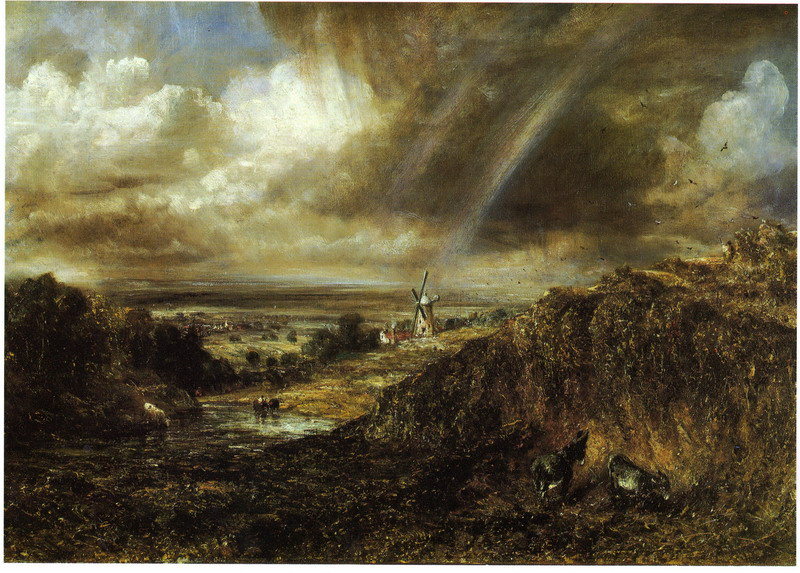
Rainbow over Hampstead Heath, 51x76 cm, 1836. Collection of the Tate, London. John Constable (1776-1837) was one of Britain’s most important 19th-century painters (contemporary with Turner), and a precursor to Impressionist painting. He was deeply influenced by Northern landscape painting and French artists Lorrain and Poussin.
He loved natural scenery; his hometown Suffolk countryside was the source of inspiration for his entire creative life. Within a Romantic spirit, he interpreted the light and shadow, as well as the chiaroscuro, of nature’s ingenious craftsmanship. He viewed the drama and mystery of natural landscapes as reflections of inner emotion, believing that nothing in nature is ugly.
The Rainbow over Hampstead Heath unfolds within this magnificent natural theater. In the foreground, two donkeys graze beneath rugged, solid rocks; in the middle ground, a pool of water where several cows drink leads the eye toward a visual focal point—a windmill. Distant, boundless pastoral scenery stretches out. On one side of the horizon, white clouds shift and a ray of sunlight suddenly breaks through; on the other, dark clouds gather, resembling an impending storm. An extraordinary rainbow hangs high in the sky between the clouds. Through skillful contrast of light and shadow, this poetic pastoral scene is constructed, revealing a natural perspective on landscape painting akin to the French Barbizon School, ushering in a new era.