Pollock (J. Pollock) - Painting
Painting 208×121.7cm 1948 Collection of the Centre Pompidou Museum of Modern Art, Paris
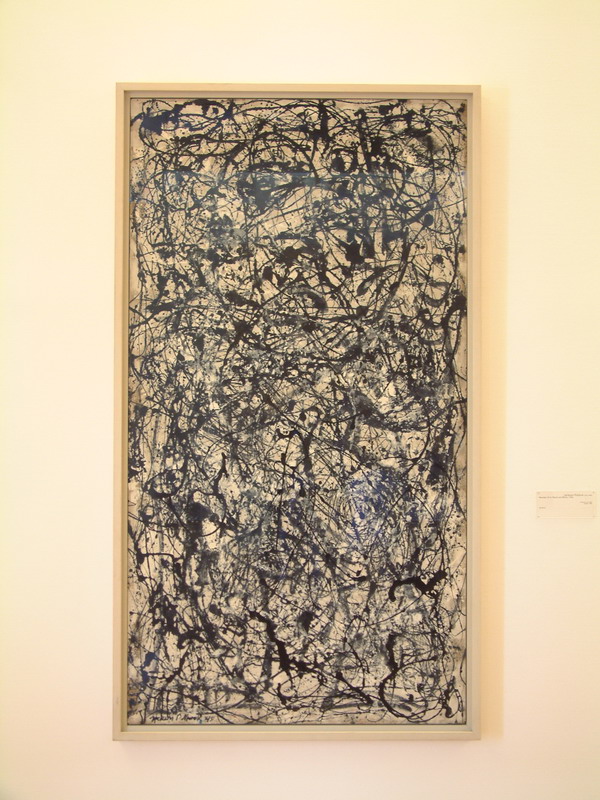
Pollock (J. Pollock, 1912–1956), the most representative painter of Action Painting in the American 1950s, was deeply influenced early on by Mexican murals and Native American sand paintings. Later, through Surrealism, he adopted a brushstroke (action) painting method in 1947—a free and amorphous abstraction—creating works through drip techniques. As art critic Rosenberg said: "The action on the canvas" is "an action liberated from political, aesthetic, and moral values."
Within this image of a passionate, homogenized optimistic new world, like a neurotic spiderweb of juxtaposed, overlapping, and intersecting multi-layered colors, when viewers face this enormous painting, it intensifies our vision, projecting us into the work to wander and imagine. This is Pollock's Action Painting that shook the international art world. His most unique aspect is stripping painting of its perspectival space within homogenization, thereby turning the European painting tradition toward the exciting American new world.
From 1950 to 1951, Pollock described his creative process: "My work does not start with sketches or color outlines. I paint directly. I am accustomed to painting on the ground… I lay the canvas flat on the ground, and I feel very comfortable this way; I feel close to the painting. Because then I can walk around the canvas, paint from all sides, or stand within the painting, like the Western Native Americans painting sand paintings. Sometimes I use brushes, but I have always preferred using sticks; sometimes I pour paint directly from cans, poke holes, and let it drip freely… I also use sand, broken glass, string, nails, stones, and other peculiar things. The method of painting develops naturally, starting from necessity. What I want is not so much fame as to express my feelings."
The renowned American art critic San Hunter provided a good explanation of Pollock's shift toward a more personal style of painting concept. He believed that Pollock's "fundamentally new meaning of freedom" was unexpectedly bestowed by the automatic techniques of Surrealists like Ernst, Masson, and Matta, who had "halted the strict formalism of modern art, etc., and elevated the emotional power of chance and accident in art, making it the first principle of creation."
Pollock believed that the source of art lies in the unconscious. For Surrealism, the unconscious is the source of "metaphors of symbols"—that is, only in their irrational associations is painting equated, recognized, and distinguished from ordinary perceptual imagery.