J. Vermeer: The Lacemaker
The Lacemaker (c. 1665): 24x21 cm, oil on canvas, held in the collection of the Louvre Museum, Paris.
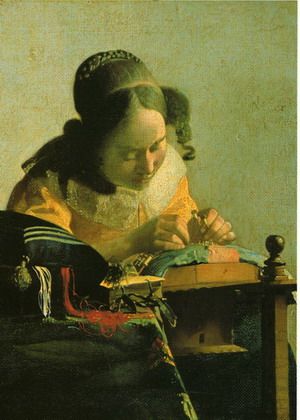
The Lacemaker (c. 1665): 24x21 cm, oil on canvas, held in the collection of the Louvre Museum, Paris.
J. Vermeer (1632-1675) was the most representative realist painter of 17th-century Netherlands. Brilliant yet forgotten by history for two centuries, he was accidentally rediscovered in 1866 by French art critic Thore-Burger. His early works were heavily influenced by Italian painters, especially Caravaggio, but he quickly developed his personal style, particularly in the depiction of light. He skillfully used bright brushwork to explore issues related to vision and space, focusing especially on poetic themes; his works radiate a rustic atmosphere and timeless tranquility.
The Lacemaker is Vermeer's most typical subject and a traditional manifestation of Dutch painting, particularly regarding ordinary figures from daily life. Like Rembrandt, Vermeer excelled at transforming the most mundane aspects of everyday life into highly poetic art. This piece depicts a young woman with neatly styled hair, wearing a yellow top with a white collar, leaning over a small table and working intently. Her hands are busy making lace; her left hand seems to hold a fine needle, while her right fingers pinch two small bobbins that strike the thin thread, with several small pins stuck in the cloth. In the foreground, on a large tabletop, sits a plump dark blue pillow adorned with contrasting red and white yarns that drape onto the surface like waterfalls, full of vitality; beside it rests a pincushion with several bobbins stuck in it. Illuminated by light (which provides an illusion of brightness and three-dimensionality in the room) and the purest colors (yellow, blue, white, etc.), the entire work exudes an atmosphere of focused tranquility. It is so perfect that no wonder the Impressionist painter Renoir called it "the most beautiful painting in the world," allowing Vermeer to be hailed as a master of realism in everyday life.