Whistler (J. Whistler) - Nocturne in Blue and Gold
Nocturne in Blue and Gold, 66.6×50.2 cm, oil on canvas, 1872-1875, held at the Tate Gallery, London. This is Whistler's most Impressionist masterpiece...
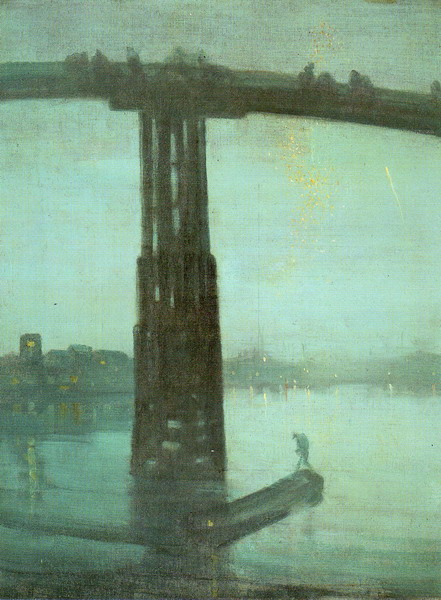
Nocturne in Blue and Gold, 66.6×50.2 cm, oil on canvas, 1872-1875, held at the Tate Gallery, London. This is Whistler's most Impressionist masterpiece, where sketch outlines dissolve into hazy colors. The "Nocturne" under the vast night sky captures the atmosphere of the scene rather than clear forms, reminiscent of Monet's "Impression, Sunrise." Nocturne in Blue and Gold depicts the night scenery over the Thames in London, with a tall, vertical, parallel iron bridge at the center as the main structural element. Amidst the gray-blue tones, under the hazy night sky where city lights meet the horizon, distant twinkling lights of the metropolis, and a starry sky shimmering in blue and gold. Beneath the hazy bridge stands a figure on a small boat; amidst the ethereal atmosphere, the artist constructs this scene with rough strokes. This poetic painting, structured by impression and feeling, reveals an obviously rigorous abstract structure as its core, with the gray-blue atmosphere becoming its soul. The artist described his colors as having a musical effect, stating that "in the elements of natural color are content, the form of the picture has been intensified, like a keyboard, all the notes of music. The artist's talent is to keenly integrate and use these elements, just as a musician gathers these notes to compose harmonious music from discordant sounds." Whistler's bold nocturne series was strongly criticized by conservative art critic John Ruskin, who accused him of "being the first I have seen daring to demand two hundred Venetian negroes to throw a pot of paint in the public's face."