Whistler (J. Whistler) - Portrait of the Artist's Mother
Portrait of the Artist's Mother 144.3×162.5cm Oil on canvas 1871 Paris Musée d'Orsay collection
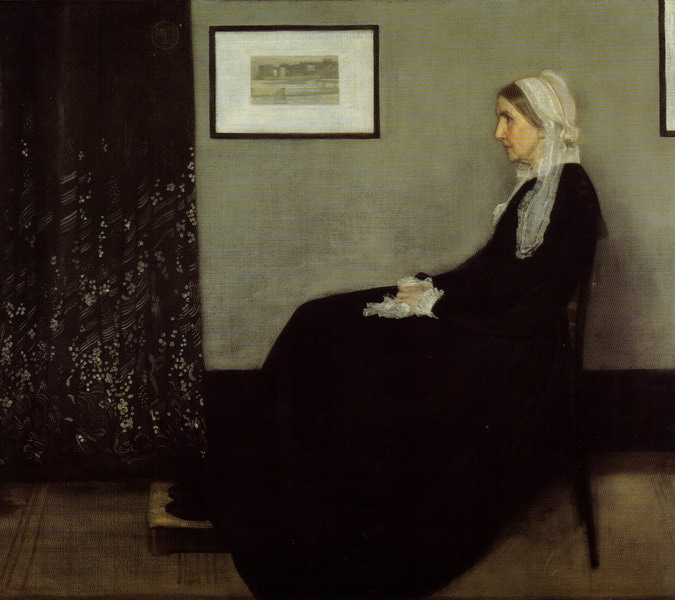
Portrait of the Artist's Mother 144.3×162.5cm Oil on canvas 1871 Paris Musée d'Orsay collection. Whistler (James Abbott McNeill Whistler 1834-1903) is the only American painter included in Impressionism, known for his rigorous structure. He was born in the United States, spent his childhood in Russia, and his adolescence in America. In 1856 he settled in Paris, never leaving Europe again, studying art in Gleyre's studio, where he became close friends with Fantin-Latour and associated with young Impressionist painters. Whistler greatly admired Courbet, refining his realistic techniques. Rejected by the Salon in 1859, he moved to London the following year and participated in the Royal Academy Salon. In 1863 he took part in the famous Salon des Refusés with "The Blonde Girl," causing controversy similar to that of his artistic friend Manet's Le Déjeuner sur l'herbe. Influenced by Japanese woodblock prints, he began to affirm his personal style. In Whistler's early realist period, this vividly rendered Portrait of the Artist's Mother is a masterpiece of that time. From 1872 onwards, in his series of poetic nocturnal landscapes shrouded in mist, his rigorous realistic contours were integrated into the colors of painting, demonstrating the characteristics and elegance of Impressionist painting. He continued to affirm the bewitching light and extraordinary atmosphere presented in his Venice series. In 1891, this portrait of the mother entered the Louvre collection; his portrait paintings achieved unprecedented success. He returned to Paris in 1896 and died in London in 1903.
Clearly, the Portrait of the Artist's Mother is a masterpiece of Whistler's realist era, within the style of Courbet's realistic realism. The kind mother sits gracefully in profile, her dignified cheeks clad in a black evening gown (this bewitching black becomes the core of the painting), wearing a light white silk hat on her head, holding a white silk handkerchief in her hands. Under the strong contrast between black and white, her feet are placed on a small stool. Against an extremely simplified gray wall background, the black figure stands at a right angle to the patterned floor-length curtains on the left. A black thin-framed white cardboard print adorns the wall; the geometric black frame enclosing the white paper appears particularly conspicuous, as does the painting on the far right that escapes the picture plane (as if the painting continues to extend outward). In the most perfect and rigorous geometric abstract structure and the substantial tones of black, gray, and white, it reveals not only the external image of the sacred mother but also features beyond representation and manifests inner expression. The artist wrote: "What the artist paints in the painting is beyond the image of the portrait at that time; the woman's expression transcends clothing and does not depend on it."