Jasper Johns (born 1930)
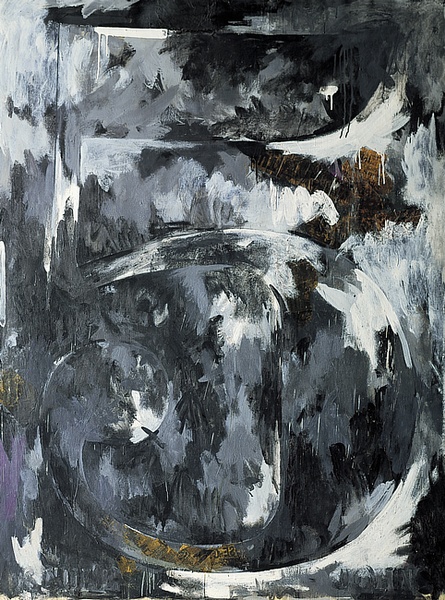
Large Figure 5, 183x137.5cm, 1960, Collection of the Centre Pompidou, Paris. Image from the Centre Pompidou website.
Jasper Johns (born 1930): His works are very concise and give people an impression of being cultivated. If Rosenberg handled his works using social signs, then Johns delves deeper into these signs. His works are relatively serious but carry a touch of humor and wit, often expressing a subtle didactic meaning through the reproduction of "readymades." They possess a symbolic quality, adeptly presenting subtle differences in emotion—alienated and vague—through the most ordinary objects. Because Johns uses extremely simple and familiar things as subjects, as he himself said: "These things can liberate him, allowing him to develop freely to another level." Although Abstract Expressionism in New York during the 1940s and 1950s was full of various inventions and displayed different personalities, Johns presented non-inventive things in unexpected ways, highlighting famous yet often overlooked items. Between 1955 and 1961, Johns chose his main themes: targets, letters and numbers, flags, rulers, and fragments of the human body; thus, his flag paintings became classics of American modernism. Johns once stated: "Using the American flag as a subject saves a lot of trouble because I don't have to design the composition myself, so I continued to use familiar subjects like targets, which are well-known." However, his main theme is to express the difference between signs and art, and no image clarifies this difference better than a target, turning a sign that can only be gazed at into a painting.
The main feature of these images—numbers, letters, targets, flags, etc.—is precisely their lack of distinctive features, prompting viewers to seek special meanings when looking at the paintings. But the painter's main concern is how to create a picture. Johns' target graphics also remind one of Kenneth Noland's color field abstractions; he was equally interested in the inactivity of the picture plane. One reason for choosing ordinary subject matter is that they might no longer generate any power. At the same time, he was deeply interested in the idea that painting itself is an object, not a form of expression. In some works, he used two canvases juxtaposed to form one piece, but placed a pair of wooden balls between them, so that from the front, one could see the wall behind, or added other things to other works, such as a ruler, a long broom, a spoon, the reverse side of the painting, or plaster models. For Johns, although his works are full of artistic interest, painting is merely a means to achieve a certain result, which might also be achieved by other methods, such as objects on the painting, sculptural readymades like toothbrushes, flashlights, bottles, body parts, or even the reverse of the canvas itself, paintbrushes, or the floor of the studio.
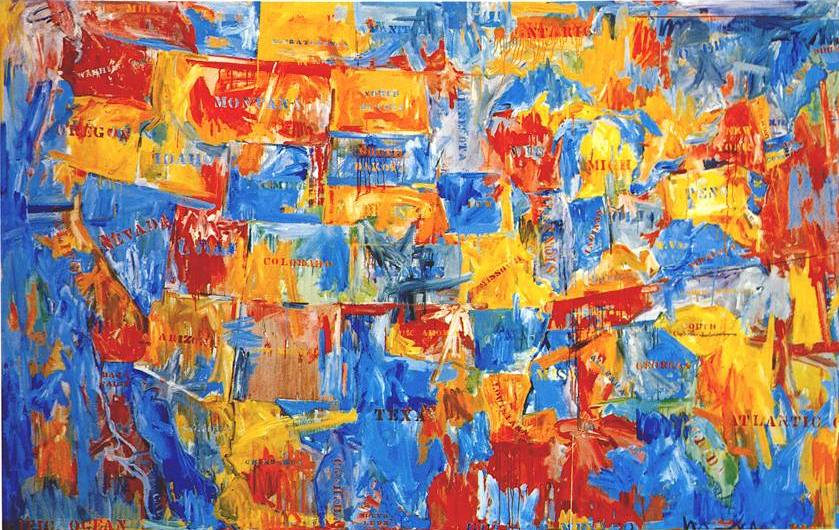
When late Abstract Expressionism was declining and becoming stale, Johns provided an invigorating vitality. He forced viewers to think about the representational meaning of these works (unlike Abstract Expressionists who indulged in an empty emotional world), rather than just pictures of creative passion. He separated the function of original objects from the meaning of color, solely to reveal another visual appearance. This is evident in his American maps, where the guiding purpose is thoroughly eliminated by wild, storm-like brushstrokes. The text he used, such as the word "red," is painted in blue or yellow, perfectly illustrating this intent.
But what further meaning could be imposed on the American flag, a symbol for Americans? Johns' strategy was to delay visual transmission through painting; he insisted that it is not a flag. This sophistry comes from Magritte's "This is not a pipe." Why? Because it is just a painting. It shares some characteristics with the American flag: it has stars and stripes, and it is painted on canvas, but it is not a flag. Just like the target he painted, it does not provide a target for shooting, it does not flutter in the wind, it is static. The stripes are drawn in an accurate diagrammatic way. Its flatness is the flatness of art, not the flatness of cloth. People first see the pale painting, and then realize that the flag symbol hidden beneath the colors has lost its power. In the ideal space of art, the flag becomes so abstract. People know that color can make anything abstract, even the American flag. However, describing Johns' works in terms of "subject matter" is incorrect. Because there is no real difference between the painting and the flag, the distance between medium and message is almost reduced to zero. These things only prove that Johns is a famous painter who leaves pleasant traces stroke by stroke with a sense of uncertainty and lack of confidence.
Johns attempted to merge subject and object into a realm of questioning, which clearly had a great impact on art, especially in American art of the 1960s. As artist Max Kozloff said: "Johns reduced the flag and target to many abstract forms, which were meanings previously granted to them by social customs, but now, after being displaced to new contexts, they no longer function from a social perspective." From this astonishing insight emerged the opportunity for Pop Art. (Refer to Taipei Fine Arts Museum, Modern Art No. 40, Chapter 7: Culture as Nature, pages 66-70, original text by Robert Hughes, translated by Chang Hsin-Lung; and Visual Arts Since World War II, Chapter 5, pages 121-125, by Smith, translated by Li Chang-Chun, published by Continental Bookstore.)