Jean Koons - Versailles Palace Solo Exhibition
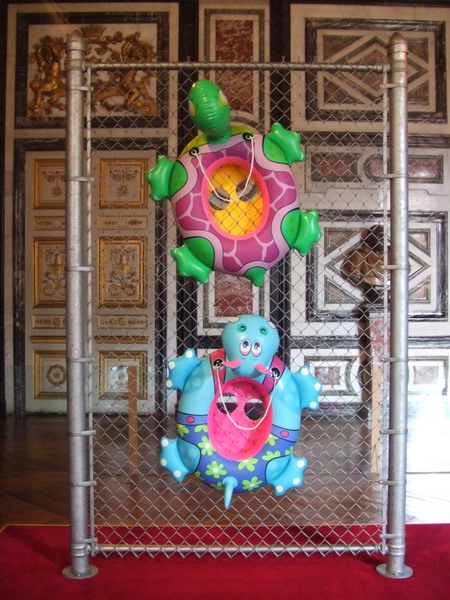
Queen's Guard Room - Children's toy swim ring placed on wire: Vulgar Eye (2003-2008)
In the verdant orange grove stands a monument-like sculpture of twin wooden horses, carved from tens of thousands of evergreen plant flowers. The 2008 solo exhibition by Jeff Koons at the Palace of Versailles, extended from September 10, 2008, to January 4, 2009, was Paris’s most dramatic and controversial show of the year. It clearly demonstrates that mainstream art today is an art of consumption and the consumption of art; the commercialized art world resembles a shopping mall, artworks are commodities, and exhibitions are trade fairs. Postmodern visual art excels in renewal, plagiarism, appropriation, simulation, and transformation, skillfully manipulating ready-made objects with the ultimate goal of fame and profit. Contemporary artists are not only like stars but also dream managers or manufacturers. Jeff Koons transforms the impossible into reality, turning items ready for taking into those ready for collection. As he said, "I think the ultimate purpose of art is a pure function, a method of affirmation and security." His works start from everyday collections of different social classes, presenting a social dimension; they are vulgar in price but not base, and can be collected at high prices.
In today's super-consumerist material life, vulgar things fill the world, permeating people's living spaces and minds. Vulgarity has become a sign of life, and the spirit has unconsciously sunk to its lowest point. Contemporary art—neo-populism after pop—is a sociological reflection. They all revive Duchamp and attach themselves to Andy Warhol's soul, attempting to create myths and deliriums from daily life, each becoming more vulgar than the last. Vulgarity becomes the consumer fashion of mass culture. The most representative artist is undoubtedly Jeff Koons, who calls himself the legitimate disciple of Duchamp and Warhol. On one hand, he inherits Duchamp's ready-mades; on the other, he adds Warhol's factory-style reproduction process. He believes his artworks derived from mass culture ready-mades possess a new aesthetics (new consumerist aesthetics). What he replicates is the popular taste between celebrity culture and mass culture. His art is purely built on the concept of commodities, representing contemporary (super-high-level) consumption and serving as the paradigm of consuming art.
Jeff Koons (born 1955) is currently the living contemporary artist with the highest auction prices (Balloon Flower (Magenta) sold for £12,921,250 / €16,343,000 at London Sotheby's last year) and is also the most active globally. He specializes in sculpture, objects, painting, photography, and ceramics. Born in Pennsylvania, USA, he entered the School of the Art Institute of Chicago in 1975, influenced by the Chicago New Image Painting movement. He later worked in securities trading on Wall Street, New York, gaining considerable understanding of commodity market transactions. In 1979, he opened a personal art studio in Chelsea, near New York. A team of about a hundred artists with various specialties helps him handle and manufacture works. On this efficient production line, resembling a factory (even more industrialized than Warhol's), no work is made by his own hands (all concepts come from him), constructing an art system under the notion that artworks are commodities.
Jeff Koons' skilled renewal, plagiarism, appropriation, simulation, and manipulation of mass culture ready-mades borrow Duchamp's ready-made corpse and restore the soul of everyday objects like Oldenburg. Of course, he thoroughly executes Andy Warhol's mass media-ization and factory philosophy. Constructing a new prospect of mass culture imagination, he probes "how to sanctify consumer products." He claims to seek an objective sense of eternity, without subjective cognition, emotional projection, or metaphorical suggestion. Ultimately, he refines and sanctifies the vulgarity of art or the artistic nature of vulgarity into commodification, making the vulgar extraordinary and turning it into middle-class luxury goods and museum consumer art. His most representative works include the dramatic three basketballs balancing in water (1985), Rabbit (1986), the playful Jackson and His Chimpanzee (1988), Pink Panther (1988). The erotic series from the 1990s features ceramic sculptures of him having sex with Italian sexy star Ciccolina, monument-like balloon dogs, mesmerizingly colored moons, playful caterpillar ladders or children's swim rings - Vulgar Eye, and finally, hanging hearts full of romantic sentiment.
The Jeff Koons - Versailles Palace Solo Exhibition displayed 17 symbolic three-dimensional sculptural works. Exhibited works from early to recent periods were more restrained, with drama and playfulness outweighing eroticism. In the Cour d'Honneur, a magnificent monument-like statue of Balloon Flowers, folded from balloons and enlarged cast bronze, fills the space between figurative and abstract with imagination. The palace exhibition begins in the Hall of Hercules with an extraordinary Magenta Balloon Dog (1995-2000). In the opulent Golden Room, the artist's symbolic bronze Rabbit statue (1986). The Venus Hall holds the sensual Jackson and His Chimpanzee (1988); the Diana Hall features the humorous Ushering in Banality (1988); the Mars Hall displays an ordinary large lobster (2003); the Mercury Hall showcases the majestic bust of Louis XIV, the Sun King (1986); the Apollo Hall presents Koons' confident self-portrait statue before the Sun King statue (1991); the War Hall features Disneyland-like statues of bears and police (1988); the magnificent Hall of Mirrors contains the imaginative Violet Moon (1995-2000); the Peace Hall exhibits the sensual Pink Panther sculpture (1988); the Hall of Nobility shows a train in a display cabinet (); the Grand Dining Room antechamber resembles a home appliance showroom with a vacuum cleaner neon-lit home appliance display cabinet (1981-1987); the Queen's Guard Room houses a children's toy swim ring placed on wire: Vulgar Eye (2003-2008). On the exit tour staircase stands a silver sculpture of a hanging heart full of happiness and romance (1994-2006). Finally, in the verdant orange grove, a monument-like sculpture of twin wooden horses, carved from tens of thousands of evergreen plant flowers.