Jean-Michel Othoniel
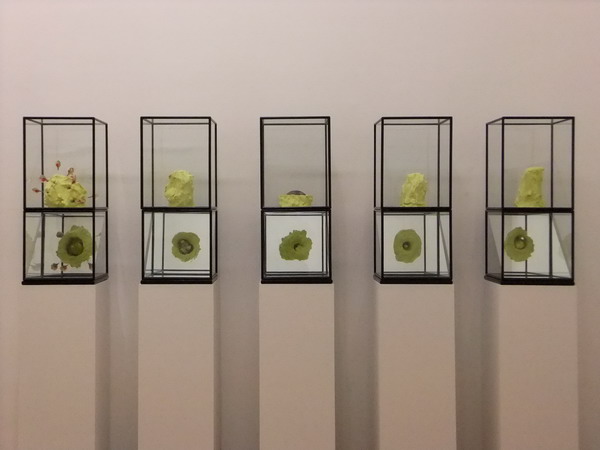
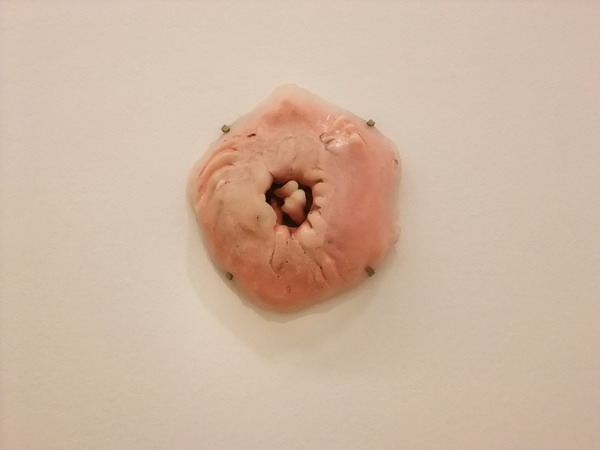
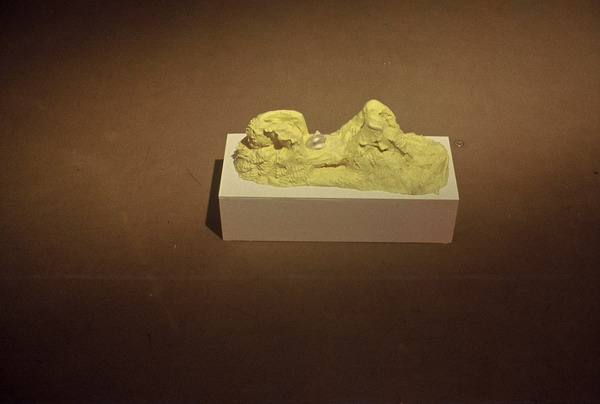
"Suerte's torment, green anus, slaughter's tail, bride's fingers, and celebrity smoke": Melted sulfur series, 1991.
Born in 1964, Jean-Michel Othoniel is one of France’s most representative contemporary artists and an atypical nomadic creator. His works emerge from travel and diverse cultural encounters, often involving cross-disciplinary collaborations with experts. He favors experimenting with unusual materials—such as sulfur, wax, phosphorus, and glass—acting like an alchemist with these easily moldable, organic substances. In this technological age, he is among the rare artists returning to traditional folk craftsmanship, echoing Italian Arte Povera. Othoniel is renowned for his mesmerizing glass sculptures and installations; his diverse object-sculptures become large strands of jewelry, bead curtains, sensual objects, and architectural forms. Through a taste for deformation, excellence, and transformation, he delights in revealing the beauty hidden within matter. As the artist says: "Glass is so complex (...) there are so many techniques and such a world worth exploring that I am always happy to use them. Exchanging ideas with glassblowers is crucial for me. That gesture is often one of great tenderness. Of course, it is very direct. The image appears quickly; she exists, one can feel her." Under the physical beauty of poetry, he offers an alternative perspective: "For him, beauty is a trap; first, one indulges in it, drawn to it. Like a butterfly lured by a flower (...) 'Beauty' allows dialogue between the artist and the audience."
Othoniel’s art delves into personal trauma and the meaning of existence. Starting with early mysterious "self-portraits" (1986) where he wore clerical robes, he intimately references imagined, virtual secret tragedies under a pessimistic semiotic framework of failure, loss of intelligence, and scars. These elusive, pale blue photographic bodies echo the phenomenon of ghosts and fading ambiguity that reality cannot grasp. The "Failed Photographs" series (1987-88) is no exception, situated within postmodern bad taste. Soon after, the artist abandoned photographic reference, exploring other materials to construct his collection of curious small objects. In a state close to surrealism, these micro-installations became signs, revealing existential questions through light and shadow changes; delicate objects remind us of life’s fragility. Existence is open, with various possibilities. In accidental encounters during life, Othoniel came into contact with chemical sulfur (Le soufre). The French word for sulfur is nearly homophonous with the verb souffrir (to suffer), adopting this linguistic duality and metaphor. Attracted by the substance’s intense color, he immediately fell in love with this extraordinary material, making sulfur the core of his work. First, handcrafted zodiacal small objects (1989) quickly evolved toward voluminous sculptures requiring more material media and processing techniques. For the first time, the artist collaborated with scientists and industry, such as in the object installation "Also Obvious" (1989), featuring a huge yellow sulfur rock displayed on a contrasting black pedestal. Collaborations would deepen in subsequent years. Traveling as a nomad, nurturing new products in new contexts, encountering and meeting became his artistic world.
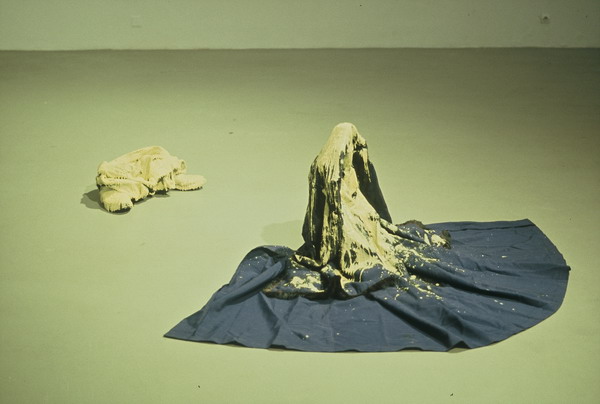
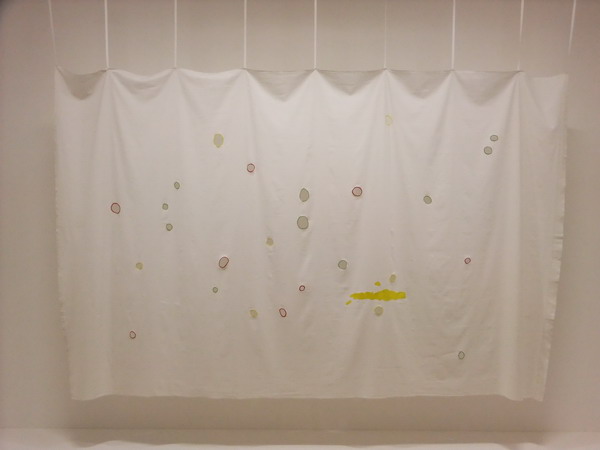
In the 1990s, emphasizing fragmented bodies within a symbolic and metaphorical framework. In 1991, in Hong Kong, the "Melted Sulfur Creation Series" featured naturally formed mountains. Within the negation of formal sculptural characteristics, the concave base of the mountain revealed sensual body fragments: fingers, tongues, female genitalia, or anus. Titled "Suerte's Torment, Green Anus, Slaughter's Tail, Bride's Fingers, and Celebrity Smoke," these surreal objects were placed in glass cabinets, revealing hidden truths and beauty through mirrors below. The following year, participating in Documenta in Germany, Jean-Michel Othoniel attracted widespread attention with this innovative material. He collaborated with choreographer Daniel Larrieu to delve into the bodies of the AIDS generation, constructing bodies like matter, pouring sulfur onto clothing referencing sexual bodies. Simultaneously, he introduced new materials and colors—wax. With its plasticity, he constructed object-sculptures full of sensuality and imaginative space: such as "Mount Venus," "Sibyl's Cave," etc. In 1995, he explored another natural organic material—phosphorus (the substance used to make matches)—dramatically presenting a huge phosphorus scraper titled "The Wishing Wall." Inviting viewers to light a match and make a wish, he engaged with aesthetic concepts. Later that year, another feminine work, "Glory Holes," featured white bedcloths embroidered with holes resembling women’s nipples, full of ambiguity and emotional contradiction.
In 1992, while searching for sulfur in the volcanic hot spring areas of the Eoliennes islands in southern Italy, he unexpectedly discovered another natural material—obsidian, a mysterious black natural glass. Donated to the industrial research department of the Cirva Glass Experiment Center in Marseille, Othoniel created a work using this material, shaped like Italy’s Stromboli volcano. From a visit to the Murano glass workshops in Venice in 1993, meeting master glass technician Oscar Zanetti, he began exploring this extraordinary material—glass. In an experiment of materiality involving conversion, transformation, and transparent media, through rituals of shaping processes, he found resonances of extraordinary forms. Between solid and fluid, glass holds a memory equality for him, connecting continuously between two transient states and two realities. He attempts to enter an imaginative journey and recall playing with glass beads that same year.
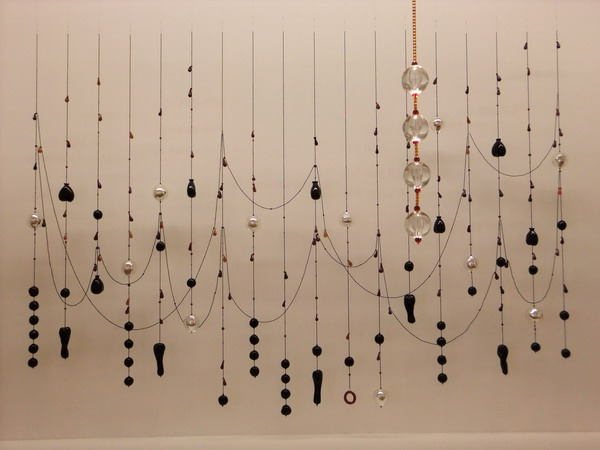
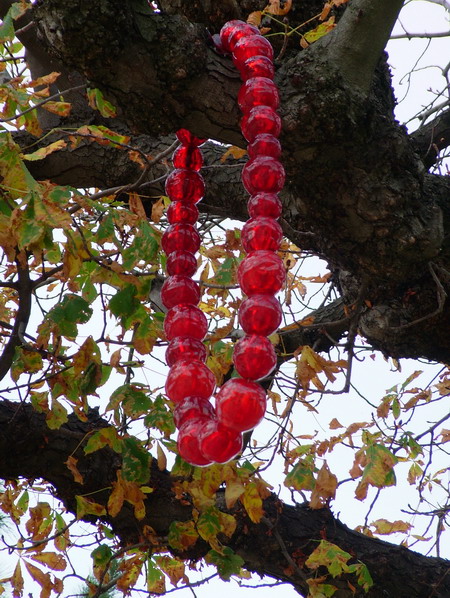
In 1996, when Jean-Michel Othoniel resided at the Villa Medici in Rome, France, he began assembling these transparent painted glass beads (from the famous glassware of Murano, Italy). Weaving large glass beads into giant jewelry hung on outdoor trees, integrating them into the natural environment, shining among lush green leaves like extraordinary fruit types, he pioneered a remarkable object-sculpture installation. It was not until 1997 that he truly began collaborating with the Murano glass workshops, delegating artistic actions to technicians for the first time to achieve these shimmering and ambiguous organic forms. The series of imaginative hanging works attempted were quite sensual, oscillating between phallus and plant. The artist said: "I want my works not only to stimulate viewing but also to make people want to lick them with their tongues."
He built his work’s core around damage and irregularity. The artist said: "I work on broken glass. Flawed glass: glassblowing carries traces of the blower’s body. It is kneaded and stirred, held in his hands. The glass technician explained to me that the difficult part is that it must be perfect; if there is any breakage on the bead, after melting, the trace will not change. I like this concept: of course, everything can be beautified, cracks will reappear. I choose to work on these accidents; I need the technician to break the glass before working, which can create irregular forms, especially leaving traces of flaw in the work, where I see true beauty. I propose an idea: presenting the material violence of the work (...). I am interested in this folk art; glassware, like other crafts, has many defects. Generally, these objects look beautiful from a contemporary perspective. I want to change the technicians’ viewpoint, even if they think it is wrong, trying something else, in a very Pasolinian relationship. At the same time, it becomes for them a method of expression, without any deception; they know these gestures will lead to these sensual and phallic forms." (Note 1)
That same year, he strung a thousand red small glass bead necklaces and gave them to favorite friends and relatives at a public event, as a memory of the American artist Felix Gonzalez-Torres who had recently died of AIDS. Entering diverse colored glassware sculpture and indoor/outdoor space installations, developing various technical possibilities, compiling various curtains and precious large and small jewelry. Developing a new index and imaginative realm, tending toward a narrative fairy-tale world, pre-modern decorative vocabulary, religious ritual objects becoming new sources of inspiration. In 2000, Jean-Michel Othoniel constructed Paris’s most famous public art—the Palais Royal-Musée du Louvre metro station exit. Using colorful glass beads, supported by aluminum pillars topped with double (outer red, inner blue) glass bead crowns, highly decorative like an imagined stained-glass palace, it is the most striking metro station since Art Nouveau in the last century, between half-object and half-architecture. The artist said: "At the Colette square in front of the French Comedy Theater, this metro station changed the fate of my art; I feel honored."
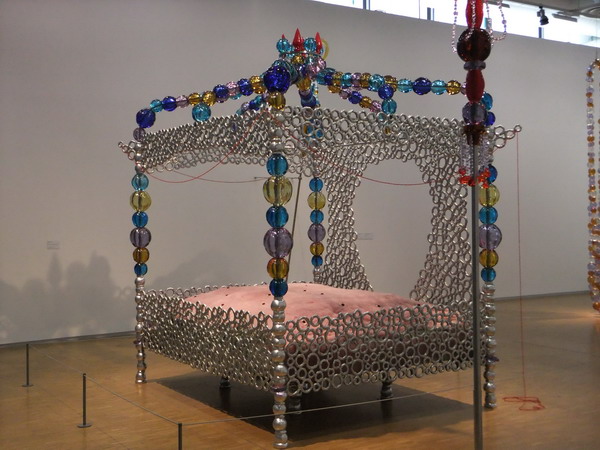
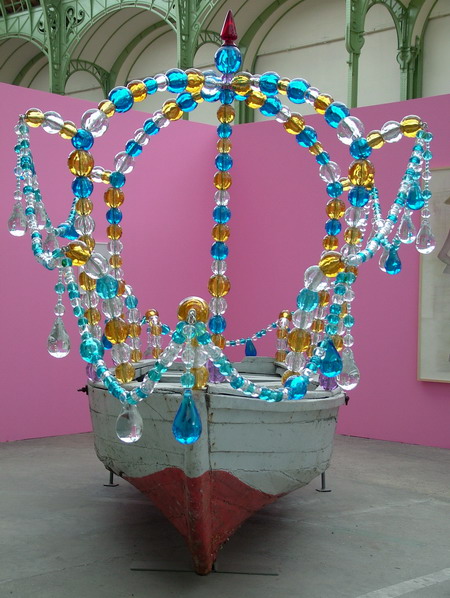
Jean-Michel Othoniel confidently welcomed new creative challenges, changing and shifting real-scale categories, turning reality into a dreamlike and magical world. Such as the large-scale space installation "Glass Palace" (Cartier Contemporary Art Center) derived from fairy tales in 2003, or "My Bed" object-sculpture, an extraordinary Baroque monument form, very designed, surrounded by circular decorations, topped with a dazzling glass bead crown. Turning flashing tears into jewelry, "Tears of the Boat" (2004) decorated a wrecked refugee boat at sea (from Cuba) with colorful glass beads, full of metaphor. The boat carried tears of suffering and joy, combining fantasy aesthetics with historical tragedy memories. Between mesmerizing sculpture and object, jewelry and architecture, poetry and allegory, dream and imagination. The artist said: "I prefer to provide visitors with a strong impression, as if facing the work alone, in a closed Eden, exotic beyond the world. My glass sculptures must be discovered and entered."
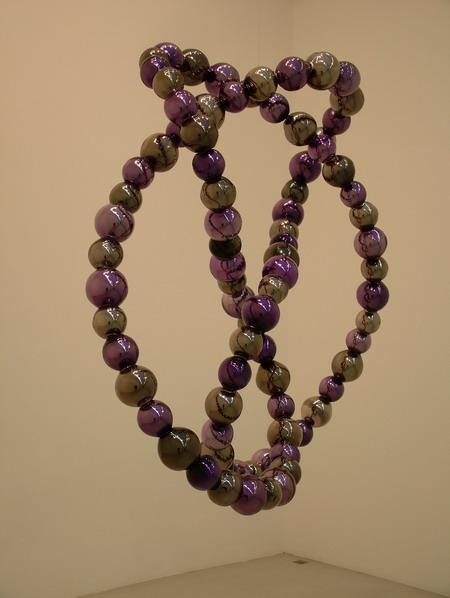
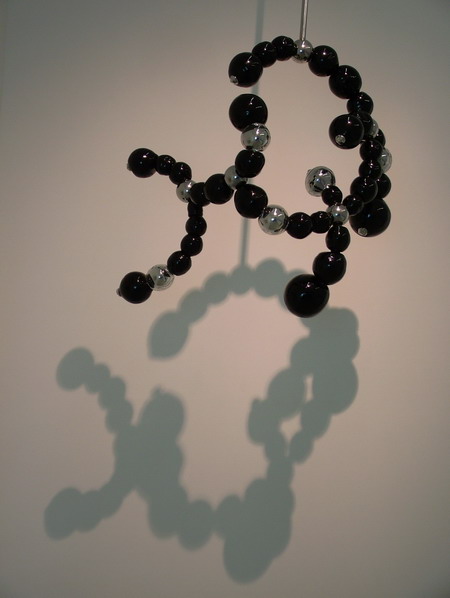
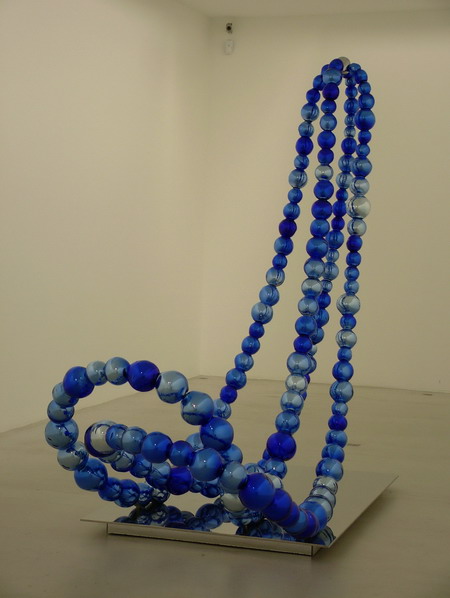
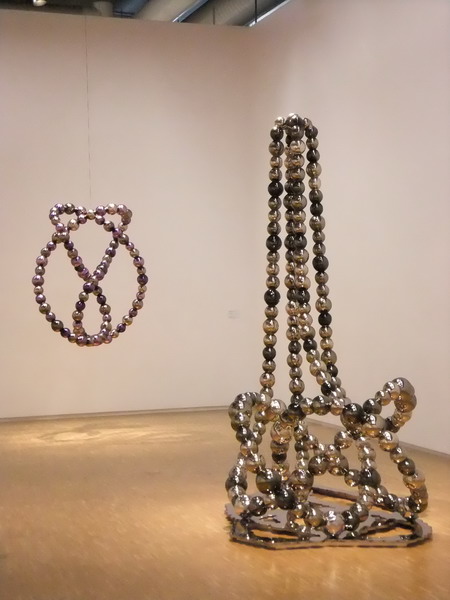
After these collaborations and material explorations, Jean-Michel Othoniel gained the trust of glass technicians. The artist said: "They reveal some secrets, especially those unique colors. I further explore the thickness of glass beads, rough surfaces, the skin of glass, which are extraordinary to them. All my glass beads are cognitive experiences of technology through observation and dialogue. I know the possible or impossible sequences, bringing them to their greatest possibilities through major diplomatic skills." In recent years, Jean-Michel Othoniel has explored abstraction beyond all artistic trends and institutional aspects. Arriving at the problem of absent bodies, developing a "physics of poetry," exposing rigorous mathematical formulas of aesthetics, continuing to retain sculptural vocabulary, constructing effective linear volumes of glass beads, equal material and immaterial expression. Numerous works reveal simple existing objects—jewelry—magnified in size to monumental large necklaces, such as the dual simple elegance of "White River" or the dual knot of "Blue Snare" (2009), presented on pedestals like object-sculptures. Or in mathematically modeled space installations, creating volume through crossed knots, forming diverse variations and organizations. "Knots," inspired by the famous French psychoanalyst Lacan, serve to display the relationship between imaginary, symbolic, and real three-dimensional spaces. Such as the simple circle of "Lasso Light Blue" (2008), forming a simple figure-8 shape, the transparent glass bead-linked "Lacan Knot" (2009), both hung on walls. Or "Kinetic Sculpture" (2009) hung in the air and the complex knot "Self-Portrait Large Knot" (2011) (presented on a pedestal) become outstanding expressions of real three-dimensional space. All within generous forms and repetitive rhythmic color structures, expressing spirit and matter, reality and imagination, lyricism and sensibility, craft and design, allowing daily life to rediscover wonder at the world in a visual feast.
(Note 1: Jean-Michel Othoniel catalog written by Catherine Grenier, Centre Pompidou, published 2010, p.148)
Appendix: Jean-Michel Othoniel, titled "MY WAY," from March 2 to May 23 at the Centre Pompidou Modern Art Museum, serves as his retrospective exhibition covering 25 years, introducing his unique creative process from 1986 to the present. "MY WAY" derives from the touching lyrical song by the deceased French singer Claude François, later taken up by the famous American singer Frank Sinatra, reaching the pinnacle of folk popularity and still touching a broad audience today.