Jim Dine (1935)
Putney Winter Heat 183x183 71-72, collection of the Musée d'Art Moderne de Saint-Étienne Métropole, France.
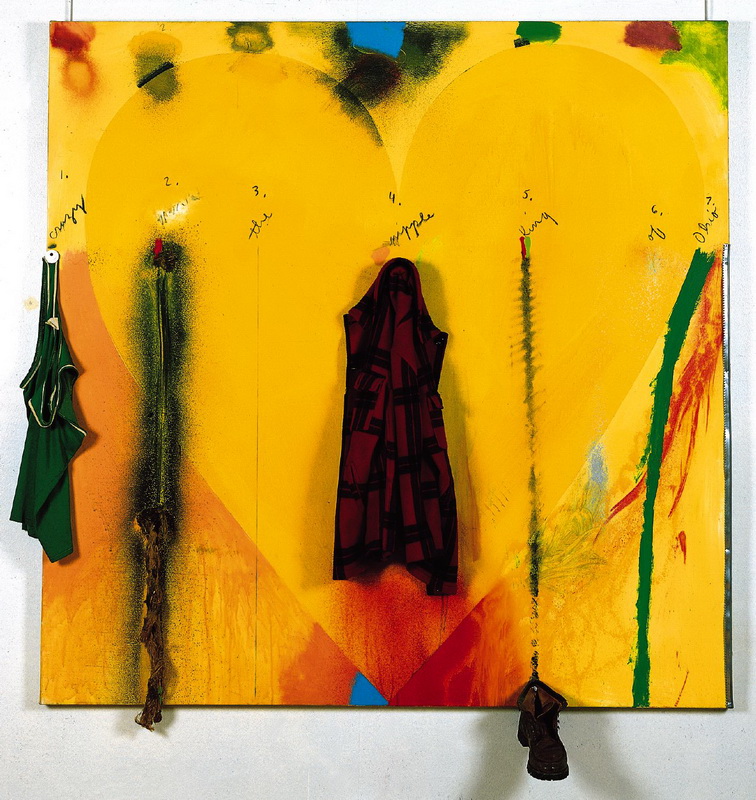
Jim Dine (1935): An artist close to Neo-Dadaism, he shares a very close relationship with Rauschenberg and Johns in two aspects (the use of readymades or the application of painting's essence, or engaging in improvisational, happenance performances like Rauschenberg). Spiritually, Dine is an assemblage and collage artist. His themes are the various appearances of real objects; in his most typical works, he pastes readymades such as clothes, washbasins, tools, etc., onto the canvas, then roughly sketches plots around these objects, usually carefully writing the names of the depicted items. However, the more closely we examine American Pop Art, the more we discover it does not praise mass culture, nor is it even an anti-mass culture action. Instead, in Pop Art, popular imagery is used as an excuse; it becomes a sneaky means of entering profound philosophical questions. These artists, when asked about their era, almost always talk about methods of observing things, rather than what we truly see—various advertisements, signs, comic strips, and other things that genuinely attract people. When we recall this issue, we find that its imagery seems {given}. It is there {for no reason}, so there is no need to be dizzy from the problem of re-creation. However, American Pop artists do not cloak their subjects in a layer of romanticism like British Pop artists do.