Jimmie Durham "Throwing Stones"
Stillness. Dramatic scene: a civilian plane crushed by a giant stone (as if a meteorite accidentally struck it). Object installation, 2008.

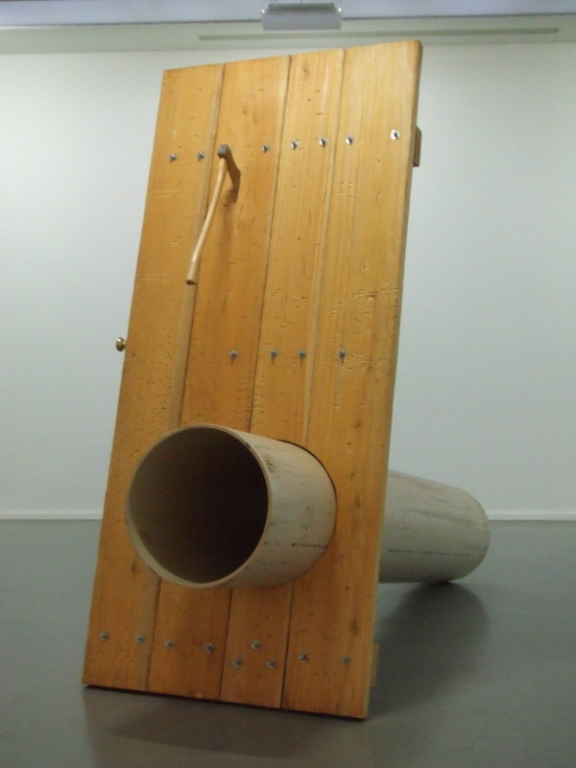
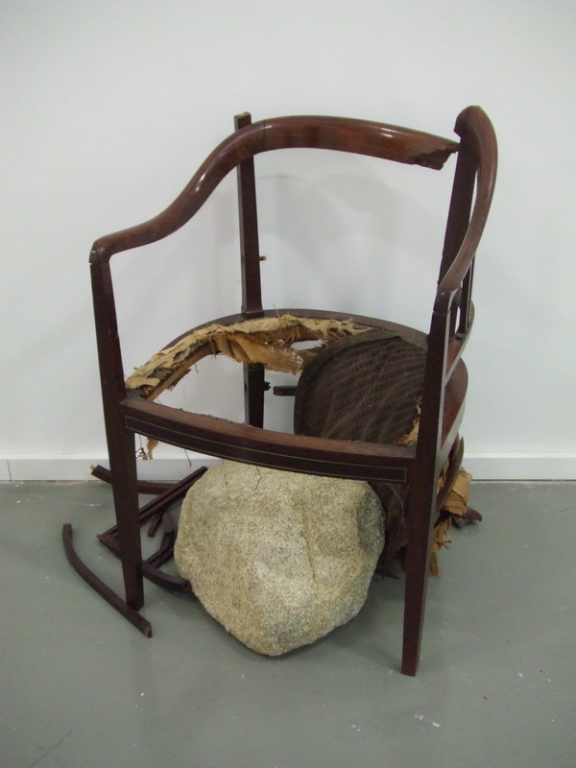
Poetic meteorite impact. Object construction, 2000. Jimmie Durham's "Throwing Stones" is on display at the ARC of the Paris Municipal Modern Art Museum from January 31 to April 12. Born in 1940, Jimmie Durham is one of America's most alternative and unusual contemporary artists. Working within the anti-form, anti-art attitudes and performance traditions of Dadaism and the Fluxus movement of the last century, he creates diversely: sculpture, installation, painting, drawing, performance, video, and photography. Grounded in social consciousness and total art concepts, he affirms an organic discourse. His works begin with appropriating natural materials or everyday ready-mades; sometimes humorous, sometimes violent, they ingeniously transform, assemble, and juxtapose objects unexpectedly, sparking extraordinary imagination and introducing a critical tone of separation and empire. Through these explorations, he emphasizes personal eternal freedom, avoiding all systems. In the 1970s, Durham was a member defending American Indian civil rights; his art clearly explores individual identity through wit, humor, and violence, possessing poetic social consciousness and political critique. Early US works focused on personal identity, such as the ideological Jesus (Es geht um die Wurst) (1992), using thematic contrasts to metaphorically reflect personal identity and consciousness. Since settling in Europe in 1994, questioning whether his discourse is contemporary or historical, he has shifted from personal biography to general critique, approaching a critical cognitive system of traditional archetypes, constructing our relationship with the world. From here, "stones" are not just metaphors for resistance but symbols of architecture, appearing as tools of power in this unusual creative work. The exhibition theme makes this clear: seeing the entrance hall, a dramatic scene shows a civilian plane crushed by a giant stone (as if a meteorite accidentally struck it). The artist humorously titled this unusual disaster "Stillness" (2008), opening an unconventional imaginative space and unique poetry. For Durham, stones serve as both behavioral tools and objects. In the "Portrait Photo Series" (1995–2006), this similar and primary relationship holds true. More remarkably, in an attitude-driven action, the artist smashed an old American refrigerator with a stone for a week until it was unrecognizable. This dramatic, violent act became the video art documentary "Stoning the Refrigerator" (1996). The battered refrigerator left behind became the remarkable work "St Frigo" (1997), where the stone replaces the hammer as a tool for changing objects. A classical chair crushed by a meteorite is poetically titled "A meteoric fall to healen" (2000). The artist says: "I often use handmade objects; I treat stones as tools to change their form. The violence of the work reveals this perspective, which becomes the core." Additionally, referencing history, "Gilgamesh" (1993) features a plastic tube piercing a wooden board with an axe, invoking legends of Mesopotamian kings from the third century BC through relationships of up/down, inside/outside, heaven/earth. "The Personal Triumphal Arch" (2003) fills imaginative space, transforming Europe's unique triumphal arch into a witty, humorous personal image. The artist states: "The triumphal arch is a unique European product; I try to give it a certain distance and personal style." Questioning the relationship between art and society, "Chasing Happiness" (2002) is a dramatic video art piece. The monumental "Something perhaps a Fugue or an Elegy" (2005) is constructed from various received objects, acting like a living machine of life signs between objects and language.