Joana Vasconcelos "Where Black is a Color" Solo Exhibition
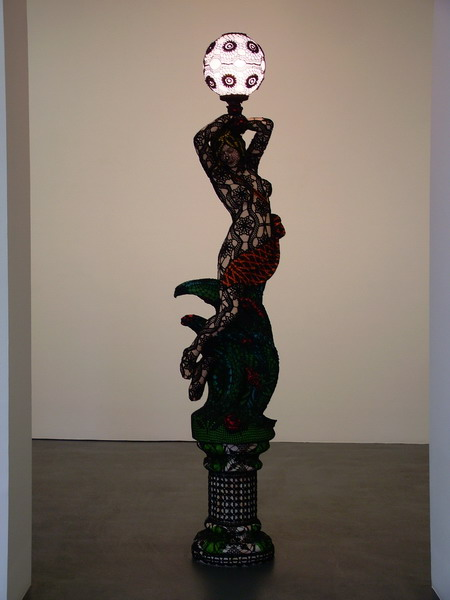
Euphrosyne Sculpture-Object 2008

Victoria Fabric-Object Environmental Space Installation Detail 2008 Joana Vasconcelos "Where Black is a Color" Solo Exhibition: On view from January 12 to March 1 at Galerie Nathalie Obadia. Joana Vasconcelos (born in Paris in 1971, Portuguese) is one of Portugal's most representative contemporary artists. In globalized art, it is rare to see Portuguese contemporary art; located on the edge of the EU, like Spain, Portugal carries strong cultural traditions and customs, especially in color. Black has become an image and meaning of a certain Portuguese consciousness of life. Many widows wear this extraordinary traditional black clothing. Today, in all advertisements related to Portugal, such as those for Bordeaux wine, black dominates, becoming the symbol of the Portuguese people. In her first solo exhibition at a Paris gallery, Joana Vasconcelos legitimately uses the theme "Where Black is a Color" to cite its local essence.
At last year's International Art Fair in Paris, I noticed Joana Vasconcelos' remarkable monument-form sculpture "Priscila" in the Tuileries Garden. It was a giant woman's high heel constructed from stainless steel kitchen pots. I am now pleased to see her solo exhibition. The main characteristic of Joana Vasconcelos' work tends toward female delicacy and sensitivity, exploring complex plots and feelings deep within women's hearts. She particularly emphasizes shared identities and consciousness of the global and local, innovatively involving differences in female identity and social classes. Her creations clearly receive symbolic and consumer objects from social folk life, as well as local cultural code elements. She often adopts a poetic and sensual way to satirize and criticize the consumer society under globalization.
In this solo exhibition, Joana Vasconcelos presents six monument-form works, with femininity being the greatest feature. "Red Autonomous Heart" is an object-sculpture installation in an independent exhibition space. A giant, sexy red heart-shaped form rotates endlessly to the light, ethereal, and sorrowful melody of Portuguese folk music (Fado). Love's romance carries a hint of grievance, expressing the love sentiment of Portugal, once a great maritime nation, or current forms of consumerist romance. This work presents two symbols of Portuguese culture: traditional sorrowful folk music and the legendary Heart of Viana. The sculpture draws inspiration from the local tradition of Viana de Castelo (women in this area like to wear small, charming silver or gold heart necklaces), completed using plastic sheets and refined local traditional craftsmanship. Of course, bright red symbolizes love and passion.
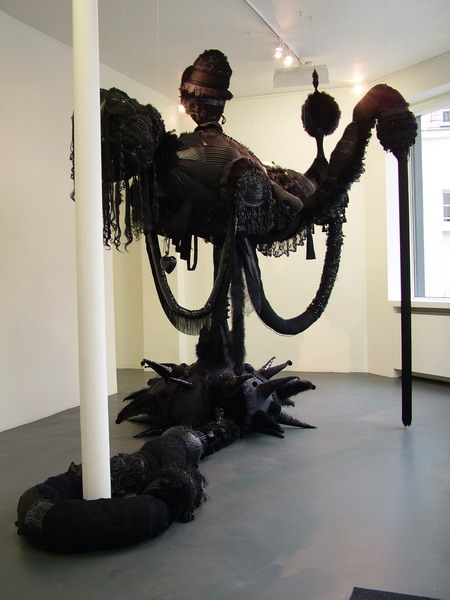
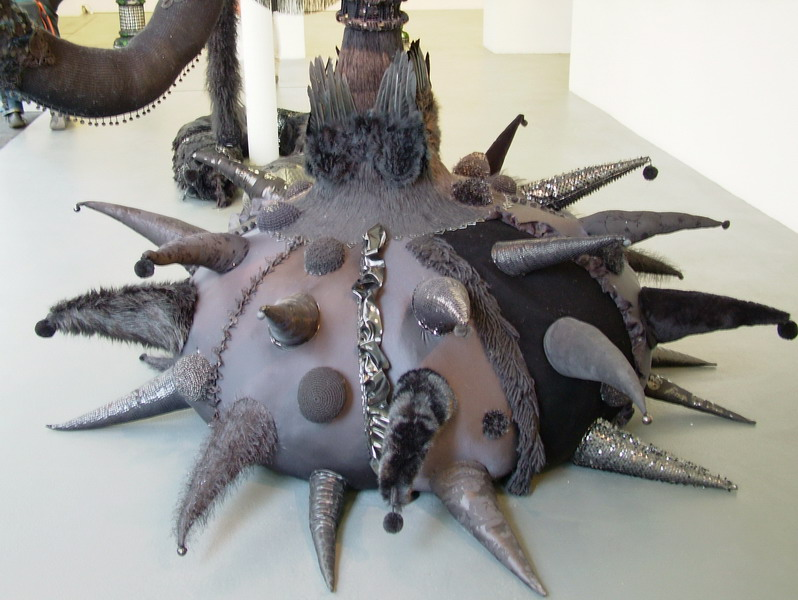
The most striking piece in the large exhibition room is the huge monster-like "Victoria," a fabric and woven soft-object installation. It wraps around viewers in a four-unlike-all-black form-object-sculpture, with an extraordinary shape beyond imagination, resembling organic reptiles or legendary monsters. Bewitching in various black textures (glossy black, pitch black, rough black, etc.), it is divided into two parts: a winding crawler on the ground connected to a poly-horned black starfish-like object, and another body standing upright hanging in mid-air. An irregularly shaped object resembling a monster's head sits atop, with smaller heads featuring hanging hair and twists, surrounded by hanging ornaments that reach the floor, creating bizarre freaks. Here, the indescribable qualities and elusive moods of women are emphasized. Through the delicate weaving of Portuguese or Mediterranean traditional women, female characteristics and identity are fully displayed.
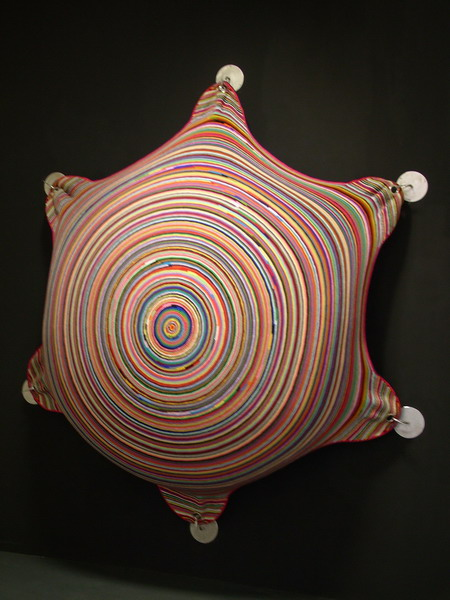
Another dazzling piece is "Big Booby," another soft fabric work. Ingeniously crafted from colorful woven bedspreads into an extraordinary object-sculpture, it forms a semi-circle within concentric rings of color, spreading infinitely like water ripples. Suspended symmetrically by six legs on the wall, it forms a magnificent structure. These infinite spreading colored rings leave viewers dumbfounded, poetically guiding them into deep psychological consciousness and perception. Clearly, Vasconcelos again receives objects from social folk life, updating tradition into current artistic objects. Next are three series of works receiving Western classical Greek statues: "Euphrosyne," "Thalie," and "Aglaia." These three nymphs from ancient Greek mythology represent women's outstanding elegance, aesthetics, and sensuality, also indicating the concept of woman-as-object. Here, the artist cleverly dresses the statues in full-body attire using traditional Portuguese women's embroidery. Under various shapes and colors, she gives the statues new magic and life, transforming free and sensual women into satirical images. Finally, the new electronic age theme "www.fatimashop" video and object work presents a three-wheeled truck. Inside the cargo area are placed Fatima nun statues of various sizes. Vasconcelos says, "You Parisians have the Eiffel Tower, so we Portuguese have Fatima nun statues (this is Portugal's national icon, currently lacking any cultural symbolic meaning, becoming a consumer object)." On the wall plays a documentary of the artist driving these two trucks loaded with Fatima nun statues around the capital Lisbon. She reveals this social symbol, which is not religious but rather a popular connection and a critique of profit-driven concepts.