John Baldessari Solo Exhibition of New Works from the Hands and Feet Series
One of the new works from the "Hands and Feet Series," 100x150 cm, photo collage, 2009.
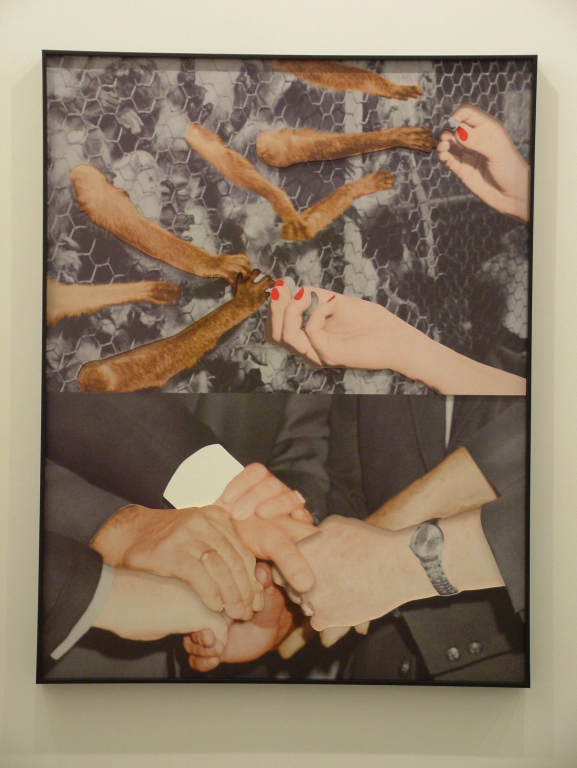


John Baldessari’s solo exhibition, New Works from the Hands and Feet Series, runs from October 17 to November 28 at Marian Goodman. Born in 1931, John Baldessari is one of the most representative artists of American narrative art in the 1970s, renowned for constructing composite photographic images and serving as a pioneer of contemporary digital photography. His innovative works embody the humor and satirical spirit characteristic of people on the American West Coast. He studied at the San Diego Art Institute in California from 1949 to 1957, initially engaging in painting until he resolutely abandoned traditional painting in 1966. Adopting an anti-object stance, he turned toward conceptual art exploration, beginning to shoot films and engage in video art. In 1967, he radically eliminated all imagery, expressing himself directly through written text; notable works from this period include Everything That Can Be Removed From Painting Should Be Removed (Concepts Enter Into The Work). He further began constructing composite photographic images and texts within narrative concepts, as seen in his groundbreaking works such as Ryan Oldsmobile (1967) or Composing on a Canvas (1967–1968).
In 1969, when Doug Yule declared, “The world is full of more or less interesting objects, I do not wish to add any others,” Baldessari took even more radical action on May 24, 1970, by organizing what was named “The Cremation Project.” In this act, he burned all the paintings he had created between 1953 and 1966. The following year, he constructed his conceptual works through written statements, such as I Will Not Make Any More Boring Art. In 1971, Baldessari moved from San Diego to a new studio in Santa Monica, marking the start of a new creative phase focused on various images from mass media: television, news, magazines, particularly those mesmerizing cinematic images from Hollywood. Living adjacent to California and Hollywood, he subtly became aware of these cultural shifts (of course stemming from Pop Art), using these images to question artistic conventions and boundaries. Through the assembly, editing, and juxtaposition of photographic images, he constructed an art form akin to that of a film editor.
Baldessari thus emerged from the linguistic dialectics of conceptual art, demonstrating a new era aesthetics within visual formal compositions, latent narrative content, and emotional structures, while exploring various possibilities of form, as seen in the series A Monie Diretional Piece Where People one Looking (1972–1973). Later, he reorganized photographic plots, often in geometric forms, combining them under multiple reading functions, or emphasized structural analysis of images in series like Blasted Allegories Colorfui Sentence and Purple Patch (1978). In the 1980s, prioritizing sharp and emotional image combinations, he manifested diverse sensations; through the overlapping of these photographs, he constructed unexpected effects as literary plots, developing allegory and hinting at possible narratives, as in the Bloody Sundae series (1987). Then, adding symbolic colors in series like Composition Pour Violons et Voix, he formed a unique poetic painting imagery. In 1988, he further explored contrasts in new images, such as in A Fix d Inflexible Sorrow, revealing violence, crisis, truth, and poetry within an excellent and rigorous aesthetic perspective on formal structure, quite literary and resembling visual cinema, full of imaginative space.
In the 1990s, Baldessari mixed black-and-white and color photographs to construct combinations, integrating various plot images, such as in the Killer Wahle Man Water Glass series (1991), emphasizing the possibilities of formal language and multi-image narration, filled with poetic imagination. Starting in the mid-1990s, in two major series, Overlapping and Crossing, these images continued to come from films and real-life imagery (apartment buildings, port cargo ships, landscapes, etc.), completing the combination of film (video), real life, and painting. In the Overlapping series, he constructed indeterminate pictorial forms. In the Crossing series, he built distinctive “T” and “+” shapes, dividing nature and culture, parallel coastlines and vertical skyscrapers, implying narrative plots and presenting the living real world within poetry, imagination, form, and space; the artist called this the “area of imagined conflict.”
In the solo exhibition New Works from the Hands and Feet Series, John Baldessari continues to explore human identity through images of body parts. Cleverly combining black-and-white and color photographs of human and animal parts, he creates visual syntax on rigorous vertical and horizontal structures and embossed image surfaces, forming an unusual dialogue between photography, painting, and sculpture. Baldessari eliminates all traditional reading conventions, providing a broad space for annotation, which depends on his cultural connotations and imagination. The artist states: “For most of us, we believe that photographs express truth; however, an outstanding artist can enhance reality through the manipulation of form and image, along with the restoration of painting. It is quite mesmerizing, just as I manipulate truth, it is so easy to juxtapose contrasting photographs or strip them of their background. By pitting two forces against each other within the same photographic image, I can endow them with vibrant vitality—for example, a knight and his horse, a mummy standing on a coffin, and a terrified woman watching him. Editing and manipulating an image can make it more ambiguous, the result resembling a battle.”