Kara Walker "My Enemy, My Brother, My Executioner, My Lover" Special Exhibition
(Plate 1) A scene from the space installation *Slavery! Slavery!*, 1997. (Plate 2 left) Two large white silhouettes in *Excavated from the Black Heart of a Negress*, emphasizing the slaves' pitiable story with strong emotional quality, 2002. (Plate 2 right) The most spectacular, ironic, and bewitchi
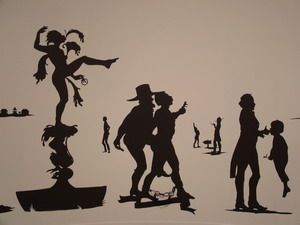


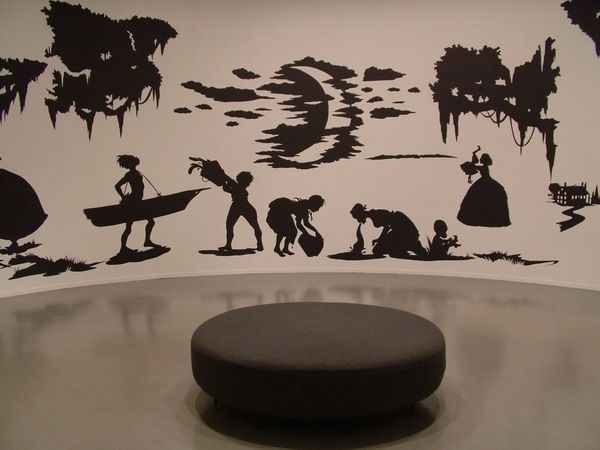
(Plate 1) A scene from the space installation Slavery! Slavery!, 1997. (Plate 2 left) Two large white silhouettes in Excavated from the Black Heart of a Negress, emphasizing the slaves' pitiable story with strong emotional quality, 2002. (Plate 2 right) The most spectacular, ironic, and bewitching dramatic panoramic view against a black background, where two large white silhouettes attract viewers most, 2002. (Plate 3) A scene from the dramatic scene installation Slavery! Slavery!, 1997. Kara Walker's special exhibition "My Enemy, My Brother, My Executioner, My Lover (Mon Ennemi, Mon Frère, Mon Bourreau, Mon Amour)" is on display at the ARC Museum of Modern Art in Paris from June 20 to September 15. This is the first major solo exhibition in Europe for the current American Black female artist Kara Walker (here, mentioning "Black" is not meant to insult or belittle, but simply to emphasize her characteristics). Blessed by the open art of postmodernism and globalization, where marginalized culture has become today's mainstream ideology and prominent study, from Basquiat, the graffiti master of New York in the 1980s, to Steve McQueen, the British video artist of the 1990s, to the famous African sculptor Ousmane Sow and the younger artist Berthelemy Toguo today, the Black Sun slowly rises as dawn breaks, dyeing the Western sky and attracting attention. Contemporary African or Black art exploration has become one of the most innovative and indispensable parts of global art today.
Contemporary African or Black art exploration stems from its cultural traditions, past tragic history, current politics, society, and humanities. On both emotional instinct and rational intellect, it explores diverse aspects from history, politics, society, race, and local culture, developing its possibilities through various methods and materials. Young American Black female artist Kara Walker (born in California in 1969) is currently the brightest star in the American art world. She graduated from Atlanta University in 1991 and then from the Rhode Island School of Design in 1994. In 1997, she received sponsorship from the MacArthur Genius Award Foundation. In 2002, she participated in the São Paulo Biennial in Brazil; in 2004, she won the Deutsche Bank Prize; this year she participates in the Venice Biennale in Italy; and she currently teaches at Columbia University in New York.
Kara Walker's entire artistic creation is built upon the history of American slavery and the various social problems inherited today, strongly expressing relationships such as between Blacks and Whites, masters and slaves, segregation, and contradiction. It addresses human cruelty and violent drama, as well as those unspoken intimate relationships (sexual violence, sexual assault, sexual irony, sexual abuse). Obviously, these inspirations come from sad, cruel, violent, and broken histories, folk novel plots, firsthand records of slaves, physiognomy, etc., to refute the magnificent historical stories depicted in American Hollywood films and heroic literature.
Kara Walker's unique artistic language is built on the imaginative "black-and-white silhouette" of traditional American Southern folk art. From silhouettes, she develops "shadow play" video art, highly emotional comprehensive media sketches (mixed charcoal, pencil, colored pens, watercolor, or prints), and diverse memorial-style spatial installations (some projecting images via projectors). All are within her literary, bewitching, dramatic imagery. Through narrative plot themes, sometimes reinforced by written text and anecdotal stories, she constructs various heroic historical viewpoints of the Black past, and the various issues of Blacks in contemporary American society and politics with a heart of freedom and liberation after emancipation, possessing strong criticality, irony, and historical reflection.
Spatial installation works: Early 1994 Gone, An Historical Romance of a Civil War as it Occurred Between the Dusky Thighs of One Young Negress and Her Heart; 1997 Slavery! Slavery!; 2001 Endless Conundrum, an African Anonymous Adventuress; 2002 Excavated from the Black Heart of a Negress. These are all large black-and-white silhouettes directly installed on white-black contrast walls, constructed with superb, concise realism and vivid forms, brilliantly depicting the heroic and dramatic scenes of slaves (or Blacks). Among them, the recent 2002 work Excavated from the Black Heart of a Negress is the most spectacular, ironic, and bewitching. Against a black background's dramatic panoramic view, the series features two large white silhouettes among brownish ones, front and back, which attract viewers most, emphasizing the slaves' pitiable story with strong emotional quality.
Obviously, recently Kara Walker has focused on shadow play-form video art. 2004 Testimony: Narrative of a Negress Burdened by Good Intentions; 2005 8 Possible Beginnings or: The Creation of African-America; 2007 …The Angry Surface of Some Grey and Threatening Sea. Two of these are black-and-white videos, while the 2007 creation is color video. Notably, these videos are silent films, with the artist personally manipulating the shadow puppets, accompanied by narrative subtitles. The pitiable theatrical plots are quite cruel and violent (including physical and sexual), containing many metaphors of life, reflecting on history and humanity. Series of brilliant silhouette cutouts and emotional written texts include, for example, Do you like creme in your coffee and chocolate in your Milk (1997), Negress notes (Brown Follies) (1996-97), and Negress notes (1995). Strong multi-media sketch series such as Allegory (1996) and Harper's Pictorial History of the Civil War (Annotated) (2005) express emotionally the feelings and historical emotions of slaves being oppressed and treated inhumanely.
One obvious trend in contemporary art is narrative aesthetics, with numerous narrative images and readable written texts. For example, the popular French artist Sophie Calle (representative artist for the French Pavilion at this year's Venice Biennale) is an example (in her fictional or diary-like plots). Looking over Kara Walker's art, she also explores this aspect, building on racial post-historical plots, using narrative imagery as depiction, constructing scenes through dramatic spatial installations or explaining stories through video.