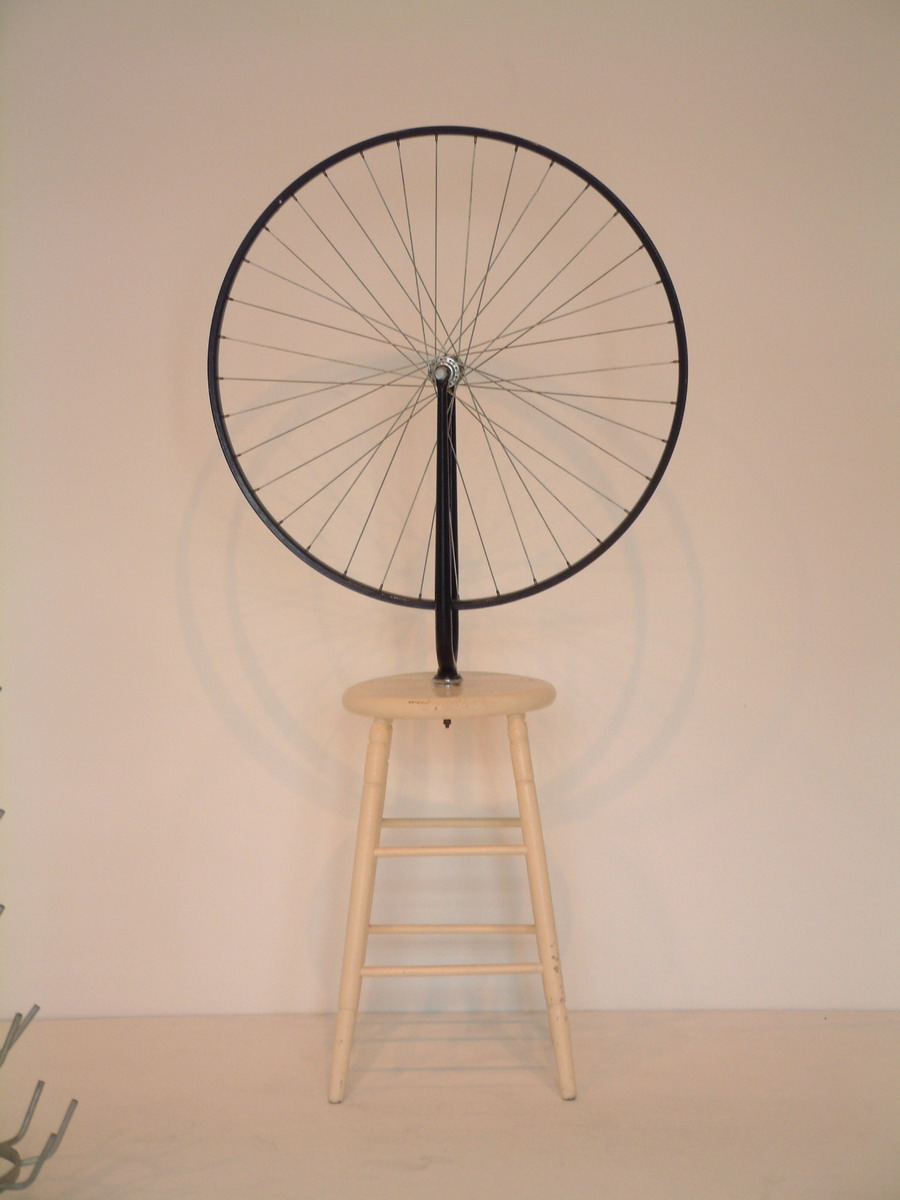
Duchamp (M. Duchamp) - "Bicycle Wheel"
Bicycle Wheel, height 126.5cm, 1913, Centre Pompidou collection
Marcel Duchamp (M. Duchamp, 1887–1968), a French artist, is arguably the most influential figure in contemporary art and is known as the "Father of Contemporary Art." Early on, he approached Futurism with Nude Descending a Staircase (1912), then moved away from painting, heralding the arrival of Dadaism. Starting in 1913, he exhibited ordinary everyday handicrafts (readymades) as artworks, becoming one of the pioneers of Dadaism. This trend connects to his most complex work, The Bride Stripped Bare by Her Bachelors, Even, which foreshadowed the subsequent emergence of Pop Art, Nouveau Réalisme, Happenings, Conceptual Art, and the Fluxus group under Duchamp's influence.
Have you ever doubted whether works displayed in museums are truly art? Have you ever ridden a bicycle or sat on a bench? This is Duchamp’s readymade assemblage; through his highly provocative imagination and clever organization, like a magical magician turning stone into gold, it transforms the mundane. Apollinaire wrote, "The unexpected is the new major driving force." What surprises people is that it transcends our usual view of art, overturning our existing concepts of what art should be. Through this shift in perception, he inverted the wheel and mounted it on a white bench. In rejecting traditional artistic behavior, Duchamp stripped away the beautiful garments of conventional art; creativity, originality, beauty, and independence all became questions. From then on, art was no longer judged by "beauty," dissolving the boundary between life and art and destroying the system of habitual meaning.
Looking at Duchamp’s creative trajectory, after completing the famous Nude Descending a Staircase in 1912 (which, like Futurism, focused on the movement of objects), he abandoned retinal art. By assembling a bicycle wheel onto a bench, the white bench served as a pedestal for traditional sculpture, while the bicycle wheel became a truly moving object. As long as you rotate it, it moves, no longer being an illusion of retinal motion. Under this dual dialectic of anomaly, it thus foreshadowed the arrival of Kinetic Art in the 1960s.