Manet - Olympia
Olympia, 130×190 cm, 1863, Musée d'Orsay Paris. This charming work caused controversy and strong criticism at the 1865 Salon but is now one of Manet's most famous masterpieces.
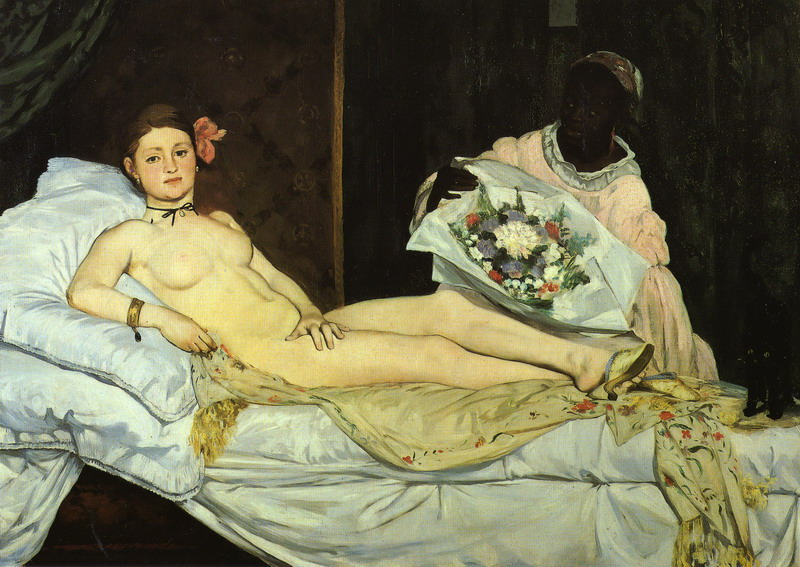
Olympia, 130×190 cm, 1863, held in the Musée d'Orsay Paris. Manet's charming work caused controversy and strong criticism when exhibited at the Salon in 1865, but today it has become one of Manet's most famous masterpieces and a world-renowned painting. "Olympia," this non-idealized modern Venus, is Manet's modern interpretation of Titian's Venus of Urbino. In the provocative image, Venus (Olympia) lies naked and comfortably on the bed, wearing only a thin black ribbon around her neck, gold bracelets on her hands, a flower in her hair, and high heels; she gazes forward as if waiting for a customer. Behind her, a servant carries a large bouquet of flowers (likely sent by a customer), and a black cat at the foot of the bed (symbolizing a courtesan) creates a sense of unease; yet today, the nude woman in Olympia remains so charming and provocative due to Manet's bold innovation and vivid portrayal. With its simplified forms, color planes, and rigorous structure, it is like a modern Mona Lisa with humor. Undoubtedly, this is one of the most crucial masterpieces in 19th-century modern painting. The famous French writer Zola wrote to the painter Manet regarding others' criticism of this painting: "Tell them loudly, dear master (...), a painting is merely a simple pretext for analysis for you. You paint a nude woman, you choose the first Venus-Olympia, you paint these bright and radiant tones and add a colorful bouquet. And against the contrasting black, you paint a black maid and a black cat. What does this mean? You may not be very clear, nor am I. However, you have succeeded so astonishingly in completing a painting, a great painting; I would say it is an interpretation full of energy and a language of light and shadow revealing the truth of women and objective reality."