Mannerism (Maniérisme) (1520-1600)
(Top left) The Death of Christ, Le Rosso, 130x102 cm, 1524-1527, Boston Museum of Fine Arts. (Top right) The Visitation, Le Pontormo, 202x156 cm, 1526-1528, S-Michel Church, Carmignano, Italy. (Bottom left) Jupiter and Io...


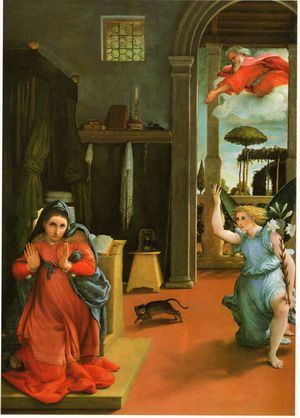
(Top left) The Death of Christ, by Le Rosso, 130x102 cm, 1524-1527, collection of the Boston Museum of Fine Arts. (Top right) The Visitation, by Le Pontormo, 202x156 cm, 1526-1528, S-Michel Church in Carmignano, Italy. (Bottom left) Jupiter and Io, by Correggio, 163.5x74 cm, circa 1530, Kunsthistorisches Museum collection. (Bottom right) The Annunciation, by Lotto, 166x114 cm, 1527, Recanati Museum, Italy.
The term "Mannerism" originates from the late eighteenth century, when Italian art historian Luigi Lanzi used it to categorize post-Raphaelite Italian painting. The excellence and perfection of Italian Renaissance art ended with Mannerism, which represents a distortion of classical harmony between space and form—an artistic style that is entirely anti-classical in its pursuit of perfection (since it was difficult to surpass Raphael's perfect classical art, leading to a conscious artistic reform). Artists abandoned the depiction of classical human idealism, instead distorting figures through twisted limbs or muscles (deeply influenced by Michelangelo), and yielding to these dynamic compositions. Thus, decorations became more abstract, light was renewed, and the door to Western modern painting was opened; Mannerism became the product of the transitional period from the Renaissance to Baroque art.