Marina Abramovic — "Balkan Erotic Epic" Solo Exhibition
"Balkan Erotic Epic" series, 2006. "Balkan Erotic Epic" is a solo exhibition presenting the latest work by Marina Abramovic, the most representative artist of European body art and video art, held at Cent8 Gallery, from January 6 to February 24…
"Balkan Erotic Epic" series, 2006. "Balkan Erotic Epic" is a solo exhibition presenting the latest work by Marina Abramovic, the most representative artist of European body art and video art, held at Cent8 Gallery, from January 6 to February 24. Marina Abramovic (born in Yugoslavia in 1946) is one of the most important body artists today. She early on affirmed body performance from within her environment, and her performances all revolve around questions of human pain, time, and space, exploring the domains of physical and psychological limits. Her recent works have clearly incorporated political consciousness, particularly focusing on the political transformations and traditional social consciousness of the Balkan corridor.
From 1972 to 1974, she exhibited the deadly Rhythm series of works, in which the artist keeps screaming until she loses her voice; keeps dancing until she is exhausted and collapses on the ground; keeps ramming into a machine until she falls unconscious; takes drugs until she is drowsy, inducing hallucinations; or lies inside a star-shaped ring of fire. All of these present a sense of crisis and violence. Several times she was brought back from the brink of death, her life saved only through the intervention of the audience. Sometimes the performances employed various tools (knives, guns, and fire) and invited audience participation.
In 1975 she settled in Amsterdam, the Netherlands, where she joined the Dutch artist Uwa Laysiepen (known as Ulay), and they collaborated on performances together. Their most important performances include the 1975 works Thomas s Lips and Freeing the Body, and the 1988 work The Lovers: Walk on the Great Wall, all of which, grounded in physical pain, jointly consider the constraints between man and woman, modern and traditional, and East and West. In the 1990s she returned to solo performance, and through a series of more subdued installation objects — sculptures, like performance art, she invited the audience to engage with those excessive objects, such as the 1990s work Film, Mineral: an installation of four pieces of natural quartz (green, black, bright, and amethyst) and four benches. The benches can be moved freely and used for rest, while on the anomalous theme of Film, a projection space of a pure mental state is introduced, immersing viewers in a "mineral thinking" mode, and so forth.
From 1997 onward, under the post–Cold War political situation in Eastern Europe, particularly in the deconstruction of her homeland Yugoslavia, Marina Abramovic began to explore the post-political formations and inherent traditional culture of the Balkan Peninsula through her own identity. From the "Balkan Baroque" installation series at the 1997 Venice Biennale, through the 2003 "Count On Us" series, to today's "Balkan Erotic Epic" video and photography series, she has attempted to investigate the political situation and historical sentiments of the Balkans, developing an exploration of the human body, eroticism, and sexuality through pagan culture and customs. This series is uniformly dressed in symbolic traditional Yugoslav Serb attire, and in dramatic traditional religious ritual settings, boldly exposes male and female sexual organs.
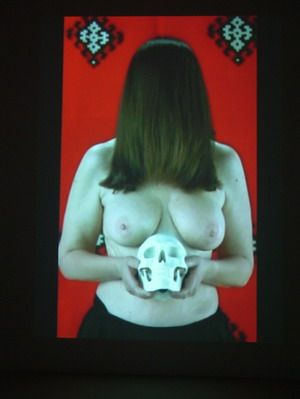
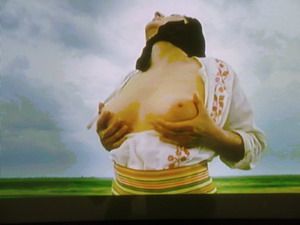
For example, in the series of photographic images, a group of traditional peasant women in a pastoral setting collectively scream wildly, lifting their skirts to display their sexual organs, praying to heaven for divine grace (praying for rain) — quite sensual and full of symbolism. The video art is even more remarkable: in one video, the artist wears traditional dress with a black headscarf, her chest and arms bared, continuously caressing her own breasts, full of desire and pleasure (as in the image on the right). Another video shows the artist half-naked, her long hair covering her face, standing amid traditional Yugoslav red tapestries, continuously striking a skull against her chest, rhythmically producing sounds of impact and breath, and under the utmost physical trial, expressing a tragic sentiment and concern for life and traditional culture (as in the center image).
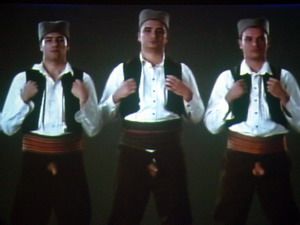
The most monumental video installation (as in the left image, partial view) is the most dramatic and spectacular video installation: in left-right symmetry, a row of five young men in traditional dress with red caps stands on each side, their hands pulling black small vests in unison like soldiers. Beneath the black trouser legs, one sees them revealing their proudly erect members. In the center appears a dignified soprano singer in an evening gown, who only intermittently opens her mouth to sing a passage, as if an invitation to dance. Sexuality becomes the core of traditional cultural ritual, and the bodily language that constructs the harmony of society and family. This series by Marina Abramovic is filled with numerous political, social, economic, and cultural metaphors. 2007-2-15