Masaccio (1401–1427) - The Tribute Money (c. 1424)
The Tribute Money (c. 1424), 255×598 cm, fresco, housed in Santa Maria del Carmine, Florence. He is the most representative painter of a new era in Renaissance painting, bridging Giotto's art and deeply influenced by his teacher Masolino. His strongly individualistic...
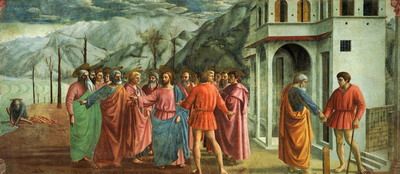
The Tribute Money (c. 1424), 255×598 cm, fresco, housed in Santa Maria del Carmine, Florence. He is the most representative painter of a new era in Renaissance painting, bridging Giotto’s art and deeply influenced by his teacher Masolino. His painting with strong individuality contrasts sharply with Angelico’s lyrical elegance. Through careful observation of nature, it approaches natural realism, exploring new forms, volume, light, and space, thus opening the prelude to Italian Renaissance painting.
The Tribute Money depicts one of the series on the life of Saint Peter. In its revolutionary naturalism, it presents new imagery, light, three-dimensionality, tone, and perspective creating a theatrical scene infused with sensibility. Within this distinctive narrative setting, it unifies three stories of Saint Peter on a single canvas. The composition centers on the group in the middle, with distant hills and wilderness as the background, and a geometric building on the side indicating perspective and a city-state. Jesus Christ, wearing red robes and a blue cloak, serves as the axis; Saint Peter is on the left, Saint Matthew on the right, with other apostles surrounding them. Facing us, a customs official stretches out his hands demanding the temple tax. Jesus gestures for Saint Peter to go to the lake to find money. Thus, on the far left, Saint Peter is shown searching for coins by the lake. On the right, the same figure, Saint Peter, pays the tax to the official. This perfect narrative sequence represents a unique storytelling form of early Renaissance art.