Maurice Denis (1870–1943) Special Exhibition
Denis, "The Muses," 1893, 168 x 135 cm.
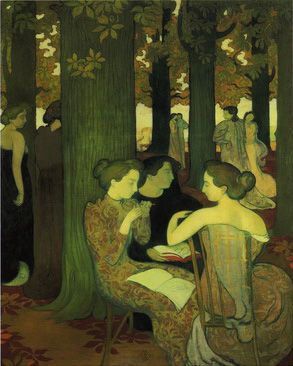
Denis, "The Muses," 1893, 168 x 135 cm.
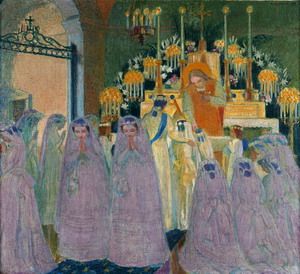
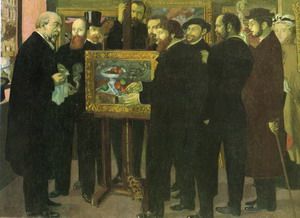
Denis’s religious and symbolic work "The Baptism" (1907). – Denis, "Homage to Cézanne" (1900), 180 x 240 cm. From October 31, 2006, to January 21, 2007, the Musée d'Orsay paid highest tribute to the prophetical master Maurice Denis (1870–1943), exhibiting his artistic creations from every stage of his life. Through this exhibition, one can clearly see the characteristics and style of his lifelong creative output. Besides being an outstanding painter, Denis was also an accomplished photographer; viewers could also see a series of photographs taken with his Pocket Kodak: snapshots of daily life (family, babies, travel, beaches, etc.).
Denis was a dominant painter and theorist of the Nabi movement at the end of the 19th century. Influenced by Paul Gauguin’s Synthetism through his friend Émile Bernard (Serusier), and by Italian Renaissance painting (he visited Italy twice in 1895 and 1897), he co-founded the Nabi group in 1890 at the age of 20, along with friends Pierre Bonnard, Édouard Vuillard, Félix Vallotton, and others (see footnote below). In this painting, Denis was quite bold, using flat planes of color and organizational rhythm to imbue the entire pictorial structure with decorative power. He proposed his theory of painting: "Before one sees a picture, it is a horse, a nude woman, or some allegorical story; now it should primarily be a plane covered with colors arranged in a purely ornamental manner." Clearly, Denis and the Nabis pointed toward the exploratory directions of 20th-century modern painting. The Nabi painters believed that pure color equated to light, and like expressions of spiritual joy, these elements pointed toward abstract art concepts.
The distinctive features of Denis’s painting—narrative, decorative, flat, and patterned—closely resembled the Art Nouveau style.
The Nabis (from Hebrew for "prophets") was a name bestowed in 1888 by the poet Charles Péguy (source says Cazalis, but historically it's often associated with the circle; sticking to source: Cazalis) upon a young group of painters. The school was established in 1890, with members including painters Pierre Bonnard, Maurice Denis, Édouard Vuillard, Félix Vallotton, and Émile Bernard. They believed that pure color equated to light and served as an expression of spiritual joy. They understood that all art is a transformation, akin to a receptive sense, and recognized objective deformation based on purely aesthetic and decorative concepts. This special coloring technique and objective deformation entered the artist's personal expression. The painting characteristics of the Nabi school were narrative, decorative, flat, and patterned, approaching the Art Nouveau (Art Nouveau) style of the late 19th century.